When Menopause Estrogen Needs a Dose Review
Ongoing symptoms or new concerns are reasons to review your treatment, not to raise the dose on your own.
A review can help when the symptoms you’re treating remain bothersome, return, or change, or when you notice a possible side effect. Before the conversation, note your symptoms and their impact, the estrogen product and route, and any missed doses or difficulties using it. Those details help frame a discussion; they don’t determine the right dose. Treatment decisions are individualized and periodically reassessed. 3
Begin with the symptom you want help with
Be specific about what is still bothering you and how it affects your day. For example, if you use systemic estrogen for hot flashes or night sweats, note when they occur, whether they have changed, and whether they disrupt sleep or daily activities. Hormone therapy is the most effective treatment for vasomotor symptoms, but the right plan depends on individual benefits and risks. 3
If you’re in perimenopause and your symptoms or menstrual pattern are changing, include that context. If you’re postmenopausal and a symptom has returned after improving, describe when you noticed the change. Neither situation, by itself, tells you that a higher dose is needed.
Check the details of how you use it
Bring the exact product name and strength, and be ready to say whether it’s a pill, patch, gel, spray, or another form. Note any missed doses, interruptions, or practical difficulties using the product. These are useful details to report, not proof that a problem with your routine or product is causing symptoms.
You can also note when symptoms happen in relation to your usual routine and whether anything else changed around that time. You don’t need to figure out the cause yourself. The point is to help your prescriber understand what treatment you’re actually using before discussing whether the dose, route, or overall plan should change.
Keep possible side effects separate from symptoms that persist
If you notice a new or bothersome change that you think could be related to treatment, write down what it is and when it began. Mention whether it followed a change in product or routine, while leaving the question of cause open. The goal is a review of your experience and treatment plan, not an automatic increase in estrogen.
Hormone-therapy decisions can depend on the type, dose, duration, route, timing of initiation, and whether a progestogen is used. The North American Menopause Society recommends individualizing treatment and periodically reassessing its benefits and risks. 3
Unusual vaginal bleeding while using estrogen needs attention, rather than an assumed dose adjustment. US product information says to report unusual bleeding; persistent or recurring abnormal bleeding after menopause should be evaluated. 12
Check whether the treatment matches the symptom
Systemic hormone therapy is commonly used for vasomotor symptoms such as hot flashes. Low-dose vaginal estrogen is a distinct option for genitourinary symptoms. If your main concern is vaginal or urinary discomfort, ask whether the route and type of treatment fit that concern.
For bothersome genitourinary symptoms that haven’t improved with over-the-counter therapies, the North American Menopause Society recommends considering low-dose vaginal estrogen or other treatments when there’s no indication to use systemic hormone therapy. 3 Separately, Premarin’s product information advises discussing whether a topical vaginal product may be more appropriate when oral Premarin is being used only for menopausal changes in and around the vagina. That advice is specific to that product’s labeling. 1
Bring a short, useful note
Before the review, jot down:
- The symptom you want help with and how it affects you.
- When it happens and what has changed.
- The product, strength, and route you use.
- Any missed doses, interruptions, or difficulties using it.
- Any new or bothersome changes you suspect may be side effects.
- What you most want to improve and what concerns you about changing treatment.
You might ask, “Could the route or how I’m using this affect the plan?” and “What options should we consider besides increasing the dose?” Your notes can make the discussion more focused, but no symptom checklist determines the right dose. Treatment is individualized and should be periodically reassessed. 3
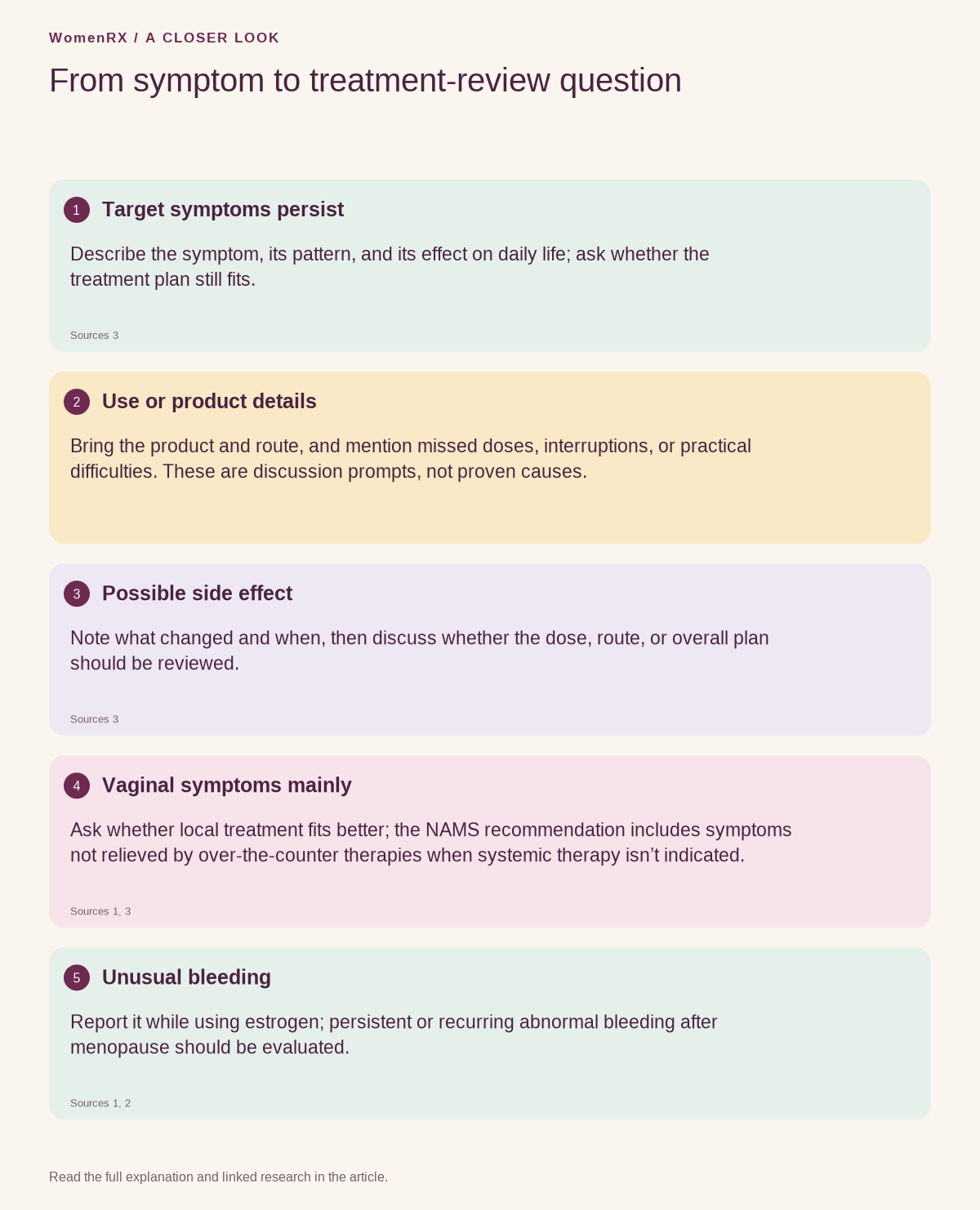
From symptom to treatment-review question
Target symptoms persist: Describe the symptom, its pattern, and its effect on daily life; ask whether the treatment plan still fits.3
Use or product details: Bring the product and route, and mention missed doses, interruptions, or practical difficulties. These are discussion prompts, not proven causes.
Possible side effect: Note what changed and when, then discuss whether the dose, route, or overall plan should be reviewed.3
Vaginal symptoms mainly: Ask whether local treatment fits better; the NAMS recommendation includes symptoms not relieved by over-the-counter therapies when systemic therapy isn’t indicated.13
Unusual bleeding: Report it while using estrogen; persistent or recurring abnormal bleeding after menopause should be evaluated.12
Read the figure as text
Use these branches to organize what to discuss. They don’t diagnose a cause or select a dose.- Target symptoms persist: Describe the symptom, its pattern, and its effect on daily life; ask whether the treatment plan still fits.3
- Use or product details: Bring the product and route, and mention missed doses, interruptions, or practical difficulties. These are discussion prompts, not proven causes.
- Possible side effect: Note what changed and when, then discuss whether the dose, route, or overall plan should be reviewed.3
- Vaginal symptoms mainly: Ask whether local treatment fits better; the NAMS recommendation includes symptoms not relieved by over-the-counter therapies when systemic therapy isn’t indicated.13
- Unusual bleeding: Report it while using estrogen; persistent or recurring abnormal bleeding after menopause should be evaluated.12
More questions, answered
Does a symptom returning mean I need more estrogen?
Not by itself. Persistent or returning symptoms are useful reasons to review what you’re treating and the product and route you use, but they don’t establish that a higher dose is the right choice. Hormone therapy decisions are individualized. 3
Should I change my dose before the review?
Don’t raise the dose on your own. Bring your symptom pattern and treatment details to the discussion so any change can be considered as part of your overall plan. Treatment benefits and risks should be periodically reassessed. 3
Sources you can check
- PREMARIN (ESTROGENS, CONJUGATED) TABLET, FILM COATED [WYETH PHARMACEUTICALS LLC, A SUBSIDIARY OF PFIZER INC.] | US prescribing information and patient instructionsAccessed 2026-09-25Return to first citation
- PREMPHASE (CONJUGATED ESTROGENS AND MEDROXYPROGESTERONE ACETATE) KIT PREMPRO (CONJUGATED ESTROGENS AND MEDROXYPROGESTERONE ACETATE) TABLET, SUGAR COATED [WYETH PHARMACEUTICALS LLC, A SUBSIDIARY OF PFIZER INC.] | US prescribing information and patient instructionsAccessed 2026-09-25Return to first citation
- The 2022 hormone therapy position statement of The North American Menopause Society.“The 2022 Hormone Therapy Position Statement of The North American Menopause Society” Advisory Panel. · Menopause (New York, N.Y.) · 2022Return to first citation