Vaginal Estrogen Interactions: What Medicines and Supplements to Review
Interactions may be uncommon, but the useful answer comes from checking your exact product against your full medicine and supplement list.
Vaginal estrogen is used locally for menopause-related vaginal symptoms, and little of the medicine gets into the rest of the body. Still, that doesn’t confirm that every product is interaction-free. Show a pharmacist or prescriber the exact product and how you use it, then review all prescriptions, nonprescription medicines, vitamins, and supplements together. Ask whether any concern is a product-specific warning or a more theoretical possibility. 125
Local treatment is reassuring, not an automatic all-clear
Vaginal estrogen can help with menopause-related vaginal dryness and irritation. It comes in forms such as tablets, creams, gels, and rings. Because little medicine gets into the rest of the body, local treatment differs from hormone therapy taken throughout the body. But “local” doesn’t mean an interaction is impossible, or that one product’s information answers questions about every other product. 2
A 2023 systematic review placed vaginal hormone therapy in a category of use without expected risks alongside 21 of the medication groups it analyzed. The review also described the interaction evidence as scarce and mainly indirect. That broad result is reassuring, but it isn’t a check of your particular product paired with every medicine you take. 5
Make the review specific to you
Bring the package or a clear photo of the label. Share the brand or generic name, the active ingredient, the form, and the directions you follow. If you know the strength, include it too. These details help the pharmacist or prescriber check the product you actually use, rather than answering for “vaginal estrogen” in general.
Include your full list, even items you take only now and then:
- Prescription medicines, including those used as needed.
- Nonprescription medicines, such as pain, allergy, or sleep remedies.
- Vitamins, herbs, and other supplements.
- Anything you’re considering starting, or have recently added.
Herbal products marketed for menopause symptoms can include evening primrose oil, soy, red clover, black cohosh, ginseng, or St. John’s wort. Mention the specific product, not just that you take “a menopause supplement.” Guidance recommends checking herbal remedies and supplements because they may affect other medicines; that does not establish that each one interacts with vaginal estrogen itself. 1
Ask the reviewer to check the exact product against your complete list using current product information and an interaction reference. If something is flagged, ask what kind of concern it is: a warning for this specific product, a known interaction involving another medicine you take, or a possible interaction based on limited or indirect evidence. Those distinctions can help you understand what the finding means and what, if anything, needs to change.
Separate interaction questions from treatment suitability
A medicine interaction is not the only reason your treatment may need review. Share relevant medical history and why you’re using vaginal estrogen. Menopause guidance emphasizes individualizing hormone therapy decisions; other health conditions can matter to whether a treatment is appropriate, even when they don’t create a drug interaction. 35
For example, if you have a history of an estrogen-dependent cancer or cardiovascular disease, raise that as part of the treatment discussion. These are examples cited in menopause guidance about hormone-therapy decisions, not proof that vaginal estrogen is automatically unsuitable for you. 4
Repeat the medication review when you add a medicine or supplement, or when your vaginal estrogen product changes. An answer about one combination shouldn’t be treated as a blanket clearance for another.
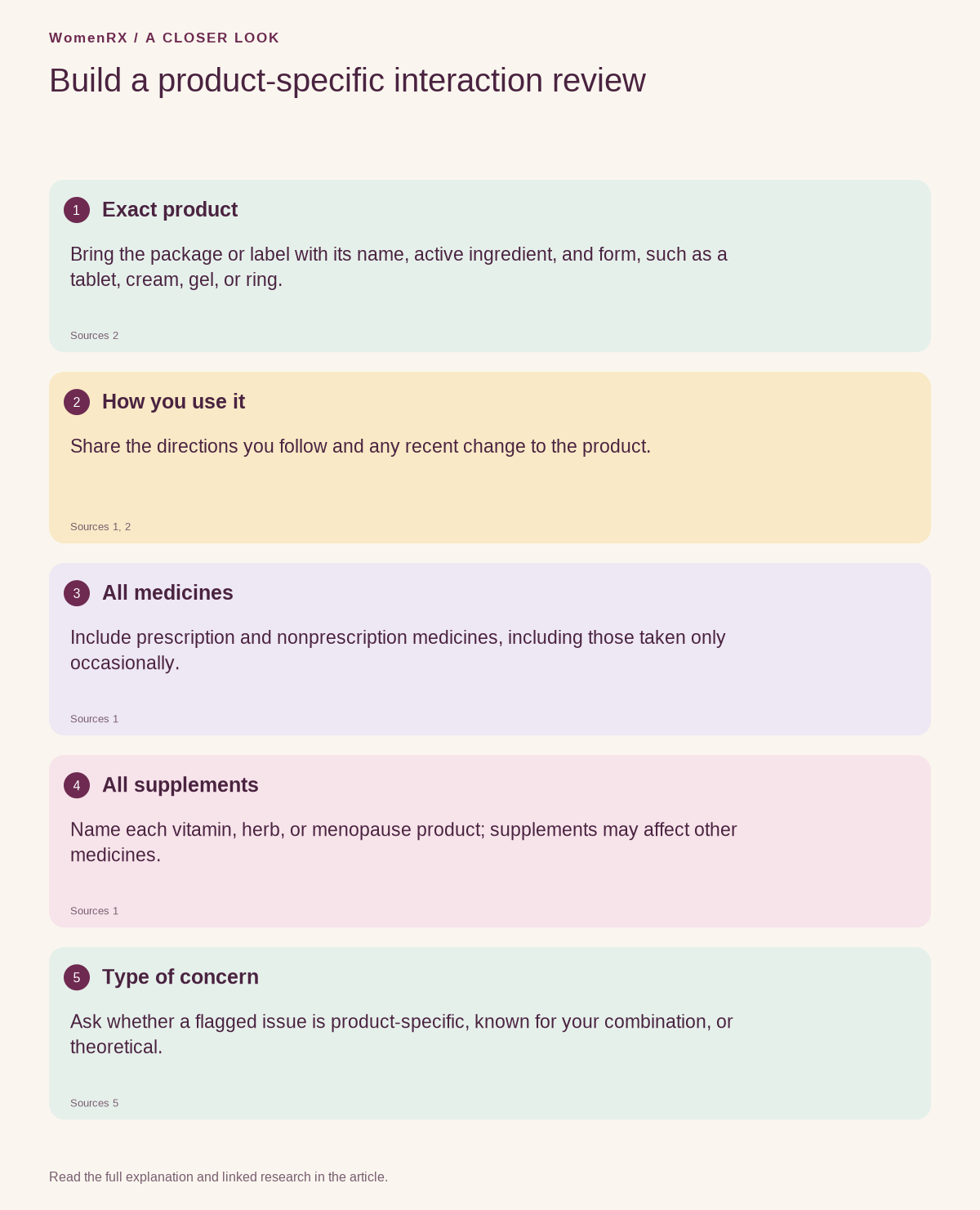
Build a product-specific interaction review
Exact product: Bring the package or label with its name, active ingredient, and form, such as a tablet, cream, gel, or ring.2
How you use it: Share the directions you follow and any recent change to the product.12
All medicines: Include prescription and nonprescription medicines, including those taken only occasionally.1
All supplements: Name each vitamin, herb, or menopause product; supplements may affect other medicines.1
Type of concern: Ask whether a flagged issue is product-specific, known for your combination, or theoretical.5
Read the figure as text
Gather the exact vaginal estrogen product and your complete medicine and supplement list so the reviewer can assess your actual combination.- Exact product: Bring the package or label with its name, active ingredient, and form, such as a tablet, cream, gel, or ring.2
- How you use it: Share the directions you follow and any recent change to the product.12
- All medicines: Include prescription and nonprescription medicines, including those taken only occasionally.1
- All supplements: Name each vitamin, herb, or menopause product; supplements may affect other medicines.1
- Type of concern: Ask whether a flagged issue is product-specific, known for your combination, or theoretical.5
More questions, answered
Do I need to mention supplements if I take them only occasionally?
Yes. Include occasional vitamins, herbs, and other supplements in the review. They may affect other medicines, and their being sold as supplements doesn’t establish whether they interact with your specific vaginal estrogen product. 1
Does a possible interaction mean I should stop vaginal estrogen?
Not necessarily. Ask what the concern is based on and whether it applies to your exact product and medicine combination. The available review describes interaction evidence as scarce and mainly indirect, so a flagged possibility needs context rather than an automatic conclusion. 5
Sources you can check
- Using vaginal oestrogen with other medicines and herbal supplements - NHSAccessed 2026-09-25Return to first citation
- About vaginal oestrogen - NHSAccessed 2026-09-25Return to first citation
- The 2022 hormone therapy position statement of The North American Menopause Society.“The 2022 Hormone Therapy Position Statement of The North American Menopause Society” Advisory Panel. · Menopause (New York, N.Y.) · 2022Return to first citation
- The 2023 nonhormone therapy position statement of The North American Menopause Society.Menopause (New York, N.Y.) · 2023Return to first citation
- Pharmacological interactions and menopausal hormone therapy: a review.Fasero M, Quereda F, Andraca L, Coronado PJ, HT Eligibility Criteria Group. · Menopause (New York, N.Y.) · 2023Return to first citation