Menopause Insomnia: What Can Supplements Do?
A supplement may affect sleep quality or sleep timing, but the next step depends on what’s keeping you awake.
A menopause review suggests prolonged-release melatonin for women 55 and older. Ashwagandha studies have found some sleep improvements in adults who weren’t studied as a menopause-specific group. 4 5 Neither finding means a supplement is the best answer to every waking pattern. If hot flashes, pain, or breathing interruptions are disrupting your sleep, those problems may need attention in their own right. 2 3 5
First, notice what kind of night you’re having
Insomnia can mean taking a long time to fall asleep, waking repeatedly and struggling to return to sleep, or both. These patterns can feel similar by morning, but they don’t always have the same cause. Menopause may coincide with hot flashes and night sweats, while pain, mood symptoms, medicines, and other sleep disorders can also interrupt rest. 1 2 5
For example, lying awake at bedtime is different from waking drenched and overheated, then settling once the sweating passes. 1 Repeated awakenings with loud snoring or interrupted breathing point to a different possibility again. 3 Menopause can be part of the picture without being the whole explanation. 5
What the supplement evidence actually says
Melatonin: A menopause-focused review suggests prolonged-release melatonin as a possible option for women aged 55 and older. The evidence cited here doesn’t establish which pattern, trouble falling asleep or waking during the night, may benefit most. Treat it as a possibility to discuss, not proof that melatonin addresses the cause of your sleep problem. 5
Ashwagandha: The NIH Office of Dietary Supplements summarizes a meta-analysis of five trials involving 372 adults, either describing themselves as healthy or having insomnia. The studies took place in India and lasted 6 to 12 weeks. Results suggested improvements in several sleep measures, including sleep quality, sleep efficiency, total sleep time, and time to fall asleep. In one six-week placebo-controlled trial of 150 adults with sleep problems, participants taking ashwagandha extract also showed improvement in waking after sleep onset. The participants weren’t a menopause-specific group, so these findings don’t establish a benefit for perimenopausal or postmenopausal insomnia. 4
Those outcomes aren’t interchangeable. A change in reported sleep quality doesn’t necessarily mean fewer night awakenings, and an improvement in waking among mixed adults doesn’t show that a supplement prevents waking from hot flashes. 4 5
Before trying a sleep aid, review it with your clinician alongside any medicines you take. Some nonprescription sleep aids can cause drowsiness, which may affect activities such as driving. This is a general caution about sleep aids, not a specific interaction established for melatonin or ashwagandha. Ashwagandha raises different concerns: its long-term safety is unknown, it may have adverse effects on the liver and thyroid, and it might not be safe during pregnancy or breastfeeding. 3 4
When the cause may be the better target
If night sweats repeatedly wake you, consider whether you’re having other menopause symptoms as well. Hot flashes and night sweats are common reasons for sweating at night, but anxiety, some medicines, low blood sugar, and alcohol or drug use are among other possible causes. Regular drenching sweats, especially with unexplained weight loss, feverishness, cough, or diarrhea, deserve medical assessment rather than being assumed to be menopause. 1
When hot flashes are disrupting sleep, menopausal hormone therapy may be considered for related insomnia after an individual assessment of benefits and risks. That’s a way to address the waking symptom rather than relying on a supplement to improve sleep quality. 5
If the main problem is persistent difficulty falling or staying asleep, cognitive behavioral therapy (CBT) is a better-established treatment direction than relying on a supplement. A menopause review identifies CBT as first-line insomnia treatment in the general population, including when mood symptoms or hot flashes are present. This targets the thoughts and habits that can keep insomnia going, rather than aiming only to make you feel sleepy. 3 5
Also notice signs that suggest another sleep disorder. Snoring or interrupted breathing during sleep can be associated with sleep apnea, and pain or medicines may also interfere with sleep. Treating the relevant problem, when possible, is part of insomnia care. 2 3
A practical way to choose your next step
For a few nights, identify the main pattern: trouble falling asleep, repeated waking without sweating, waking with a hot flash or soaking sweats, or disrupted sleep with snoring or breathing pauses. This isn’t a diagnostic test; it’s a way to avoid expecting one supplement to solve several different problems. If sleep trouble is affecting your day or has lasted for months, it’s reasonable to seek help identifying the cause and discussing insomnia-focused care. 2 3
Choose the next step based on what’s interrupting your sleep. Don’t let a supplement trial delay assessment of persistent drenching night sweats or signs of another sleep disorder. 1 3
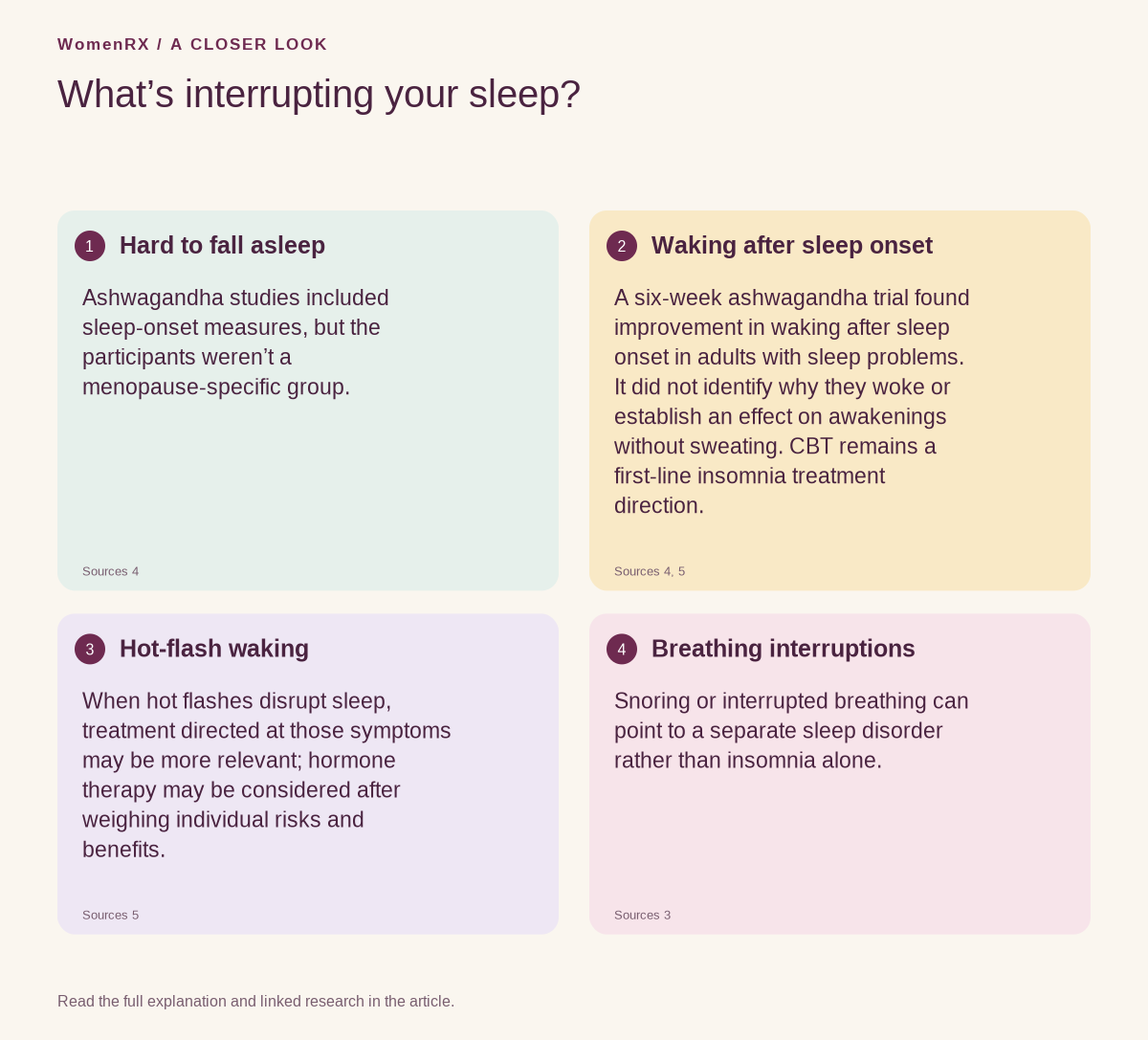
What’s interrupting your sleep?
Hard to fall asleep: Ashwagandha studies included sleep-onset measures, but the participants weren’t a menopause-specific group.4
Waking after sleep onset: A six-week ashwagandha trial found improvement in waking after sleep onset in adults with sleep problems. It did not identify why they woke or establish an effect on awakenings without sweating. CBT remains a first-line insomnia treatment direction.45
Hot-flash waking: When hot flashes disrupt sleep, treatment directed at those symptoms may be more relevant; hormone therapy may be considered after weighing individual risks and benefits.5
Breathing interruptions: Snoring or interrupted breathing can point to a separate sleep disorder rather than insomnia alone.3
Read the figure as text
The waking pattern can point toward different next steps; supplement findings don’t apply equally to every kind of sleep disruption.- Hard to fall asleep: Ashwagandha studies included sleep-onset measures, but the participants weren’t a menopause-specific group.4
- Waking after sleep onset: A six-week ashwagandha trial found improvement in waking after sleep onset in adults with sleep problems. It did not identify why they woke or establish an effect on awakenings without sweating. CBT remains a first-line insomnia treatment direction.45
- Hot-flash waking: When hot flashes disrupt sleep, treatment directed at those symptoms may be more relevant; hormone therapy may be considered after weighing individual risks and benefits.5
- Breathing interruptions: Snoring or interrupted breathing can point to a separate sleep disorder rather than insomnia alone.3
More questions, answered
When should night sweats be checked?
Regular drenching sweats that wake you should be assessed, particularly if you also have unexplained weight loss, feverishness, cough, or diarrhea. Night sweats can have causes other than menopause. 1
Sources you can check
- Night sweats - NHSAccessed 2026-09-25Return to first citation
- Insomnia | MedlinePlusAccessed 2026-09-25Return to first citation
- Insomnia - NHSAccessed 2026-09-25Return to first citation
- Ashwagandha: Is it helpful for stress, anxiety, or sleep? - Health Professional Fact SheetAccessed 2026-09-25Return to first citation
- Insomnia and menopause: a narrative review on mechanisms and treatments.Proserpio P, Marra S, Campana C, Agostoni EC, Palagini L, Nobili L, Nappi RE. · Climacteric : the journal of the International Menopause Society · 2020Return to first citation