Menopause and Insomnia: When to Get Help
If poor sleep keeps returning or makes your days harder, you don’t have to wait for hot flashes to stop before seeking help.
A few difficult nights may settle as a stressor or routine change passes. If trouble falling asleep or staying asleep keeps returning, affects your mood or concentration, or leaves you too sleepy to function safely, it’s reasonable to seek an assessment. Insomnia during perimenopause or after menopause can occur with or without hot flashes. 126
Look at the night and the next day
Insomnia isn’t only lying awake at bedtime. It can mean waking during the night, sleeping for short stretches, or waking without feeling refreshed. During the day, you might notice low energy, irritability, anxiety, or trouble concentrating. Those effects matter when you’re deciding whether to get help. 1
A brief spell of poor sleep can follow stress or a change in routine and may pass. But you don’t need to wait until it meets a formal duration label to bring it up. MedlinePlus calls insomnia lasting a month or longer chronic, while NHS guidance uses three months or longer for long-term insomnia. If sleep trouble keeps returning or makes daily life hard to manage, the pattern and its impact are reason enough to seek an assessment. 12
Don’t put off addressing sleepiness that makes driving unsafe. Insomnia-related drowsiness can make it dangerous to drive. 1
Hot flashes are one clue, not the whole explanation
During perimenopause and after menopause, insomnia can occur alongside nighttime hot flashes, but it can also occur without them. If you’re waking with a hot flash, mention that connection. If you aren’t having hot flashes, your sleep problem still deserves attention. 46
Other possibilities can overlap. Stress, anxiety or depression, some medicines, caffeine and alcohol can contribute to insomnia. Snoring or interrupted breathing during sleep may point to another sleep problem. Rather than trying to decide on one cause yourself, describe what you’ve noticed: whether falling asleep or staying asleep is hardest, what happens the next day, and whether hot flashes, mood changes, snoring, medicines, or substances seem relevant. That gives the person assessing your sleep more to work with than “I’m sleeping badly.” 12
Ask about treatment for insomnia itself
Cognitive behavioral therapy for insomnia, or CBT-I, is worth discussing when sleep problems persist. It works on thoughts and behaviors that can keep insomnia going; it isn’t simply a reminder to have better sleep habits. Reviews of studies in menopausal women report improvements in sleep quality or insomnia severity with CBT-I, although one review notes that many of the women studied were white and well educated. 256
There’s also early research on an approach adapted for women who have both insomnia and nighttime hot flashes. In a randomized pilot trial of 43 perimenopausal or postmenopausal women with insomnia disorder and at least one reported nighttime hot flash per night, the adapted CBT group had greater reductions in insomnia severity than a menopause-education group after treatment and at one month. That’s encouraging for this specific combination of symptoms, but the small trial doesn’t tell us how well it works for everyone. 4
If hot flashes are bothering you too, discuss them as a related but separate treatment question. Hormone therapy is the most effective treatment for vasomotor symptoms, such as hot flashes, but its benefits and risks vary between people. Treating hot flashes shouldn’t be assumed to address every contributor to insomnia. 3
The useful next move is to bring up sleep trouble when it persists, recurs, or changes what you can do during the day. You can ask two distinct questions: “What else might be affecting my sleep?” and “Would CBT-I be a good option for the insomnia?” If hot flashes are part of your nights, ask what might help those symptoms as well. 1235
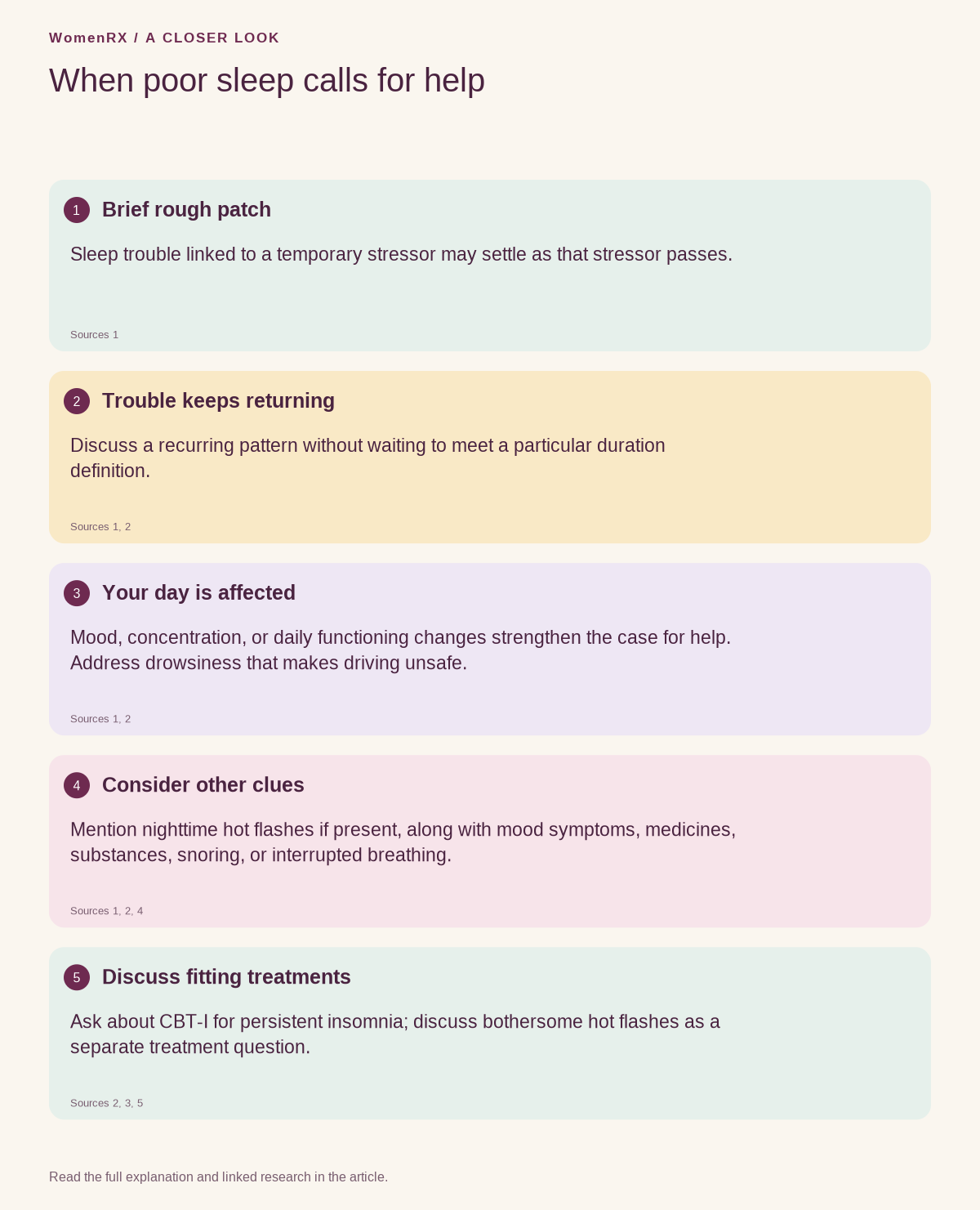
When poor sleep calls for help
Brief rough patch: Sleep trouble linked to a temporary stressor may settle as that stressor passes.1
Trouble keeps returning: Discuss a recurring pattern without waiting to meet a particular duration definition.12
Your day is affected: Mood, concentration, or daily functioning changes strengthen the case for help. Address drowsiness that makes driving unsafe.12
Consider other clues: Mention nighttime hot flashes if present, along with mood symptoms, medicines, substances, snoring, or interrupted breathing.124
Discuss fitting treatments: Ask about CBT-I for persistent insomnia; discuss bothersome hot flashes as a separate treatment question.235
Read the figure as text
Start with the pattern and its effect on your day, then consider clues that could shape an assessment.- Brief rough patch: Sleep trouble linked to a temporary stressor may settle as that stressor passes.1
- Trouble keeps returning: Discuss a recurring pattern without waiting to meet a particular duration definition.12
- Your day is affected: Mood, concentration, or daily functioning changes strengthen the case for help. Address drowsiness that makes driving unsafe.12
- Consider other clues: Mention nighttime hot flashes if present, along with mood symptoms, medicines, substances, snoring, or interrupted breathing.124
- Discuss fitting treatments: Ask about CBT-I for persistent insomnia; discuss bothersome hot flashes as a separate treatment question.235
Sources you can check
- Insomnia | MedlinePlusAccessed 2026-09-25Return to first citation
- Insomnia - NHSAccessed 2026-09-25Return to first citation
- The 2022 hormone therapy position statement of The North American Menopause Society.“The 2022 Hormone Therapy Position Statement of The North American Menopause Society” Advisory Panel. · Menopause (New York, N.Y.) · 2022Return to first citation
- Cognitive behavioral therapy for menopausal insomnia in perimenopausal and postmenopausal women with insomnia and nocturnal hot flashes: a randomized-controlled pilot trial.Arentson-Lantz EJ, Muench A, Kokonda M, Meers JM, Swartz M, Manber R, Thurston RC, Nowakowski S. · Menopause (New York, N.Y.) · 2026Return to first citation
- The Effectiveness of Cognitive Behavioral Therapy on Insomnia Severity Among Menopausal Women: A Scoping Review.Ntikoudi A, Owens DA, Spyrou A, Evangelou E, Vlachou E. · Life (Basel, Switzerland) · 2024Return to first citation
- Pharmacological and non-pharmacological treatments for chronic insomnia in perimenopausal and postmenopausal women: a systematic review and meta-analysis.Bruyneel M, Rozenberg S, Sanida C, Demaeyer N, Castermans E, Bruyneel AV. · Sleep medicine · 2026Return to first citation