How to Check a Schisandra Supplement Label
A schisandra label can help you identify the plant and preparation, but testing and health claims answer different questions.
Start with the full botanical name, Schisandra chinensis, and the plant part. Then check whether the ingredient is raw, processed, or an extract: related species and differently processed material can have distinct chemical profiles. 4 5 Ask what testing covers and whether results apply to the batch you’d buy. Neither a detailed label nor a purity test proves a health benefit or establishes safety during pregnancy or breastfeeding.
Start with the plant, not the promise
If a bottle says only “schisandra,” you’re missing a useful detail. Look for Schisandra chinensis rather than relying on the common name. Researchers comparing it with another species, Schisandra sphenanthera, found distinct chemical profiles. Both may be called “Wuweizi” in traditional Chinese medicine, so the common name alone cannot settle which species is in a product. 4
Check the plant part, too. The traditional medicinal material described in research on S. chinensis is the dried mature fruit. If a label names another part or doesn’t identify one, ask the company what it uses. 2 3
A botanical name is the company’s description of an ingredient, not proof that the contents were authenticated. If the company says it verifies plant identity, ask what it tested and whether that result applies to the product you’re considering.
Read the preparation as a separate detail
“Schisandra” can describe more than one preparation. A chemical analysis distinguished raw S. chinensis from vinegar-processed and wine-processed material. That tells you processing can change what researchers measure in the plant; it doesn’t show that one version works better for your health goal. 5
If you’re comparing extracts, see whether each label identifies the extract and states how much is in a serving. A named compound, an extract ratio, or a prominent “standardized” claim may give you something more specific to ask about. None is a clinical result. Schisandra contains multiple groups of compounds, and identifying those compounds does not show that a particular bottle improves a symptom. 2
Find out what “tested” covers
“Purity tested” sounds reassuring, but it doesn’t say what was measured. Was the test intended to check botanical identity, a named constituent, or contaminants? Can the company provide results tied to the batch being sold? These are different questions, and a test result answers only the question that test was designed to address.
Keep product testing separate from evidence of benefit. In one species-comparison study, researchers measured chemical profiles and antioxidant activity in laboratory assays. They did not test whether taking a retail supplement improved anyone’s health. 4 A review of S. chinensis research also concluded that high-quality clinical trials are lacking to validate efficacy in humans. 2
That distinction matters when a label promises support for energy, hormones, or liver health. Ask what human research supports the specific claim, rather than treating a plant compound or laboratory finding as proof. MedlinePlus recommends looking for balanced research behind health information and being wary of dramatic promises. 1
Check safety claims on their own terms
Identity and contaminant testing cannot tell you whether a supplement is safe during pregnancy or breastfeeding. If a company makes a claim about either life stage, ask what human evidence addresses that use and the preparation in the bottle. The same goes for a benefit marketed to women: research in people generally is not automatically evidence for someone who is pregnant, postpartum, cycling, in perimenopause, or postmenopause.
Medication-interaction information needs its own scrutiny. If you take medication, look for information about the particular schisandra preparation rather than assuming a purity result answers an interaction question. If a company mentions CYP3A4 or says its product has no effect on medication metabolism, ask what human interaction evidence supports that wording. MedlinePlus advises discussing health information with your care provider before relying on it for a decision that may affect your health. 1
The useful comparison isn’t simply which bottle has the most claims. It’s which company can tell you what plant and preparation it sells, what its testing actually checked, and what human evidence supports the outcome you care about. Those answers help you judge the product without mistaking a well-described ingredient for a proven treatment.
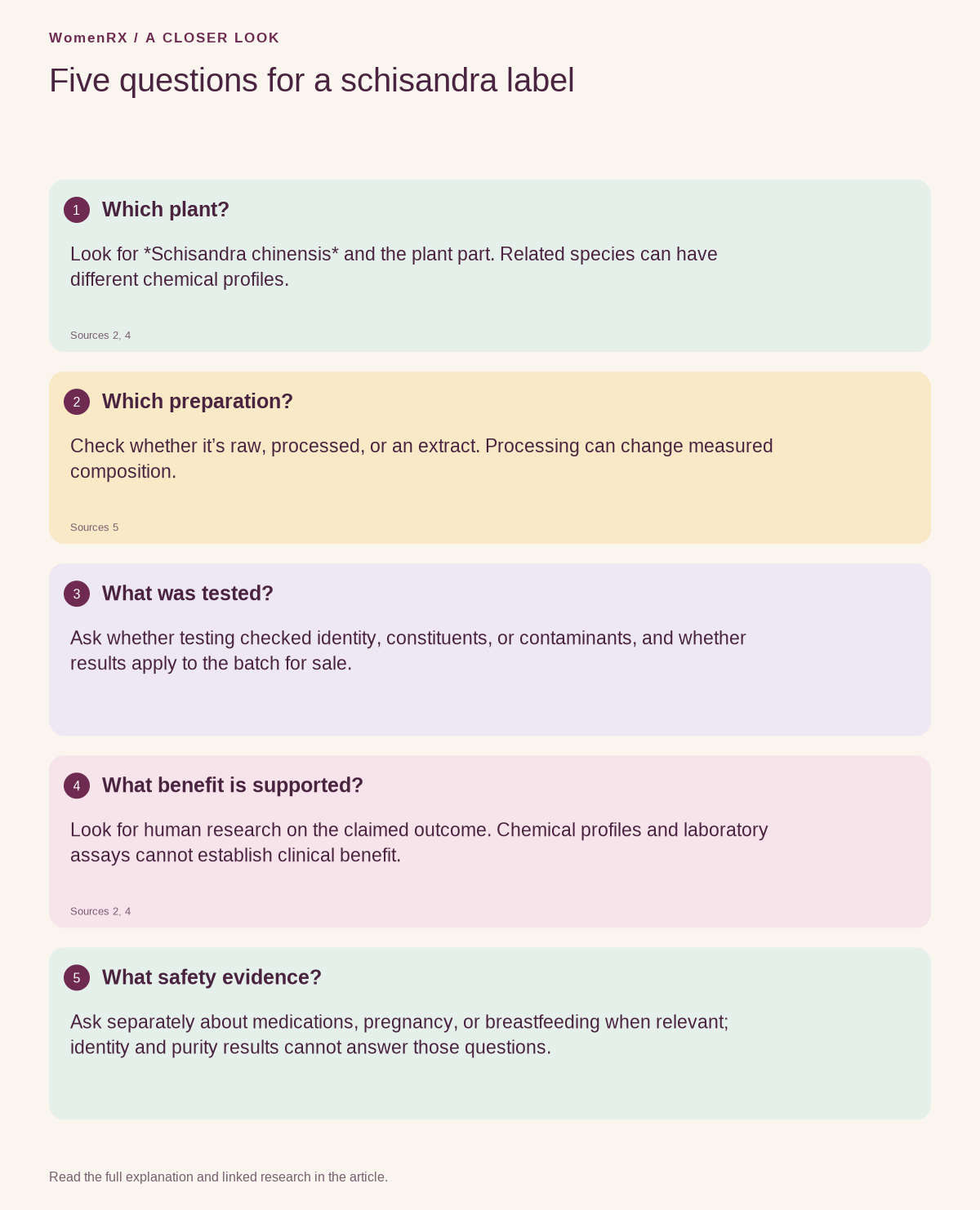
Five questions for a schisandra label
Which plant?: Look for *Schisandra chinensis* and the plant part. Related species can have different chemical profiles.24
Which preparation?: Check whether it’s raw, processed, or an extract. Processing can change measured composition.5
What was tested?: Ask whether testing checked identity, constituents, or contaminants, and whether results apply to the batch for sale.
What benefit is supported?: Look for human research on the claimed outcome. Chemical profiles and laboratory assays cannot establish clinical benefit.24
What safety evidence?: Ask separately about medications, pregnancy, or breastfeeding when relevant; identity and purity results cannot answer those questions.
Read the figure as text
Each check answers a different question about the product; none stands in for evidence of a health benefit.- Which plant?: Look for *Schisandra chinensis* and the plant part. Related species can have different chemical profiles.24
- Which preparation?: Check whether it’s raw, processed, or an extract. Processing can change measured composition.5
- What was tested?: Ask whether testing checked identity, constituents, or contaminants, and whether results apply to the batch for sale.
- What benefit is supported?: Look for human research on the claimed outcome. Chemical profiles and laboratory assays cannot establish clinical benefit.24
- What safety evidence?: Ask separately about medications, pregnancy, or breastfeeding when relevant; identity and purity results cannot answer those questions.
More questions, answered
Does third-party testing mean schisandra works?
No. Testing may help answer a specific question about a product, depending on what was tested. It does not show that taking the product improves a health outcome. A review concluded that high-quality human clinical trials are lacking to validate S. chinensis efficacy. 2
Sources you can check
- Evaluating Health Information: MedlinePlusAccessed 2026-09-25Return to first citation
- Modulation of disease-associated gut microbiota by Schisandra chinensis: a literature review.Liu Z, Wang C, Fan H, Yue Y, Sun T, Sun L. · Frontiers in pharmacology · 2026Return to first citation
- Integrated transcriptomic and metabolomic analyses reveal the mechanisms underlying bio-organic fertilizer-mediated growth and nutrient enhancement in Schisandra chinensis (Turcz.) Baill.Xu R, Zhang W, Chen S, Song S, Dong J, Yang Z, Ma Y. · Frontiers in plant science · 2025Return to first citation
- Characterization of Differences in Chemical Profiles and Antioxidant Activities of Schisandra chinensis and Schisandra sphenanthera Based on Multi-Technique Data Fusion.Lin L, Tang Z, Xie H, Yang L, Yang B, Li H. · Molecules (Basel, Switzerland) · 2024Return to first citation
- Rapid identification of chemical compositions of three species of Schisandra chinensis by ultra-high-performance liquid chromatography quadrupole-orbitrap-mass spectrometry.Shu L, Qiu H, Zhang S, Xue J, Liu S, Qian J, Chen S, Xu Y, Li Y. · Journal of separation science · 2023Return to first citation