Schisandra Dose and Safety: What the Label Can Tell You
A milligram amount is only useful when you know which schisandra preparation it describes.
There isn’t one research-backed dose that applies to every schisandra product. Studies and reviews describe dried fruit, individual plant compounds, and extracts mixed with other herbs; their weights aren’t interchangeable. 1 4 To assess a product, record its botanical name, plant part, preparation, serving amount, and other ingredients. Bring those details, along with your medicines and any pregnancy or breastfeeding questions, to a pharmacist or clinician.
A supplement label can make dosing look simple: one number of milligrams per serving. But that number might describe dried fruit, an extract, or an entire multi-herb blend. It doesn’t, by itself, show whether the product matches a preparation studied in people.
The useful question isn’t “What dose do women take?” It’s “What exactly is in this product, and what can the research on that preparation tell me?” The findings below don’t establish a women-specific dose.
The preparation changes what the number means
Start with the botanical name and plant part. Then check whether the label describes dried fruit, a powder, an extract, or a combination. If it gives extraction details or the amount of a named constituent, record those too. Finally, check what counts as one serving: a milligram amount per tablet isn’t necessarily an amount per day.
For example, a small randomized trial enrolled 40 healthy women and tested a single 270-mg tablet of ADAPT-232 against placebo. The tablet was a standardized combination of schisandra, rhodiola, and eleuthero extracts. Its 270 mg described the blend, not schisandra alone, and the single-dose trial doesn’t establish a daily dose for a standalone schisandra supplement. 1
A review of schisandrin B, a compound found in schisandra, gives a different kind of figure. It cites a suggested adult amount of 0.5-1.5 grams of air-dried fruit twice daily and gives a corresponding estimate of 20-60 milligrams of schisandrin B per day. Separately, the review uses animal-to-human dose calculations to discuss findings from mouse experiments. Neither the cited dried-fruit amount nor those animal comparisons establish an effective or safe dose for a particular person. The review says the optimal human dose and duration still need to be determined. It also doesn’t establish how much of a particular extract would equal that dried-fruit amount. 4
A label checklist for a useful comparison
Before comparing a bottle with a research preparation, capture these details:
- Identity and plant part: Does it name Schisandra chinensis? Does it specify fruit or another part?
- Preparation: Is it dried fruit, powder, an extract, or a blend? Record any extraction details provided.
- Serving amount: How much is listed, and how many capsules, tablets, or scoops make one serving?
- Named constituents: Does the label state an amount for a particular compound or standardized group of compounds? That detail can help describe the product, but it doesn’t prove equivalence to another preparation.
- Other active ingredients: Are other herbs included? A blend can’t be assessed as though its full weight were schisandra.
If a detail isn’t on the label, mark it as unknown rather than filling in the blank. A photo of the full label gives a pharmacist or clinician more to work with than the brand name alone.
Add medicines and life circumstances to the safety check
A retrospective chart review identified adverse-event reports involving schisandra alongside bupropion, amitriptyline, or fluoxetine. Because it examined selected reports, it can’t tell you how often a problem occurs with any of these combinations or predict what will happen for you. It does give you a concrete reason to mention schisandra when reviewing those medicines. 3
Another study found that schisandra extract changed the absorption of particular ginseng compounds in pharmacokinetic and intestinal experiments. That finding concerns the studied schisandra-and-ginseng combination; it doesn’t establish an interaction with a specific prescription medicine. If your product contains ginseng too, include both herbs when you ask about it. 2
Pregnancy and breastfeeding deserve a separate question before use. The trial in healthy women assessed one dose of a three-herb blend; it doesn’t answer whether schisandra is safe during pregnancy or breastfeeding, or what dose would be appropriate in either circumstance. 1 Mention pregnancy, breastfeeding, or plans for pregnancy when discussing a product.
To make that conversation specific, bring the label and say how you’re considering using the supplement and why. Include prescription medicines, over-the-counter products, and other supplements. Then ask: “Does this match a preparation studied in people?” and “Do any of its ingredients raise a concern alongside what I already take?”
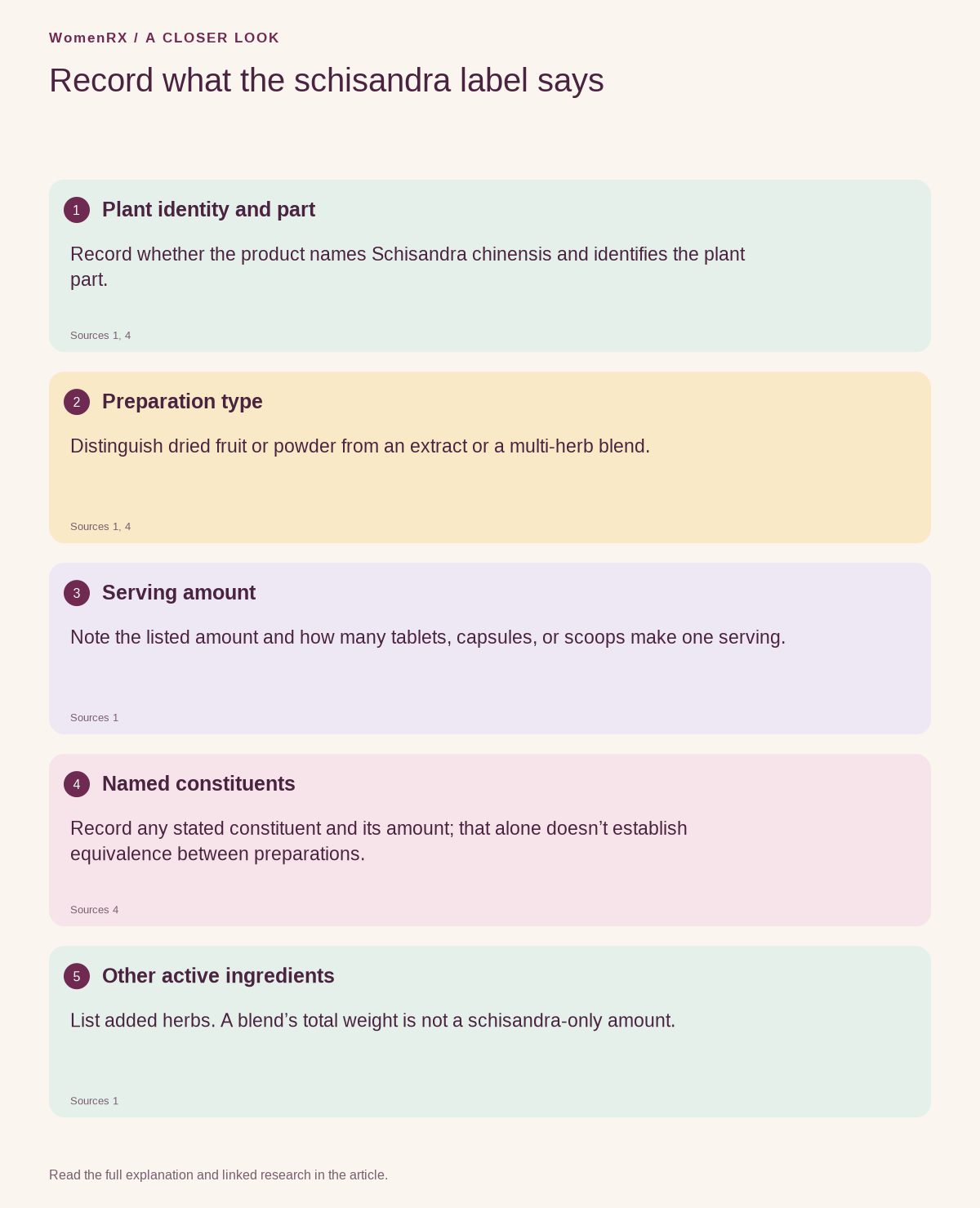
Record what the schisandra label says
Plant identity and part: Record whether the product names Schisandra chinensis and identifies the plant part.14
Preparation type: Distinguish dried fruit or powder from an extract or a multi-herb blend.14
Serving amount: Note the listed amount and how many tablets, capsules, or scoops make one serving.1
Named constituents: Record any stated constituent and its amount; that alone doesn’t establish equivalence between preparations.4
Other active ingredients: List added herbs. A blend’s total weight is not a schisandra-only amount.1
Read the figure as text
These details help distinguish a product from the preparations described in research.- Plant identity and part: Record whether the product names Schisandra chinensis and identifies the plant part.14
- Preparation type: Distinguish dried fruit or powder from an extract or a multi-herb blend.14
- Serving amount: Note the listed amount and how many tablets, capsules, or scoops make one serving.1
- Named constituents: Record any stated constituent and its amount; that alone doesn’t establish equivalence between preparations.4
- Other active ingredients: List added herbs. A blend’s total weight is not a schisandra-only amount.1
More questions, answered
Can I compare an extract with dried berries by milligrams?
Not from weight alone. The cited amount for air-dried fruit and its estimated schisandrin B content don’t establish an equivalent amount for a particular extract. 4
Does a study of a schisandra blend establish a schisandra-only dose?
No. The 270-mg ADAPT-232 tablet contained extracts from schisandra and two other plants. Its total weight isn’t a reported schisandra-only dose. 1
Sources you can check
- Double-blind, placebo-controlled, randomised study of single dose effects of ADAPT-232 on cognitive functions.Aslanyan G, Amroyan E, Gabrielyan E, Nylander M, Wikman G, Panossian A. · Phytomedicine : international journal of phytotherapy and phytopharmacology · 2010Return to first citation
- Effects of schisandra lignans on the absorption of protopanaxadiol-type ginsenosides mediated by P-glycoprotein and protopanaxatriol-type ginsenosides mediated by CYP3A4.Li Y, Yang K, Zhao L, Xu C, Zhou W, Wang Z, Hu H, You Y. · Journal of ethnopharmacology · 2024Return to first citation
- Harder, better, faster, stronger? Retrospective chart review of adverse events of interactions between adaptogens and antidepressant drugs.Siwek M, Woroń J, Wrzosek A, Gupało J, Chrobak AA. · Frontiers in pharmacology · 2023Return to first citation
- Schisandrin B: A Double-Edged Sword in Nonalcoholic Fatty Liver Disease.Leong PK, Ko KM. · Oxidative medicine and cellular longevity · 2016Return to first citation