Is Betaine HCl Safe to Take Long Term?
Betaine HCl can change stomach acidity for a short time, but that doesn’t tell us whether taking it regularly is safe.
Long-term safety hasn’t been established by the human studies discussed here. One small study measured stomach acidity after food; another tested a single use of betaine HCl alongside a medicine whose absorption depends on acidity. Neither measured the effects of regular use over months or years, or established safety for people with stomach conditions, during pregnancy, or while breastfeeding. 2 1
What the human studies actually tested
Betaine hydrochloride, often called betaine HCl, is sold as an acid supplement. It can change the acidity inside the stomach. That’s a measurable effect, but it isn’t the same as showing that regular use improves digestion or is safe over time.
In a 2019 crossover study, nine people received betaine HCl during different study periods after eating. Food raised stomach pH, meaning the stomach became less acidic. A tested amount of betaine HCl brought pH back to its starting level sooner than it returned without the supplement. The study measured this short-term change, not whether people felt better or what happened with daily use. 2
A separate randomized crossover study looked at a very particular medicine question. Researchers gave healthy volunteers the acid-reducing drug rabeprazole, which lowered their exposure to dasatinib, a drug whose absorption is sensitive to stomach acidity. In a single-dose comparison, adding betaine HCl increased dasatinib exposure under those study conditions. That finding matters because changing stomach acidity can change how much of a medicine the body absorbs. It is not a reason to pair betaine HCl with dasatinib or to counteract an acid-reducing prescription on your own. 1
What those results can’t tell you about repeated use
Neither study provides a rate of stomach irritation or other harms from taking betaine HCl regularly for months or years. The studies also don’t establish whether it’s appropriate for someone with reflux, an ulcer, or another acid-related condition. A short-term pH measurement can’t answer those questions. 2 1
If you’re considering it because of recurring upper-abdominal discomfort, the decision isn’t simply whether to try more acid. The reason for your symptoms matters, and these studies did not test betaine HCl as a treatment for them. If you already have an acid-related diagnosis or take medicine to reduce stomach acid, bring that context into a medical review before adding an acid supplement. If you take dasatinib, the measured change in drug exposure makes checking with the clinician managing that medicine especially relevant. 1
The same evidence gap applies if you’re pregnant or breastfeeding: these studies don’t establish safety in either situation. They also don’t report a women-specific benefit or long-term safety result. The useful distinction is between a demonstrated, brief effect on stomach pH and the much bigger claim that repeated use is safe or helpful for you. 2 1
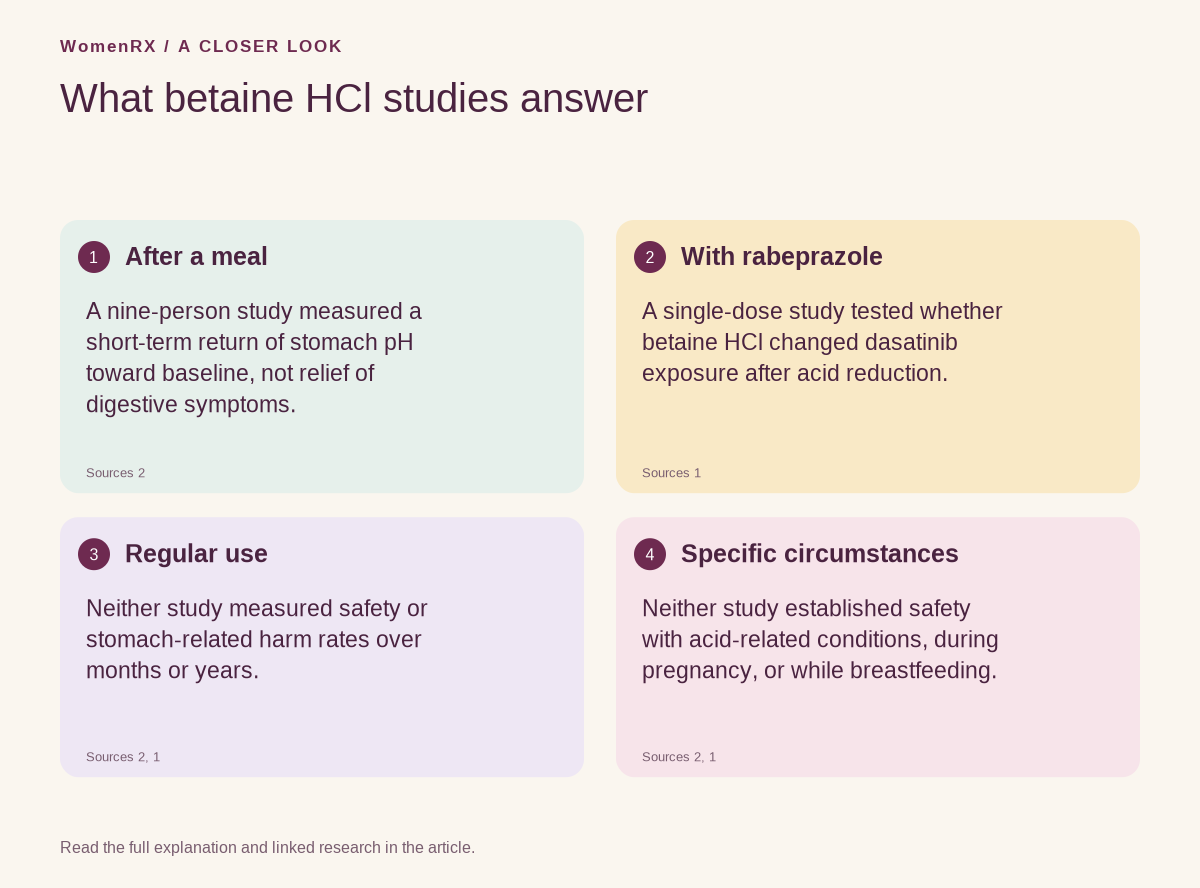
What betaine HCl studies answer
After a meal: A nine-person study measured a short-term return of stomach pH toward baseline, not relief of digestive symptoms.2
With rabeprazole: A single-dose study tested whether betaine HCl changed dasatinib exposure after acid reduction.1
Regular use: Neither study measured safety or stomach-related harm rates over months or years.21
Specific circumstances: Neither study established safety with acid-related conditions, during pregnancy, or while breastfeeding.21
Read the figure as text
The tested outcomes are narrower than the question of whether regular use is safe.- After a meal: A nine-person study measured a short-term return of stomach pH toward baseline, not relief of digestive symptoms.2
- With rabeprazole: A single-dose study tested whether betaine HCl changed dasatinib exposure after acid reduction.1
- Regular use: Neither study measured safety or stomach-related harm rates over months or years.21
- Specific circumstances: Neither study established safety with acid-related conditions, during pregnancy, or while breastfeeding.21
Sources you can check
- The use of betaine HCl to enhance dasatinib absorption in healthy volunteers with rabeprazole-induced hypochlorhydria.Yago MR, Frymoyer A, Benet LZ, Smelick GS, Frassetto LA, Ding X, Dean B, Salphati L, Budha N, Jin JY, Dresser MJ, Ware JA. · The AAPS journal · 2014Return to first citation
- Food, Acid Supplementation and Drug Absorption - a Complicated Gastric Mix: a Randomized Control Trial.Surofchy DD, Frassetto LA, Benet LZ. · Pharmaceutical research · 2019Return to first citation