Ashwagandha Long-Term Use: What Safety Evidence Can Tell You
Studies have followed some adults using specific root extracts for up to a year, but that does not establish safety for indefinite use or for every product.
Ashwagandha has been studied in adults for periods ranging from weeks to 180 days in a review of trials, and one observational study followed adults for 12 months. These findings offer limited information about the specific extracts and populations studied, not a guarantee for years of use. Mild side effects are reported; liver and thyroid concerns, medicines, pregnancy, and breastfeeding also matter. 1 3 4
Duration is only one part of the safety picture
The evidence is strongest for shorter-term use of particular products. In a randomized, placebo-controlled study, 1,002 adults with stress or anxiety took a standardized root extract or placebo for eight weeks. The study reported no serious adverse events and no significant differences between groups in liver or kidney laboratory measures. That is useful short-term evidence, but it cannot answer what happens after years of use. 2
A systematic review of 23 studies included 2,317 generally healthy adults using standardized, single-ingredient root extracts. Study periods ranged from a single dose to 180 days. The review reported no serious adverse events attributed to these extracts and noted that data beyond 180 days remain limited. These findings apply most directly to the kinds of root-only extracts included in the review, not automatically to every supplement labeled ashwagandha. 3
There is also a prospective observational study that followed 191 adults using a standardized root extract for 12 months. It reported 18 mild adverse events that resolved without intervention and no clinically significant changes in liver enzyme measurements. Because this was an observational study, treat it as additional information about longer-term use, not as proof that the same results will apply to a different product or person. 4
Taken together, the studies offer some reassurance for specific products over the durations studied. They do not establish that ashwagandha is safe indefinitely.
Check what the product actually contains
“Ashwagandha” does not identify one uniform extract. Products may contain root, leaf, or both, and the chemical composition of root and leaf differs. The systematic review focused on standardized, single-ingredient root extracts, so its safety findings should not be assumed to cover leaf-containing or combination products. 1 3
If you’re considering continued use, look at the label for the plant part, whether other ingredients are included, and whether the extract is standardized. These details won’t prove a product is safe, but they help you judge whether it resembles the products studied. If the label does not make the plant part or ingredients clear, the study findings may be harder to apply to it.
Mild effects are different from the safety signals
In clinical studies, reported side effects have generally been mild, including stomach upset, loose stools, nausea, and drowsiness. The 12-month study also reported mild events, but that does not rule out uncommon problems or establish what might happen with longer use. 1 4
Separately, case reports have linked ashwagandha use to acute liver injury. Some reports involved combination products or products whose contents were not independently verified, so they cannot show how often liver injury happens or establish that every case was caused by ashwagandha alone. Reports included jaundice, itching, nausea, unusual tiredness, and abdominal discomfort. If these symptoms develop while you’re taking a supplement, seek medical advice promptly and bring the product label. 1
Thyroid effects are another reason to check whether the evidence fits your situation. A small trial in people with subclinical hypothyroidism found changes in thyroid hormone measurements after eight weeks, and case reports have described thyrotoxicosis in women taking ashwagandha. These findings do not tell us how often thyroid problems occur, but they make thyroid conditions and thyroid hormone medicines relevant questions before continued use. 1
The NIH Office of Dietary Supplements also identifies potential interactions with antidiabetes medicines, medicines for high blood pressure, immunosuppressants, and sedatives. If you take one of these, or thyroid hormone medicine, ask a pharmacist or prescriber to check the specific combination rather than assuming that a general safety study covers it. 1
Pregnancy and breastfeeding are separate questions
Findings in generally healthy adults do not establish safety during pregnancy or breastfeeding. Some expert guidance advises against ashwagandha use in both situations. The proposed pregnancy-harm signal is uncertain and disputed, so it should not be presented as proven; at the same time, the uncertainty does not provide evidence that use is safe. 1
A practical way to weigh continued use
Think of the evidence as a match-up: how long was the product studied, how closely does its formulation resemble the studied extract, and does your health or medication situation differ from the study population? A standardized, single-ingredient root extract used for a limited period is closer to the trial evidence than an unclear or multi-ingredient product. Even the closer match does not answer the question of indefinite use. 1 3
For a personal safety check, the most useful details to have ready are the exact product label, how long you’ve used it, and whether you have liver or thyroid concerns, are pregnant or breastfeeding, or take medicines in the potentially interacting groups. That lets the discussion focus on the product and risks that apply to you, rather than treating every ashwagandha supplement as interchangeable. 1
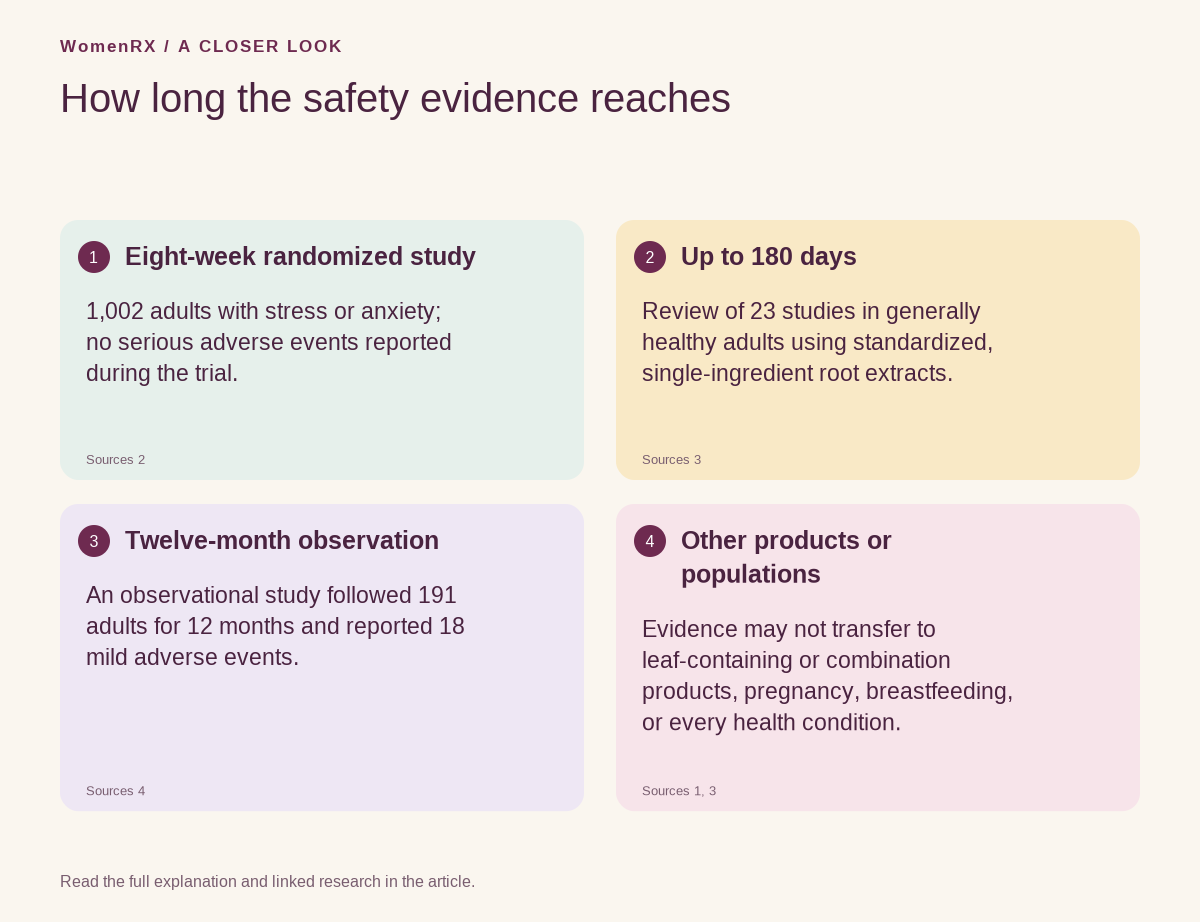
How long the safety evidence reaches
Eight-week randomized study: 1,002 adults with stress or anxiety; no serious adverse events reported during the trial.2
Up to 180 days: Review of 23 studies in generally healthy adults using standardized, single-ingredient root extracts.3
Twelve-month observation: An observational study followed 191 adults for 12 months and reported 18 mild adverse events.4
Other products or populations: Evidence may not transfer to leaf-containing or combination products, pregnancy, breastfeeding, or every health condition.13
Read the figure as text
Study duration, design, and extract type show what each safety finding can and cannot tell you.- Eight-week randomized study: 1,002 adults with stress or anxiety; no serious adverse events reported during the trial.2
- Up to 180 days: Review of 23 studies in generally healthy adults using standardized, single-ingredient root extracts.3
- Twelve-month observation: An observational study followed 191 adults for 12 months and reported 18 mild adverse events.4
- Other products or populations: Evidence may not transfer to leaf-containing or combination products, pregnancy, breastfeeding, or every health condition.13
Sources you can check
- Ashwagandha: Is it helpful for stress, anxiety, or sleep? - Health Professional Fact SheetAccessed 2026-09-25Return to first citation
- Safety of 8-Week Administration With Ashwagandha (Withania somnifera) Root Extract in Adults With Stress and Anxiety: Findings From a Prospective, Randomized, Multi-Center, Double-Blinded, Placebo-Controlled Study.Pakhale K, Salve J, Ademola J, Parraca J, Langade D. · Phytotherapy research : PTR · 2026Return to first citation
- Back to the Roots: Safety and Tolerability of Standardised Ashwagandha (Withania somnifera) Root Extract in Healthy Adults-A Systematic Review of Biomarkers and Adverse Events.Coope OC, Willems MET, Levington A, Tallon MJ, Roman-Viñas B, Spurr TJ. · Pharmaceuticals (Basel, Switzerland) · 2026Return to first citation
- Safety of 12-Months Administration of Ashwagandha ( Withania somnifera ) Standardized Root Extract in Healthy Adults: A Prospective, Observational Study.Salve J, Kale S, Prajapati BL, Sparavigna A, Savant M, Ademola J, Langade D. · Phytotherapy research : PTR · 2026Return to first citation