Ashwagandha Risks: Side Effects and Interactions
Short studies offer some reassurance, but liver and thyroid concerns, medicine interactions, and pregnancy or breastfeeding can change the safety picture.
Ashwagandha may cause stomach upset, loose stools, nausea, or drowsiness. Short-term studies of particular extracts have generally been reassuring, but they can’t establish long-term safety or rule out uncommon harms. Check with a prescriber or pharmacist before using it if you have liver or thyroid concerns, take potentially interacting medicines, are pregnant, or are breastfeeding. 1 2
Ashwagandha’s safety depends partly on the product and on your own health and medicines. Mild stomach symptoms and drowsiness are reported. More serious concerns include reports of liver injury and possible effects on thyroid hormones. Short-term trials provide some reassurance for the specific extracts they studied, but they don’t settle safety over months or years. 1 2
Common side effects, and what short trials can tell you
In studies, reported side effects have included stomach upset, loose stools, nausea, and drowsiness. In one randomized, placebo-controlled study, 1,002 adults with stress or anxiety took a root extract or placebo for eight weeks. Researchers reported no serious adverse events and no significant differences between groups in liver-function tests. That’s useful short-term evidence for that product in those adults, not proof that every ashwagandha product is safe for everyone. 1 2
Many studies have used different extracts, plant parts, and preparations. Some products use root; others use root and leaf, and some combine ashwagandha with other ingredients. The NIH Office of Dietary Supplements notes that safety is not known for long-term use. 1
Liver injury: uncommon reports, worth recognizing
Liver injury has been reported in people taking ashwagandha. Case reports include symptoms such as yellowing of the skin or eyes (jaundice), itching, nausea, unusual tiredness, and abdominal discomfort. Some people had liver disease before taking the supplement. In some reports, products contained other ingredients or their contents weren’t independently verified, so the cases don’t establish how often ashwagandha itself causes injury. 1
If you develop jaundice or other concerning liver symptoms while taking ashwagandha, seek medical advice promptly. If you have a history of liver problems, discuss that before starting rather than relying on short-term trial results: those results don’t answer whether it’s appropriate for you. 1 2
Thyroid effects and medicines to flag
Ashwagandha may affect thyroid hormone levels. A small trial in people with subclinical hypothyroidism found changes in thyroid hormone measurements after eight weeks, and case reports describe thyrotoxicosis in women taking extracts. These reports don’t establish the likelihood of a problem, but they make thyroid disease and thyroid-hormone treatment relevant to a safety review. 1
The NIH fact sheet also says ashwagandha may interact with thyroid hormone medicines, medicines for diabetes or high blood pressure, immunosuppressants, and sedatives. If you take any of these, ask your prescriber or pharmacist to review the specific supplement and your medication list before combining them. Drowsiness is itself a reported side effect, so mention other medicines that make you sleepy as well. 1
Pregnancy and breastfeeding are separate questions
Some experts advise against ashwagandha during pregnancy because of concern about possible spontaneous abortion. That concern isn’t established as a proven effect: the NIH fact sheet notes that the American Herbal Pharmacopoeia has disputed claims that ashwagandha root causes abortion. A small, open-label study of 70 women in their second trimester reported no adverse events during 12 weeks of use, but it cannot settle safety across pregnancy, including earlier pregnancy or uncommon outcomes. 1 3
For breastfeeding, the NIH fact sheet reports that France’s food-safety agency recommends against use in breastfeeding women. The pregnancy study does not answer the breastfeeding question. If you’re pregnant or breastfeeding, don’t treat results from general adult studies as evidence that the supplement is safe for your situation. 1 3
A practical review before you use it
Bring the product label or a clear photo of it to a medication review. Check whether it contains root, leaf, or both, and whether it includes other ingredients. Mention liver or thyroid conditions, pregnancy or breastfeeding, and any medicines for blood sugar, blood pressure, immune suppression, sleep, or thyroid treatment. This helps focus the conversation on the risks that are actually relevant to you, rather than assuming all supplements or all ashwagandha extracts are interchangeable. 1
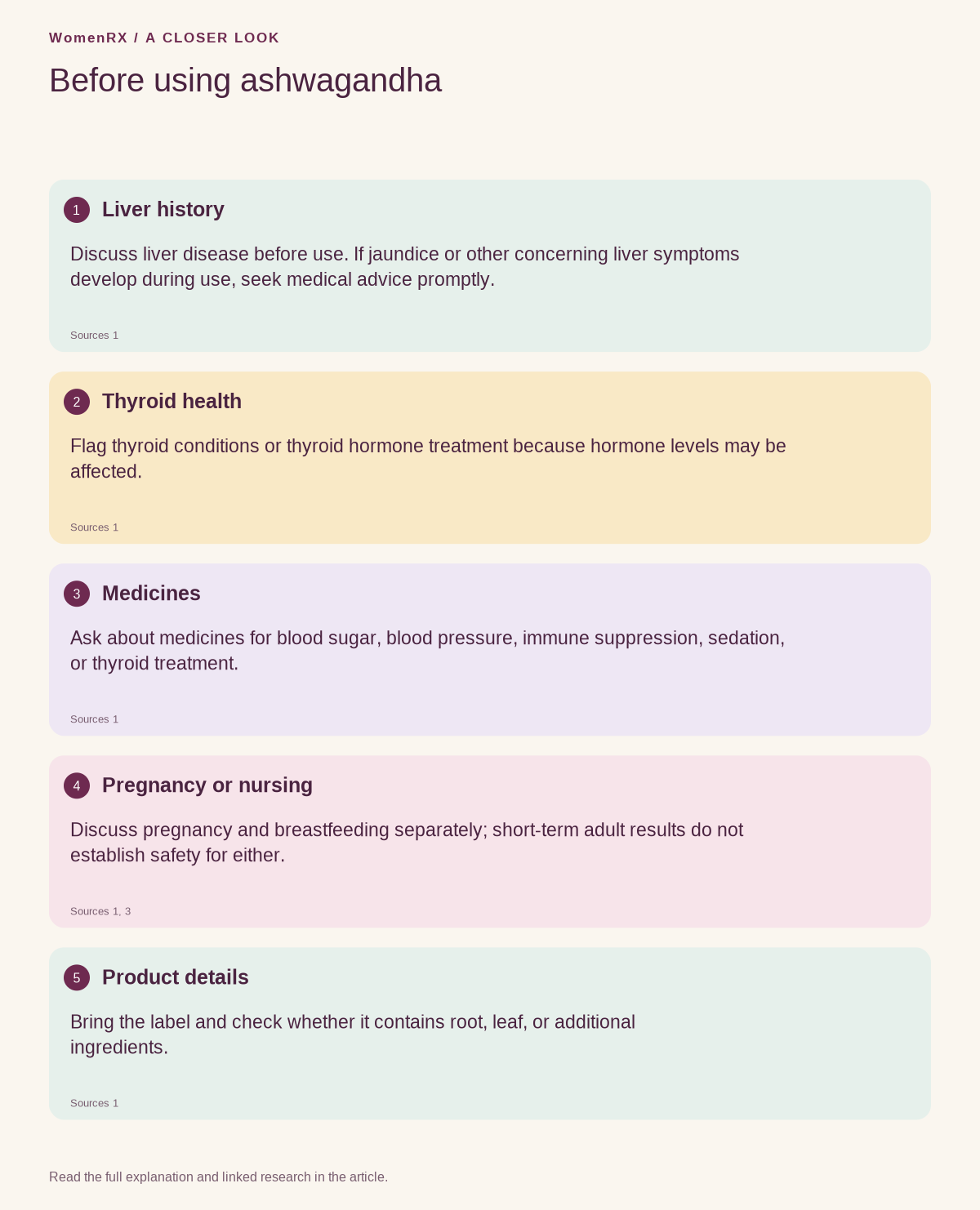
Before using ashwagandha
Liver history: Discuss liver disease before use. If jaundice or other concerning liver symptoms develop during use, seek medical advice promptly.1
Thyroid health: Flag thyroid conditions or thyroid hormone treatment because hormone levels may be affected.1
Medicines: Ask about medicines for blood sugar, blood pressure, immune suppression, sedation, or thyroid treatment.1
Pregnancy or nursing: Discuss pregnancy and breastfeeding separately; short-term adult results do not establish safety for either.13
Product details: Bring the label and check whether it contains root, leaf, or additional ingredients.1
Read the figure as text
Use this checklist to identify details that change the safety discussion; it is a prompt for review, not a risk score.- Liver history: Discuss liver disease before use. If jaundice or other concerning liver symptoms develop during use, seek medical advice promptly.1
- Thyroid health: Flag thyroid conditions or thyroid hormone treatment because hormone levels may be affected.1
- Medicines: Ask about medicines for blood sugar, blood pressure, immune suppression, sedation, or thyroid treatment.1
- Pregnancy or nursing: Discuss pregnancy and breastfeeding separately; short-term adult results do not establish safety for either.13
- Product details: Bring the label and check whether it contains root, leaf, or additional ingredients.1
More questions, answered
Do short-term studies prove ashwagandha is safe long term?
No. Studies have generally lasted weeks to about three months, and the NIH Office of Dietary Supplements says the safety of use over many months or years is not known. 1
Which symptoms have been reported in liver-injury cases?
Reports include yellowing of the skin or eyes, itching, nausea, unusual tiredness, and abdominal discomfort. The reports don’t establish how often ashwagandha itself caused liver injury. If jaundice or other concerning liver symptoms develop while you’re taking it, seek medical advice promptly. 1
Sources you can check
- Ashwagandha: Is it helpful for stress, anxiety, or sleep? - Health Professional Fact SheetAccessed 2026-09-25Return to first citation
- Safety of 8-Week Administration With Ashwagandha (Withania somnifera) Root Extract in Adults With Stress and Anxiety: Findings From a Prospective, Randomized, Multi-Center, Double-Blinded, Placebo-Controlled Study.Pakhale K, Salve J, Ademola J, Parraca J, Langade D. · Phytotherapy research : PTR · 2026Return to first citation
- Efficacy and safety of Ashwagandha (Withania somnifera) root extract in pregnant women: a prospective, randomized, comparative, open-label, 12-week study.Ajgaonkar A, Tayade H, Nayak A. · Frontiers in global women's health · 2026Return to first citation