Holy Basil in Human Studies: What Was Actually Tested
Human studies have tested tulsi for metabolic health, mood, cognition, and other outcomes, but the findings are limited and don’t establish a broad wellness benefit.
People have studied holy basil, also called tulsi, for blood sugar and other metabolic measures, blood pressure, mood, cognition, and immune-related outcomes. A human-research review found 24 studies, but they varied in preparation and quality. For example, one small crossover trial tested tulsi leaf powder against spinach powder in adults with type 2 diabetes. These findings don’t establish reliable benefits or answer most women-specific questions. 1
The studies cover several different questions
“Holy basil” and “tulsi” aren’t always precise descriptions of what was tested. A review of human studies included Ocimum tenuiflorum (also called Ocimum sanctum) and, in some cases, Ocimum gratissimum. The plants can differ in their composition, and most reports did not distinguish tulsi varieties. Studies also used different forms, including leaf powder, fresh leaves or juice, and extracts. That makes it hard to assume a result from one preparation applies to another, such as tea or a particular supplement. 1
A 2017 review identified 24 human studies, grouped mainly into metabolic outcomes, immunity, and neurocognitive function. The review reported favorable outcomes across the studies, but that summary should be read alongside substantial variation in study quality, participants, and preparations. It is a map of what researchers tried, not proof that tulsi reliably treats these conditions. 1
Metabolic measures and blood pressure
The largest cluster of studies looked at measures such as blood glucose, cholesterol and other blood fats, blood pressure, and insulin resistance. Many enrolled people with diabetes, metabolic syndrome, or high blood pressure. Some tested tulsi by itself; others combined it with food or another treatment. The studies were generally short, and their designs and reporting were uneven. 1
One controlled example focused on blood sugar: a small randomized crossover trial enrolled 40 adults with type 2 diabetes and compared tulsi leaf powder with spinach leaf powder over five weeks. The review reported lower fasting and after-meal blood glucose during the tulsi intervention. This is a specific finding from one small study, not proof that tulsi reliably controls diabetes or that another preparation would have the same effect. 1
Other findings came from different designs and outcomes. For example, an open-label study of 50 young women with low blood pressure used fresh tulsi juice for four weeks and reported changes in blood pressure. Without a comparison group, that study cannot show that tulsi caused the changes or establish a dependable effect for other women. 1
Stress, mood, and cognition
Researchers have also studied psychological stress and cognitive tasks. A review described four neurocognitive studies, including a placebo-controlled trial in 40 healthy young adults that tested attention, short-term memory, and cognitive flexibility over four weeks. The review reported improvements on some cognitive measures, with differences from placebo described after the first two weeks. Results from a small study in healthy young adults don’t establish an effect for other groups or everyday concerns such as persistent anxiety. 1
For stress-related hormones, a separate systematic review of randomized human trials included holy basil among many plants and plant compounds. Because the studies varied considerably, the review concluded that their effects on the body’s stress-hormone system were unclear overall. That’s a more cautious picture than treating “stress support” as an established effect. 3
Infection findings don’t isolate tulsi
A randomized pilot study in people with COVID-19 tested a multi-ingredient Ayurvedic regimen that included tulsi along with other herbs, a herbo-mineral preparation, and nasal drops. Any result from that regimen cannot show what tulsi alone did. It also doesn’t establish tulsi as a treatment for COVID-19 or other infections. 2
This distinction matters because laboratory or traditional-use explanations are not the same as evidence that a single-ingredient product improves health in people. Reviews of traditional plants and COVID-19 discuss potential antiviral or immune-related activity, but such discussion does not establish a clinical benefit from tulsi by itself. 4
What the studies say about women
The human research summarized in the 2017 review was not designed to answer most women-specific questions. Some studies enrolled only men, and many did not clearly report participants’ sex. The review includes the small study in young women with low blood pressure, but does not identify trials focused on menstrual symptoms, fertility or other reproductive outcomes, pregnancy, or menopause. That means these outcomes remain unanswered by the reviewed evidence, not that a benefit or harm has been ruled out. 1
The review reported no significant adverse events in the included studies. That is a report about those studies, not a guarantee that every preparation is safe: the studies were limited, and adverse-event reporting was not consistent enough to settle safety questions for all people or products. 1
A practical way to read a tulsi claim
When you encounter a claim, check what was actually studied: the Ocimum species, the form used, who participated, what outcome was measured, and whether tulsi was tested alone. A result for a specific extract or a multi-ingredient regimen is not automatically evidence for tulsi tea, another supplement, or a women’s health outcome. The clearest takeaway is that tulsi has been studied in people, but the findings are too varied and limited to support broad claims about its health effects. 12
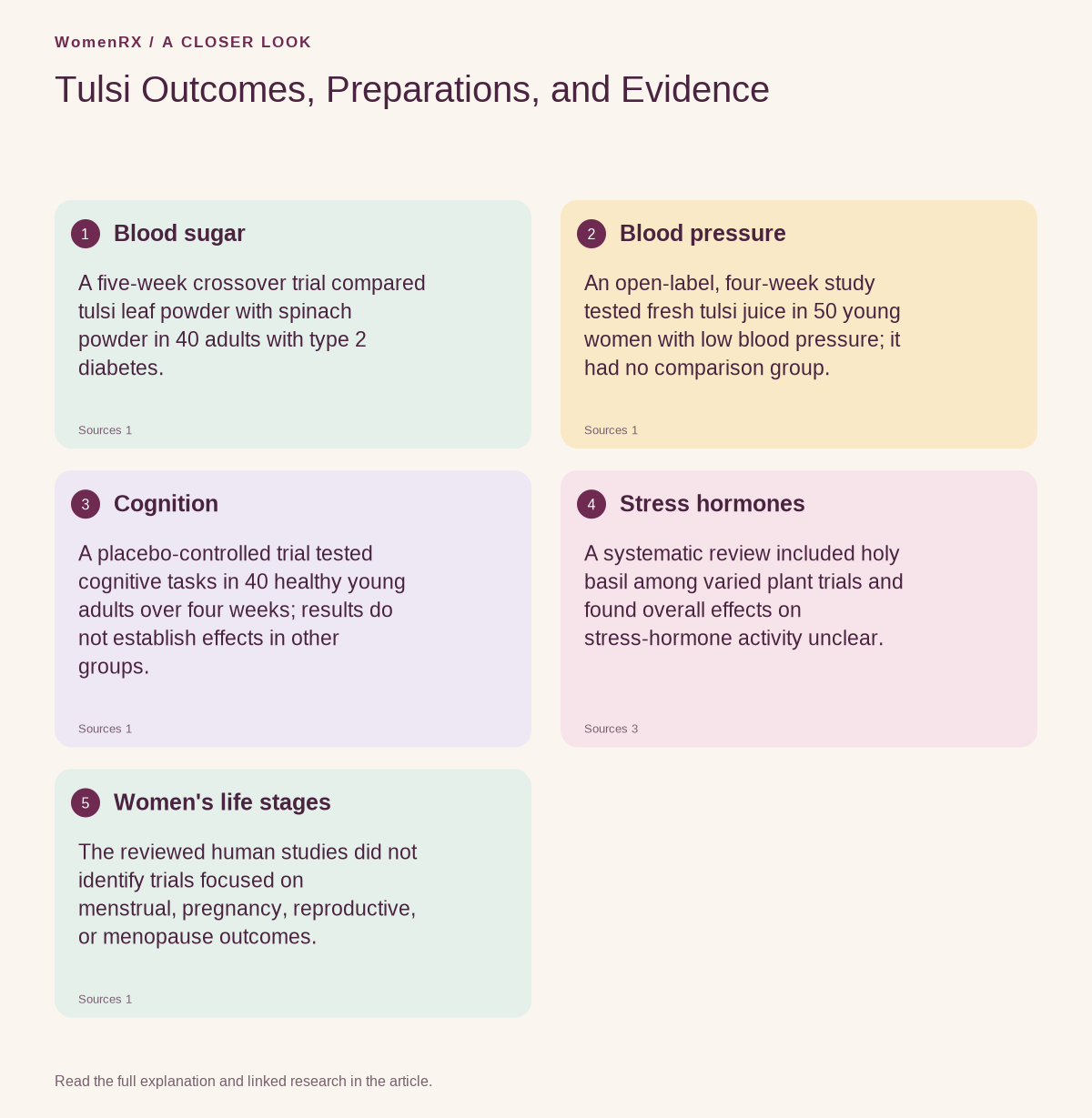
Tulsi Outcomes, Preparations, and Evidence
Blood sugar: A five-week crossover trial compared tulsi leaf powder with spinach powder in 40 adults with type 2 diabetes.1
Blood pressure: An open-label, four-week study tested fresh tulsi juice in 50 young women with low blood pressure; it had no comparison group.1
Cognition: A placebo-controlled trial tested cognitive tasks in 40 healthy young adults over four weeks; results do not establish effects in other groups.1
Stress hormones: A systematic review included holy basil among varied plant trials and found overall effects on stress-hormone activity unclear.3
Women's life stages: The reviewed human studies did not identify trials focused on menstrual, pregnancy, reproductive, or menopause outcomes.1
Read the figure as text
These examples show how the tested preparation and study design shape what each human finding can tell you.- Blood sugar: A five-week crossover trial compared tulsi leaf powder with spinach powder in 40 adults with type 2 diabetes.1
- Blood pressure: An open-label, four-week study tested fresh tulsi juice in 50 young women with low blood pressure; it had no comparison group.1
- Cognition: A placebo-controlled trial tested cognitive tasks in 40 healthy young adults over four weeks; results do not establish effects in other groups.1
- Stress hormones: A systematic review included holy basil among varied plant trials and found overall effects on stress-hormone activity unclear.3
- Women's life stages: The reviewed human studies did not identify trials focused on menstrual, pregnancy, reproductive, or menopause outcomes.1
More questions, answered
Does a study of tulsi extract apply to tulsi tea?
Not necessarily. Human studies used different forms, including extracts, powders, fresh leaves, and juice, and the review did not establish that results from one preparation carry over to another. 1
Has holy basil been shown to help with menopause or menstrual symptoms?
The human studies summarized in the review did not focus on menstrual, pregnancy, or menopause outcomes. This evidence therefore does not establish a benefit for those concerns. 1
Sources you can check
- The Clinical Efficacy and Safety of Tulsi in Humans: A Systematic Review of the Literature.Jamshidi N, Cohen MM. · Evidence-based complementary and alternative medicine : eCAM · 2017Return to first citation
- Randomized placebo-controlled pilot clinical trial on the efficacy of ayurvedic treatment regime on COVID-19 positive patients.Devpura G, Tomar BS, Nathiya D, Sharma A, Bhandari D, Haldar S, Balkrishna A, Varshney A. · Phytomedicine : international journal of phytotherapy and phytopharmacology · 2021Return to first citation
- Modulation of the hypothalamic-pituitary-adrenal (HPA) axis by plants and phytonutrients: a systematic review of human trials.Lopresti AL, Smith SJ, Drummond PD. · Nutritional neuroscience · 2022Return to first citation
- Promising traditional Indian medicinal plants for the management of novel Coronavirus disease: A systematic review.Singh RS, Singh A, Kaur H, Batra G, Sarma P, Kaur H, Bhattacharyya A, Sharma AR, Kumar S, Upadhyay S, Tiwari V, Avti P, Prakash A, Medhi B. · Phytotherapy research : PTR · 2021Return to first citation