Holy Basil for Stress: What Human Studies Have Tested
One small placebo-controlled trial found improvement in self-rated stress symptoms with a specific holy basil extract, but it can’t establish that other products work the same way.
Holy basil has some direct human evidence for stress, but it rests mainly on a six-week trial of one extract in adults in India. Participants taking that extract reported greater improvement in a set of stress-related symptoms than those taking placebo. The result doesn’t show that every holy basil supplement works, or that it treats anxiety or balances hormones. 2
What the human trial actually tested
The clearest direct test in people was a randomized, double-blind, placebo-controlled study of OciBest, an extract of Ocimum tenuiflorum (also called Ocimum sanctum). It enrolled 150 adults, ages 18 to 65, at two centers in India. For six weeks, 71 participants received 1,200 mg of OciBest actives per day and 79 received placebo. Participants rated symptoms such as forgetfulness, recent sleep problems, exhaustion, and recent sexual problems. The study reported greater improvement in the total symptom score with the extract than with placebo. 2
That’s a promising signal, not proof of a broad stress treatment. The outcome was a self-rated collection of symptoms, not a diagnosis of anxiety or a direct measure of how someone’s body responds to stress. The trial also tested one named extract over a short period. Its findings can’t automatically be applied to tea, powders, essential oils, or a different capsule.
The study authors described the improvement as 39% greater than placebo. That is their relative comparison of improvement, not a statement that 39% of participants were cured or that symptoms fell by 39 percentage points. It doesn’t predict an individual’s result. 2
A blend trial doesn’t tell you what holy basil did
A separate randomized trial tested a proprietary blend containing holy basil leaf alongside rhodiola, milky oat seed, schisandra, and ashwagandha. The study compared the blend and a separate ashwagandha product with placebo in adults reporting high stress. Because several herbs were combined, any difference in stress scores can’t be credited to holy basil alone. 1
This matters when a label advertises a blend as evidence-backed. Ask whether the human study tested the same combination, the same plant parts, and the same extract. Evidence for one ingredient in a mixture is not evidence that the ingredient itself caused the result, and evidence for one extract is not automatically evidence for a differently prepared product.
What the study says about safety, and what it doesn’t
No adverse events were reported during the six-week OciBest trial. That is useful short-term information about that study, but it can’t establish safety over longer use or for every person. The trial excluded people who were pregnant or breastfeeding, so it provides no safety reassurance for those situations. 2
The available trial information also doesn’t establish safety during fertility treatment or for people with hormone-sensitive conditions. Nor does it provide a reliable list of medicine interactions. That means a product label or salesperson claiming it is safe for everyone, hormone-balancing, or interaction-free is going beyond what this trial showed. The trial measured reported stress symptoms; it did not test hormone balance or immune function. 2
Questions that help you judge a bottle
Before comparing a supplement with the study, look for the botanical name (Ocimum tenuiflorum or Ocimum sanctum), the plant part used, and the specific extract. The trial tested OciBest at 1,200 mg of actives per day; a label that only says “holy basil” doesn’t show that its contents match the study product. That amount is a description of what was tested, not an established effective amount for other products. 2
Useful questions to ask the manufacturer or the person advising you about the product include:
- Is this a single-ingredient product or a blend? If it’s a blend, what else is in it?
- What species, plant part, and extract are in this bottle, and are they the same as the preparation studied?
- What human safety information applies to pregnancy, breastfeeding, fertility treatment, or my hormone-sensitive condition?
- Is there interaction information for the medicines and supplements I take?
The trial excluded people taking herbal or conventional medicines, so it doesn’t answer those interaction questions. If you’re pregnant or breastfeeding, undergoing fertility treatment, managing a hormone-sensitive condition, or taking medicines, use those questions to get advice specific to your circumstances rather than treating a general stress claim as a safety assessment. 2
A measured takeaway
Holy basil is worth describing as having limited early human evidence for self-rated stress symptoms with one specific extract. It isn’t established by this evidence as a treatment for anxiety, a hormone-balancing supplement, or a way to boost immunity. The practical distinction is between a result for one short trial and a claim about the whole category of products. If a product doesn’t clearly identify its preparation, you can’t tell from the trial whether its effects or safety would be comparable. 2
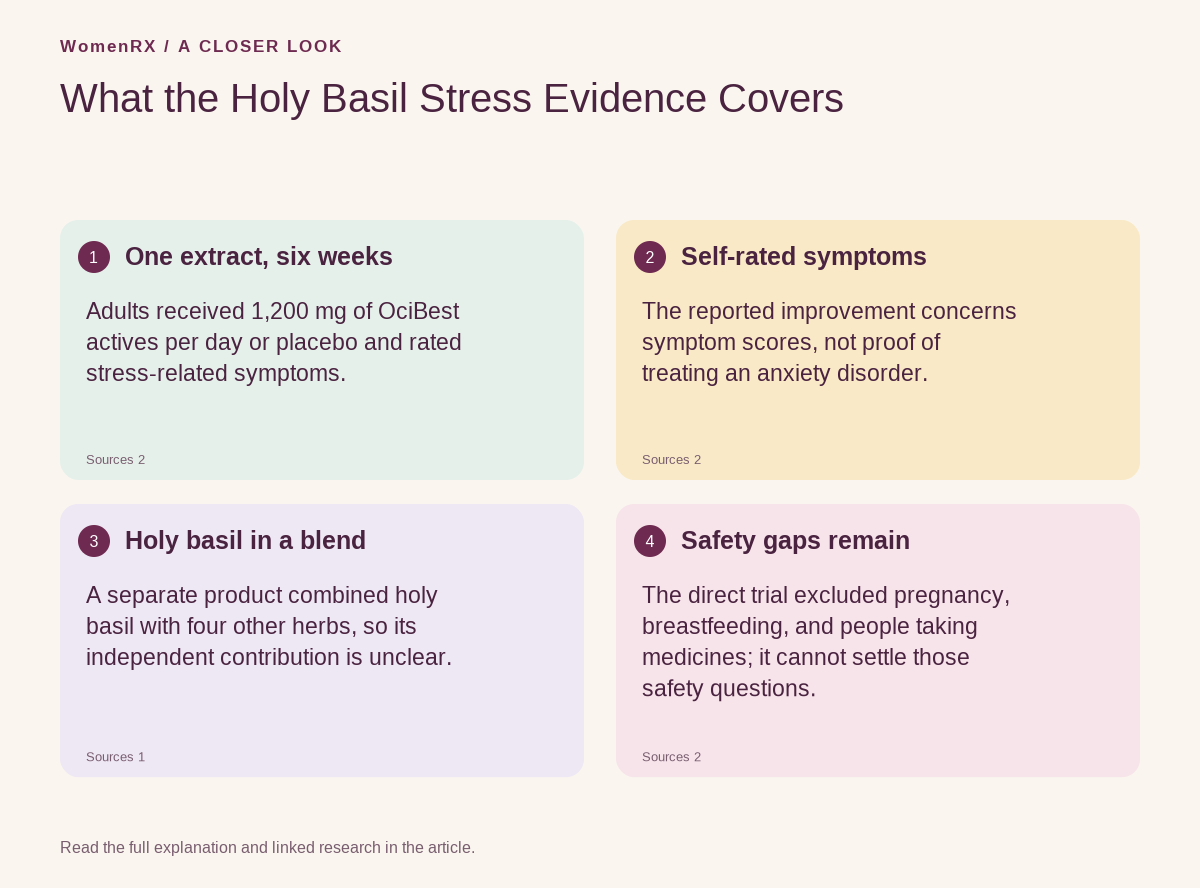
What the Holy Basil Stress Evidence Covers
One extract, six weeks: Adults received 1,200 mg of OciBest actives per day or placebo and rated stress-related symptoms.2
Self-rated symptoms: The reported improvement concerns symptom scores, not proof of treating an anxiety disorder.2
Holy basil in a blend: A separate product combined holy basil with four other herbs, so its independent contribution is unclear.1
Safety gaps remain: The direct trial excluded pregnancy, breastfeeding, and people taking medicines; it cannot settle those safety questions.2
Read the figure as text
The distinction between one direct extract trial, a multi-herb blend, and questions neither design answers.- One extract, six weeks: Adults received 1,200 mg of OciBest actives per day or placebo and rated stress-related symptoms.2
- Self-rated symptoms: The reported improvement concerns symptom scores, not proof of treating an anxiety disorder.2
- Holy basil in a blend: A separate product combined holy basil with four other herbs, so its independent contribution is unclear.1
- Safety gaps remain: The direct trial excluded pregnancy, breastfeeding, and people taking medicines; it cannot settle those safety questions.2
More questions, answered
Does holy basil treat anxiety?
The direct holy basil trial described improvement in self-rated stress-related symptoms; it did not establish holy basil as a treatment for an anxiety disorder. A separate stress trial included holy basil in a multi-herb blend, so it can’t show what holy basil alone contributed. 2 1
Can I use holy basil while pregnant or breastfeeding?
The stress trial excluded people who were pregnant or breastfeeding, so it doesn’t establish safety in either situation. It also doesn’t provide evidence about fertility treatment or hormone-sensitive conditions. 2
Sources you can check
- Effects of multi-herb and ashwagandha root formulas on stress modulation: a randomized, double-blind, placebo-controlled clinical study.McKinney E, Stewart J, Kewalramani R, Singh S. · Trials · 2026Return to first citation
- Efficacy of an Extract of Ocimum tenuiflorum (OciBest) in the Management of General Stress: A Double-Blind, Placebo-Controlled Study.Saxena RC, Singh R, Kumar P, Negi MP, Saxena VS, Geetharani P, Allan JJ, Venkateshwarlu K. · Evidence-based complementary and alternative medicine : eCAM · 2012Return to first citation