Choosing Holy Basil: Evidence and Label Details to Check
Human studies have examined tulsi for psychological stress, but the findings don’t establish which products help or whether results apply specifically to women.
Holy basil, also called tulsi, has been studied in people, including in research on psychological stress. A 2017 review reported favorable outcomes across 24 human studies, but those studies covered several health areas and the review called for clearer evidence on dose, form, and who may benefit. Before choosing a product, check its botanical name, preparation, and amount, and don’t treat general adult findings as proof of safety during pregnancy or breastfeeding. 2
What the human evidence says about stress
Holy basil has more human research behind it than traditional use alone, but the evidence doesn’t translate into a clear recommendation for a particular stress supplement. A 2017 systematic review identified 24 human studies of tulsi and reported favorable clinical outcomes across areas including metabolic health, immunity, and neurocognition. Psychological stress was among the conditions studied. The review also called for more research to clarify dose, dose form, and which populations might benefit. 2
That overall count isn’t the same as 24 stress trials. The studies addressed different conditions, and most involved people with specific acute or chronic illnesses; only three reported effects in healthy participants. The review’s summary doesn’t give a consistent stress-specific effect size or establish that products on today’s shelves match the preparations used in the studies. 2
So a fair takeaway is that stress has been studied in humans, with a promising signal in the review, but the evidence doesn’t tell you that any product labeled “holy basil” will reliably relieve stress. Nor does it establish a best brand or a proven amount to look for.
Read the label as a description, not a promise
A useful label check is whether you can tell what the product actually contains. Look for:
- The botanical name. The review uses Ocimum tenuiflorum and Ocimum sanctum for holy basil. It also describes Ocimum gratissimum as a distinct species, which it calls Vana or wild/forest tulsi. A familiar common name alone may not tell you which plant is meant. 2
- The plant part and preparation. Check whether the label identifies the part of the plant and whether it is an extract, powder, or another form. The review specifically says more research is needed to clarify tulsi’s dose and dose form. 2
- The amount per serving and extract details. These details help you compare products, but a number on a label doesn’t show that the product matches a preparation studied in people. The review notes differences in tulsi types and phytochemical composition, alongside the need for clearer dose and form information. 2
- Other ingredients. Check whether the product combines tulsi with other herbs or ingredients. A result from research on tulsi alone may not apply to a blend; the review excluded studies where tulsi was only part of a polyherbal formulation. 2
These checks help you understand what you’re considering. They don’t establish effectiveness, verify that a product contains what its label says, or identify a superior brand.
What the safety findings do and don’t show
The 2017 review reported no significant adverse events in the human studies it included. That is reassuring as far as it goes, but it doesn’t establish long-term safety or rule out uncommon harms. The review itself called for further work on the populations most likely to benefit. 2
Pregnancy and breastfeeding are particular evidence gaps for decision-making: the review’s reported findings don’t establish safety for either situation. General results from other adults can’t answer that question. If you’re considering tulsi while pregnant or breastfeeding, treat safety as unresolved rather than assuming a supplement is safe because it is an herb.
There is also a distinction between human evidence and laboratory or animal safety tests. One study assessed a standardized holy basil extract in laboratory tests and in animals, including an acute oral toxicity study in rats. Those results are not evidence that a supplement is safe for people over time, or during pregnancy or breastfeeding. 1
A grounded way to choose
If you’re comparing products, favor a label that clearly identifies the plant, its form, the amount, and any added ingredients. Then compare those details with the limits of the human evidence: studies have included tulsi and psychological stress, but the available review doesn’t establish a dependable product-to-product match or a women-specific benefit. 2
That distinction can keep a product’s marketing from doing the work of evidence. “Studied for stress” is not the same as “shown to work in this form, at this amount, for women like me.”
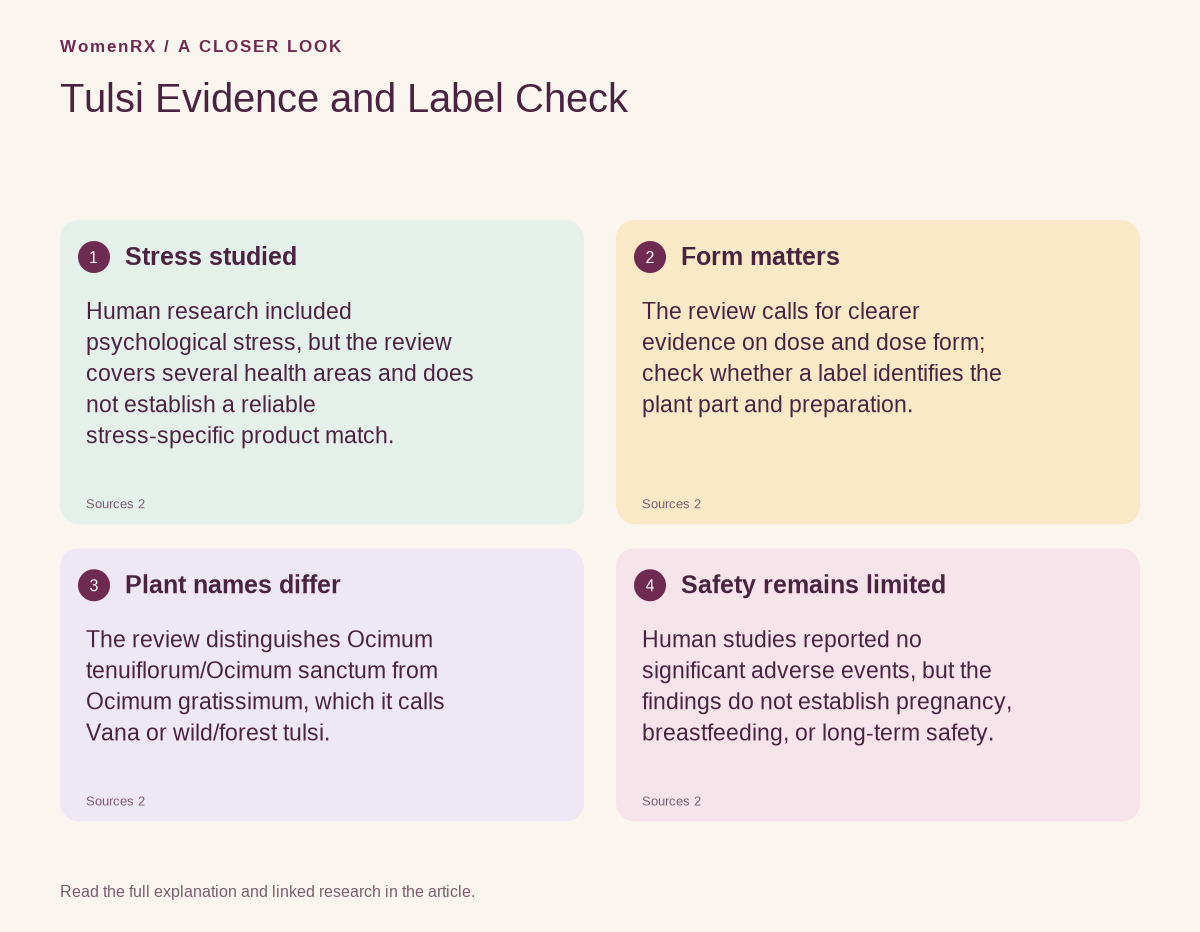
Tulsi Evidence and Label Check
Stress studied: Human research included psychological stress, but the review covers several health areas and does not establish a reliable stress-specific product match.2
Form matters: The review calls for clearer evidence on dose and dose form; check whether a label identifies the plant part and preparation.2
Plant names differ: The review distinguishes Ocimum tenuiflorum/Ocimum sanctum from Ocimum gratissimum, which it calls Vana or wild/forest tulsi.2
Safety remains limited: Human studies reported no significant adverse events, but the findings do not establish pregnancy, breastfeeding, or long-term safety.2
Read the figure as text
Separate what human studies have explored from the product and safety details the evidence does not settle.- Stress studied: Human research included psychological stress, but the review covers several health areas and does not establish a reliable stress-specific product match.2
- Form matters: The review calls for clearer evidence on dose and dose form; check whether a label identifies the plant part and preparation.2
- Plant names differ: The review distinguishes Ocimum tenuiflorum/Ocimum sanctum from Ocimum gratissimum, which it calls Vana or wild/forest tulsi.2
- Safety remains limited: Human studies reported no significant adverse events, but the findings do not establish pregnancy, breastfeeding, or long-term safety.2
More questions, answered
Does holy basil have a women-specific stress benefit?
The human review includes research on psychological stress, but its reported findings don’t establish a women-specific effect or show whether results differ by sex. 2
Does a safety study in animals prove a supplement is safe for people?
No. The reported safety testing involved laboratory tests and animals for one standardized extract. It cannot establish long-term safety in people or answer pregnancy and breastfeeding questions. 1
Sources you can check
- Assessment of genotoxicity and acute oral toxicity of a standardized Ocimum tenuiflorum extract (HolixerTM).Murugan SK, Bethapudi B, Mundkinajeddu D, D'Souza P. · Drug and chemical toxicology · 2025Return to first citation
- The Clinical Efficacy and Safety of Tulsi in Humans: A Systematic Review of the Literature.Jamshidi N, Cohen MM. · Evidence-based complementary and alternative medicine : eCAM · 2017Return to first citation