Breast Tenderness on Menopause Hormone Therapy: What to Monitor
Tenderness may ease for some women, but the timing varies; what matters is how it relates to treatment changes and whether it’s focal or persistent.
Breast tenderness can increase after starting menopausal hormone therapy, and a small trial found it decreased after one month in one specific treatment group. That isn’t a dependable timeline for everyone. Note when symptoms begin, any treatment changes, whether you’re still having periods, and whether pain is focal or persistent. Contact your clinician about a new lump, nipple discharge, or persistent focal pain. 3 5
A change after starting therapy is a clue, not a diagnosis
Tenderness that begins after starting or changing hormone therapy may be related to treatment, but timing alone can’t confirm the cause. Menopausal hormone therapy can contain estrogen alone or estrogen with a progestogen, and plans differ. During perimenopause, hormone levels and periods can fluctuate too. So a symptom pattern can provide useful context, but it can’t measure your hormone levels or tell you whether a breast change is benign. 1 2
There is some direct research on what may happen after treatment begins, but it doesn’t establish a usual settling-in period. In a randomized trial of 96 postmenopausal women, 73 completed the study. In one group taking a specific estradiol valerate and medroxyprogesterone acetate regimen, tenderness rose after treatment and decreased after one month. More than half of all participants reported no tenderness during the study. These results describe a small study of specific regimens, not a promise that tenderness will go away or a deadline for waiting it out. 5
Track the pattern, not just the pain
A short log can help you explain what changed without trying to diagnose why. Record:
- When tenderness began: Note the date and whether it affects one breast or both.
- Treatment context: Write down when you started therapy or when its type, dose, or schedule changed, if you know.
- Where and how it feels: Is it spread across an area, or concentrated in one spot? Does it come and go or persist?
- Cycle context: If you still have periods, note whether tenderness seems to recur around them. Perimenopause can bring irregular periods, so the pattern may not be predictable. 2
- Other changes: Record any lump or nipple discharge, and note vaginal bleeding separately. If you have reached menopause, include that context; menopause is defined as 12 months without a period. 2
You don’t need to wait for a particular number of weeks before raising a concern. If tenderness is persistent, worsening, or bothersome enough to make you question your regimen, contact the clinician who prescribed it to discuss whether the plan needs reassessment. Hormone therapy is individualized and should be periodically reevaluated. Don’t use tenderness alone to decide that a particular hormone level is too high or to change your treatment. 4
The breast-pain pattern matters
Pain that is diffuse, nonfocal, or cyclical generally doesn’t call for imaging beyond routine screening. Persistent pain in one specific area that isn’t cyclical is a different pattern: clinical assessment and imaging may be appropriate, depending on age and circumstances. Breast pain by itself is rarely associated with cancer, but a lump or nipple discharge changes the clinical picture. Contact your clinician about these findings rather than using timing to decide what they mean. 3
The practical distinction is between a symptom that may be worth discussing in relation to a treatment change and a breast finding that needs its own assessment. A log can help show both. It can’t determine the cause, and tenderness alone doesn’t prove a particular hormone level or breast disease.
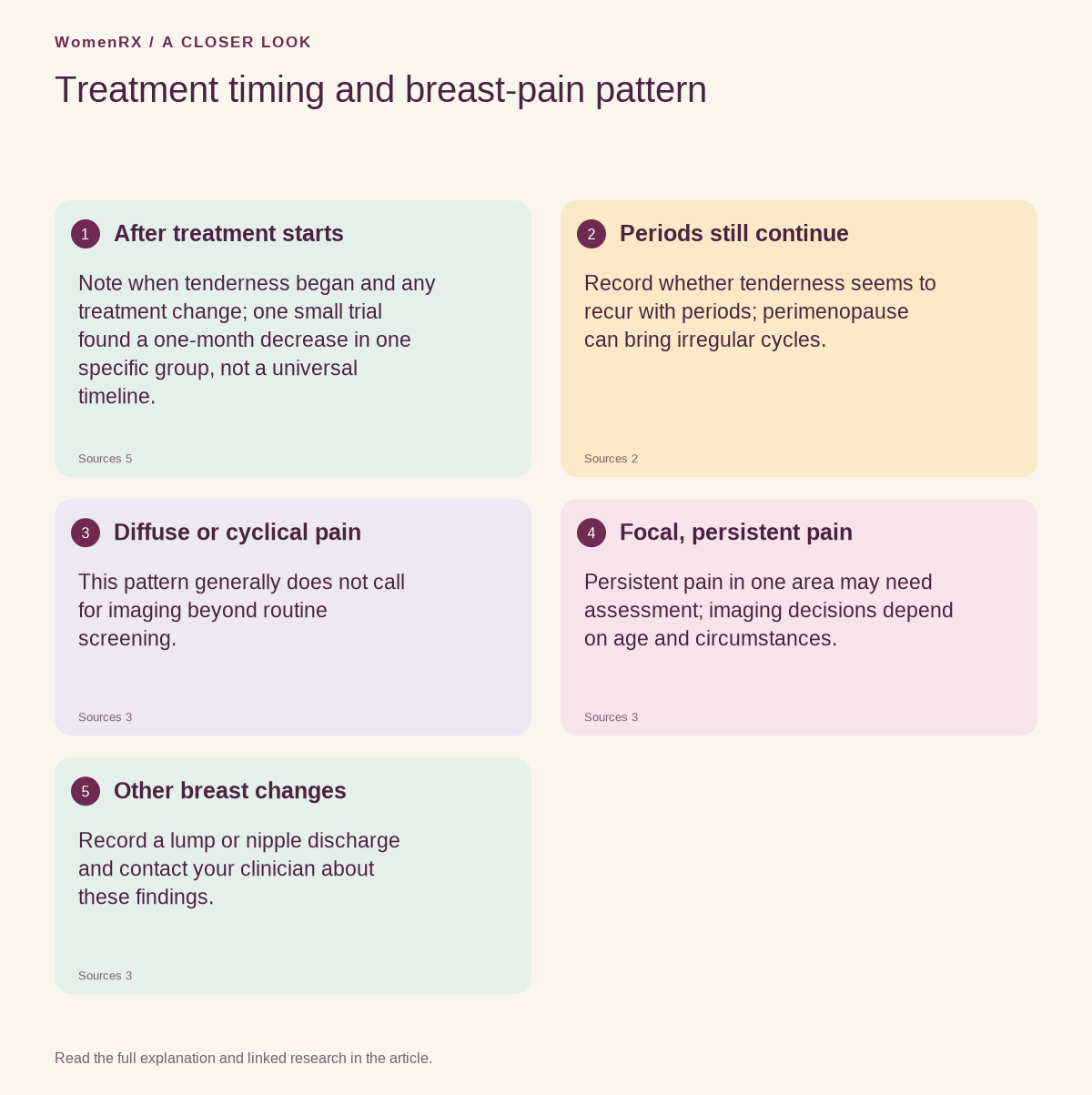
Treatment timing and breast-pain pattern
After treatment starts: Note when tenderness began and any treatment change; one small trial found a one-month decrease in one specific group, not a universal timeline.5
Periods still continue: Record whether tenderness seems to recur with periods; perimenopause can bring irregular cycles.2
Diffuse or cyclical pain: This pattern generally does not call for imaging beyond routine screening.3
Focal, persistent pain: Persistent pain in one area may need assessment; imaging decisions depend on age and circumstances.3
Other breast changes: Record a lump or nipple discharge and contact your clinician about these findings.3
Read the figure as text
These are two useful parts of the picture to record. Neither timing nor pain pattern alone diagnoses the cause.- After treatment starts: Note when tenderness began and any treatment change; one small trial found a one-month decrease in one specific group, not a universal timeline.5
- Periods still continue: Record whether tenderness seems to recur with periods; perimenopause can bring irregular cycles.2
- Diffuse or cyclical pain: This pattern generally does not call for imaging beyond routine screening.3
- Focal, persistent pain: Persistent pain in one area may need assessment; imaging decisions depend on age and circumstances.3
- Other breast changes: Record a lump or nipple discharge and contact your clinician about these findings.3
More questions, answered
Does breast tenderness mean my hormone dose is too high?
Not by itself. Tenderness can be recorded as context when discussing your treatment, but it doesn’t establish a specific hormone level or show that a dose needs changing. If it persists or bothers you, discuss the pattern with your prescriber rather than changing the regimen based on tenderness alone. 4 5
Does breast pain always need imaging?
No. Diffuse, nonfocal, or cyclical pain generally doesn’t need imaging beyond routine screening. Persistent pain in one specific area may warrant clinical assessment and imaging, depending on age and circumstances. 3
Sources you can check
- Hormone Therapy for Menopause | MedlinePlusAccessed 2026-09-25Return to first citation
- Menopause | Menopause Symptoms | MedlinePlusAccessed 2026-09-25Return to first citation
- ACR Appropriateness Criteria® Breast Pain.Expert Panel on Breast Imaging:, Holbrook AI, Moy L, Akin EA, Baron P, Didwania AD, Heller SL, Le-Petross HT, Lewin AA, Lourenco AP, Mehta TS, Niell BL, Slanetz PJ, Stuckey AR, Tus... · Journal of the American College of Radiology : JACR · 2018Return to first citation
- The 2022 hormone therapy position statement of The North American Menopause Society.“The 2022 Hormone Therapy Position Statement of The North American Menopause Society” Advisory Panel. · Menopause (New York, N.Y.) · 2022Return to first citation
- Influence of hormone therapy or C. foetida extract on breast tenderness in postmenopausal women.Gao L, Zuo H, Zheng T, Xue W, Wang Y, Deng Y, Sun A. · Climacteric : the journal of the International Menopause Society · 2018Return to first citation