What Alternatives Can Help Before Trying Testosterone for Low Sexual Desire?
Low desire around menopause can have several overlapping causes, so the next step is to match possible support to what’s actually getting in the way.
Before considering testosterone, look at what changed and what feels most difficult: pain or dryness, a medication’s effects, mood, or relationship context may all matter. Options can include treating vaginal symptoms, reviewing medicines with the prescriber, or seeking support for sexual distress. These approaches address different concerns, and none guarantees desire will change. If low desire remains distressing, ask whether testosterone is relevant and what benefits, uncertainties, and tradeoffs apply. 1 3 5 7
A change in sexual desire around perimenopause or after menopause doesn’t automatically point to a hormone problem. Desire is one part of sexual function, alongside arousal, orgasm, satisfaction, and pain. Menopause-related concerns can reflect a mix of biological, emotional, and relationship factors, so it helps to identify what has changed before choosing what to address. 5
First, name the part that’s bothering you
For example, you might still want closeness but find sex painful, feel less interested in sex generally, or feel distressed because your desire has changed. Those experiences can overlap, but they don’t necessarily call for the same approach. A menopause-focused review describes these as distinct areas of sexual function and emphasizes that they can be affected by multiple factors. 5
It’s also worth separating your own concern from pressure to want sex more often. The useful question is whether the change is bothering you and what you would like to be different, not whether your desire matches someone else’s expectations.
If sex is uncomfortable, address discomfort directly
Vaginal dryness or pain with sex can make intimacy less appealing. When these symptoms fit genitourinary syndrome of menopause (GSM), treating the vaginal symptoms may be a more targeted first step than focusing only on desire. 3 6
The North American Menopause Society’s 2022 position statement lists low-dose vaginal estrogen, vaginal dehydroepiandrosterone, and oral ospemifene as options for some women with bothersome GSM symptoms that haven’t improved with over-the-counter therapies, when systemic hormone therapy isn’t indicated. The best-supported sexual benefit of local vaginal estrogen is improvement in pain with sex; evidence is less complete for its effect on overall sexual experience. Easing pain may remove one barrier to intimacy, but it doesn’t guarantee that desire will return. 3 6
Review medicines and mood as separate pieces
Medicines can affect sexual desire or performance. If a change in desire began around the time a medicine was started or adjusted, discuss that timing and the tradeoffs with the prescriber rather than changing treatment on your own. Selective serotonin reuptake inhibitors (SSRIs) and serotonin-norepinephrine reuptake inhibitors (SNRIs), used for depression or anxiety, can have reduced sex drive as a side effect. 1 2
Mood matters in its own right, too. Support for depression or anxiety may be worthwhile even if it doesn’t solve every sexual concern. And if mood treatment may be affecting desire, that’s a reason to review the overall plan, not to assume you have to choose between emotional well-being and sexual well-being. 2 5
Stress, communication, and relationship dynamics may also be part of the picture. A review of menopause-related sexual function describes these alongside biological factors; it doesn’t mean a relationship issue must be present or that one kind of support suits everyone. If this feels relevant, psychosexual support or therapy may be an option to discuss. 5
What support for distress can look like
For some women, support focused on sexual concerns may help even when pain or medication effects aren’t the whole story. In a pilot study, 32 peri- or postmenopausal women completed a four-session cognitive behavioral therapy program after a waitlist period. Participants reported improvements in sexual functioning and distress after treatment. The small study offers preliminary evidence, not a guarantee that the program will work for everyone. 7
If hot flashes or night sweats are also affecting your well-being, raise them as their own concern. Treatments studied for menopause symptoms such as hot flashes are not automatically treatments for low desire. The North American Menopause Society’s nonhormone therapy statement focuses on vasomotor symptoms, not low desire. 4
When to ask about testosterone
If desire remains distressing after you’ve considered these possible contributors, it’s reasonable to ask whether testosterone is relevant to your situation. You might ask: “What change could I realistically expect, what are the uncertainties and tradeoffs, and how would we decide whether it’s helping?” The answer should account for your specific concern, rather than treating a change in desire as proof that testosterone is the cause or the preferred solution.
You don’t have to rule out other options first. The point is to understand what you hope to improve, address any factors that matter to you, and make a decision that reflects your priorities.
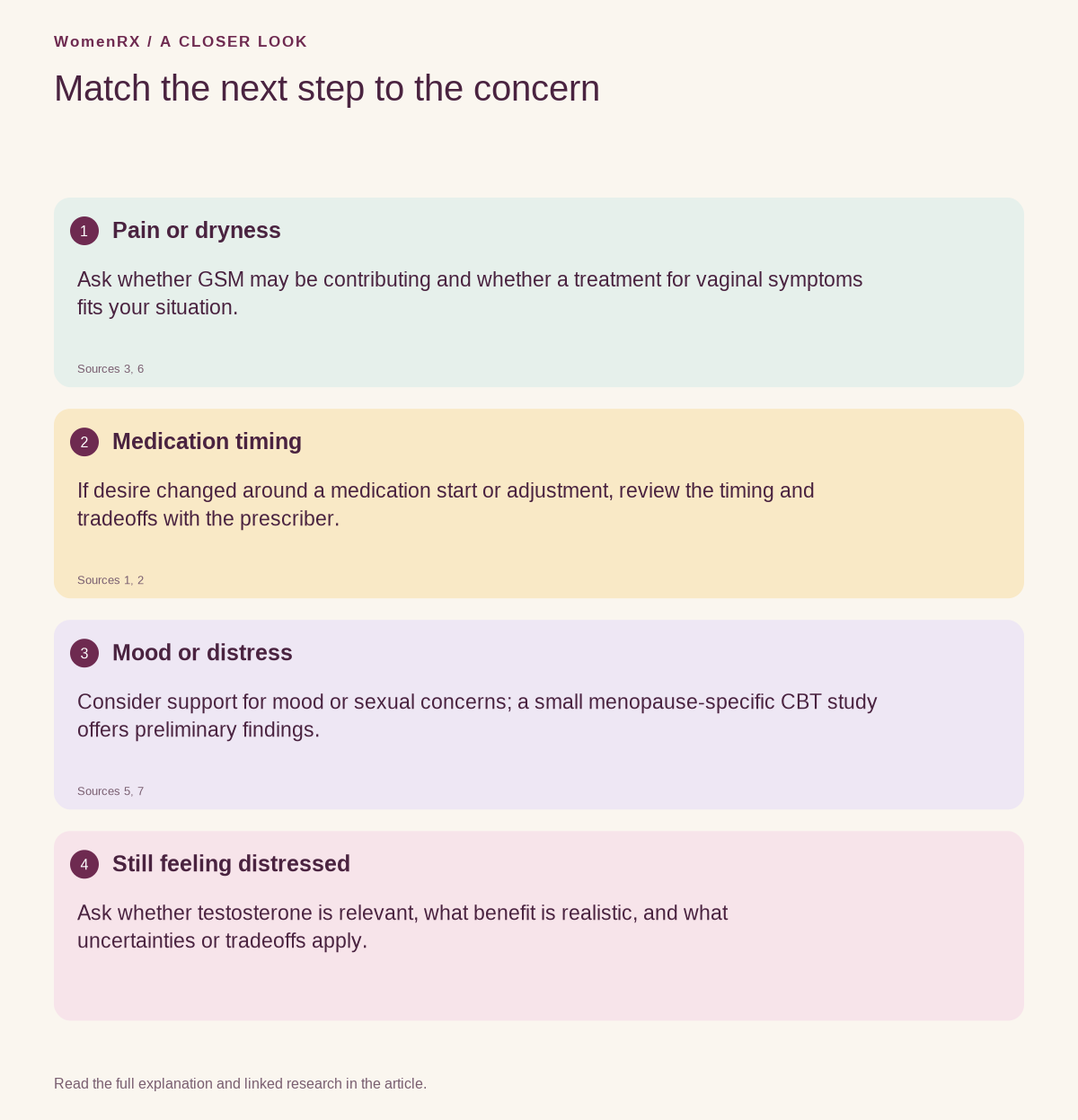
Match the next step to the concern
Pain or dryness: Ask whether GSM may be contributing and whether a treatment for vaginal symptoms fits your situation.36
Medication timing: If desire changed around a medication start or adjustment, review the timing and tradeoffs with the prescriber.12
Mood or distress: Consider support for mood or sexual concerns; a small menopause-specific CBT study offers preliminary findings.57
Still feeling distressed: Ask whether testosterone is relevant, what benefit is realistic, and what uncertainties or tradeoffs apply.
Read the figure as text
Several factors can overlap. Use the concern that feels most relevant as a starting point for considering what to address.- Pain or dryness: Ask whether GSM may be contributing and whether a treatment for vaginal symptoms fits your situation.36
- Medication timing: If desire changed around a medication start or adjustment, review the timing and tradeoffs with the prescriber.12
- Mood or distress: Consider support for mood or sexual concerns; a small menopause-specific CBT study offers preliminary findings.57
- Still feeling distressed: Ask whether testosterone is relevant, what benefit is realistic, and what uncertainties or tradeoffs apply.
More questions, answered
If vaginal dryness or pain improves, will desire come back?
Not necessarily. Treating vaginal symptoms may reduce one physical barrier, but desire can also be affected by mood, medicines, relationship context, and other factors. Evidence for local vaginal estrogen is clearest for pain with sex, with less information about its effect on the overall sexual experience. 5 6
Could an antidepressant affect sexual desire?
SSRIs and SNRIs can have reduced sex drive as a side effect. If you think the timing fits, discuss the tradeoff with the prescriber before making changes to your treatment. 2
Sources you can check
- Sexual Health | MedlinePlusAccessed 2026-09-25Return to first citation
- Other medicines for menopause symptoms - NHSAccessed 2026-09-25Return to first citation
- The 2022 hormone therapy position statement of The North American Menopause Society.“The 2022 Hormone Therapy Position Statement of The North American Menopause Society” Advisory Panel. · Menopause (New York, N.Y.) · 2022Return to first citation
- The 2023 nonhormone therapy position statement of The North American Menopause Society.Menopause (New York, N.Y.) · 2023Return to first citation
- Sexual Function Through Menopause: A Review of Basic Evaluation and Treatment.Pope R. · BJOG : an international journal of obstetrics and gynaecology · 2025Return to first citation
- Sexual function after menopause: the role of vaginal estrogens.Cucinella L, Cassani C, Martini E, Parrotta GE, Monne G, Colombo GM, Morteo V, Nappi RE. · Maturitas · 2025Return to first citation
- Cognitive behavioural therapy for sexual concerns during menopause: evaluation of a four session protocol.Green SM, Furtado M, Shea AK, Ballantyne EC, Streiner DL, Frey BN, McCabe RE. · The journal of sexual medicine · 2025Return to first citation