Crying More During Perimenopause: What to Watch For
Perimenopause can be a time of greater vulnerability to mood symptoms, but frequent crying alone doesn’t tell you why it’s happening or diagnose depression.
Mood changes can happen during perimenopause, and research suggests depression symptoms and disorders are more common in the transition than before it. But crying by itself doesn’t establish depression, and hormones aren’t the only possible influence. Pay attention to whether low mood or anxiety persists, affects daily life, or comes with other changes such as sleep or appetite shifts. Seek support for persistent or disruptive symptoms, and act right away if you may harm yourself. 4 2
Crying more easily can feel unsettling, especially if it’s new for you. Perimenopause may be part of the picture: a review of four longitudinal studies found that women in the perimenopausal and postmenopausal stages had a higher risk of depression symptoms or disorders than premenopausal women. That’s an increased risk, not a prediction that every woman will become depressed. 4
Crying alone can’t tell you whether you have depression, and it doesn’t explain what’s behind the change. Mood can also be affected by what’s happening in your life. A review of 17 studies associated stressful life events and chronic stress with depression during perimenopause. It also identified social support as a factor associated with protection against depression and anxiety, while noting that research on factors associated with perimenopausal anxiety is limited. These findings describe associations, not proof that any one factor causes an individual’s symptoms. 5
Look at the pattern, not just the tears
Notice whether the change is brief or keeps returning, and whether you’re still able to do the things that matter to you. Persistent sadness or hopelessness, changes in sleep, appetite, mood, or energy, social withdrawal, and thoughts or behaviors that interfere with work, family, or social life are reasons to take your mental health seriously. None of these signs alone establishes a diagnosis, but together they can help show when extra support may be useful. 2
Sleep is worth mentioning, too. Sleep changes can be part of a broader mental-health symptom picture, but they don’t tell you on their own whether the cause is perimenopause, depression, anxiety, or something else. 2
Try a simple check-in rather than looking for a magic number of days: When did this begin? Is it easing, recurring, or getting harder to manage? What has changed in your sleep, energy, or appetite? Is it affecting your relationships, work, or usual routines? This isn’t a diagnostic test. It’s a way to describe what’s happening clearly if you decide to ask for help.
When to reach out for support
If sadness or anxiety is persistent, worsening, or interfering with daily life, you don’t have to wait until you can name the cause. A primary care provider can be a starting point and can help connect you with a mental-health professional. Mental-health conditions can be treated; talk therapy and/or medication may be part of treatment depending on the situation. 2 3
For a care conversation, you might say: “I’ve been crying more often, and it’s affecting . This started around . I’ve also noticed changes in my sleep, energy, or appetite.” You can also mention major stressors, whether you’ve experienced depression or anxiety before, and what kind of help you’re hoping to discuss. Past mental-health history and stressful life events were among the factors associated with perimenopausal mood symptoms in a review, so this context may help make the conversation more complete. 5
If you’re thinking about killing yourself or feel you may act to harm yourself, get help right away. Call or text 988 in the United States to reach the Suicide & Crisis Lifeline. If there’s an immediate emergency, call 911. 1
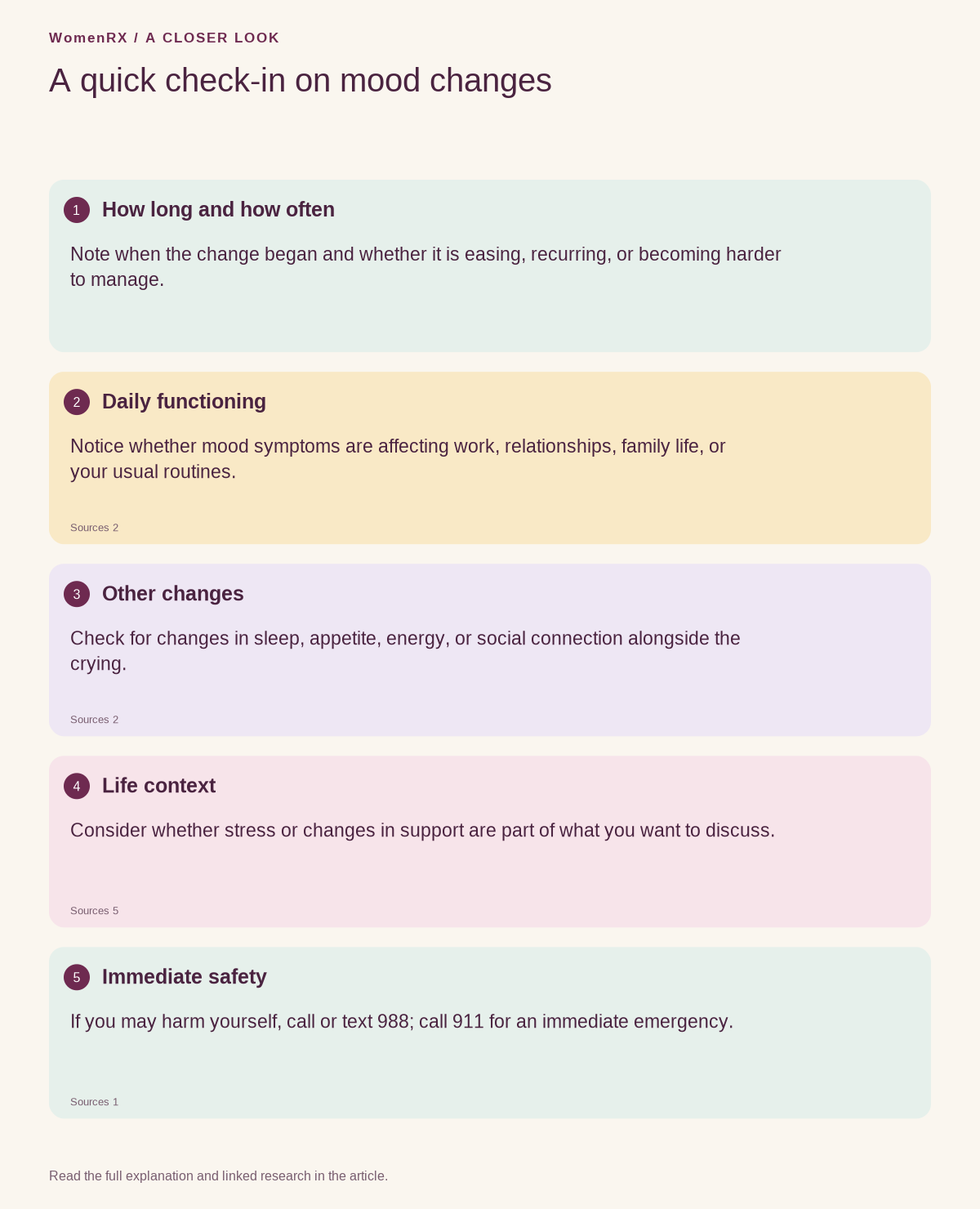
A quick check-in on mood changes
How long and how often: Note when the change began and whether it is easing, recurring, or becoming harder to manage.
Daily functioning: Notice whether mood symptoms are affecting work, relationships, family life, or your usual routines.2
Other changes: Check for changes in sleep, appetite, energy, or social connection alongside the crying.2
Life context: Consider whether stress or changes in support are part of what you want to discuss.5
Immediate safety: If you may harm yourself, call or text 988; call 911 for an immediate emergency.1
Read the figure as text
These prompts help you describe the pattern and decide whether to seek support. They are not a diagnostic score.- How long and how often: Note when the change began and whether it is easing, recurring, or becoming harder to manage.
- Daily functioning: Notice whether mood symptoms are affecting work, relationships, family life, or your usual routines.2
- Other changes: Check for changes in sleep, appetite, energy, or social connection alongside the crying.2
- Life context: Consider whether stress or changes in support are part of what you want to discuss.5
- Immediate safety: If you may harm yourself, call or text 988; call 911 for an immediate emergency.1
More questions, answered
Can I start by talking with my primary care provider?
Yes. The National Institute of Mental Health identifies primary care as a good place to start; a provider can help you consider next steps or refer you to a mental-health professional. 2
Sources you can check
- Suicide: MedlinePlusAccessed 2026-09-25Return to first citation
- NIMH: Women and mental healthAccessed 2026-09-25Return to first citation
- Mental Health: MedlinePlusAccessed 2026-09-25Return to first citation
- Cognition and mood in perimenopause: a systematic review and meta-analysis.Weber MT, Maki PM, McDermott MP. · The Journal of steroid biochemistry and molecular biology · 2014Return to first citation
- Protective and harmful social and psychological factors associated with mood and anxiety disorders in perimenopausal women: A narrative review.McElhany K, Aggarwal S, Wood G, Beauchamp J. · Maturitas · 2024Return to first citation