Paroxetine for Hot Flashes: What to Review First
The key questions are whether you’ve recently taken an MAOI, what other medicines you use, and which health conditions need a closer look.
Before taking paroxetine for hot flashes, review your medicines, health history, and pregnancy possibility with the prescriber. Use with a monoamine oxidase inhibitor (MAOI), or within the specified 14-day separation, is a product-specific contraindication. Also disclose tamoxifen, other serotonin-affecting medicines, past serotonin syndrome or neuroleptic syndrome, and relevant health conditions. These details don’t all carry the same restriction. 12
Start with the medicine list
Bring the names of everything you take, including prescriptions, over-the-counter medicines, and supplements. The distinction that matters most is between a combination the product information says not to use and one that calls for a closer review.
One explicit contraindication identified in the product information is MAOI use. The US prescribing information for low-dose paroxetine for menopausal hot flashes says it must not be used with an MAOI or within 14 days of stopping one. It also specifies a 14-day separation before starting an MAOI after stopping paroxetine. Its patient instructions name the antibiotic linezolid and intravenous methylene blue when explaining this warning. If either has been part of your recent care, or you’re unsure whether a medicine is an MAOI, say so before starting paroxetine. 1
Other medicines can increase serotonin-syndrome risk without all being subject to that same MAOI restriction. Examples named in the product information include triptans used for migraine, tramadol, fentanyl, methadone, lithium, buspirone, amphetamines, some other antidepressants, and St. John’s wort. Ask for a check of the specific combination rather than assuming that every medicine on this list has the same rule. 1
Serotonin syndrome can involve changes in thinking or behavior, fever or heavy sweating, tremor or stiff muscles, and nausea, vomiting, or diarrhea. Get medical help right away for symptoms such as high fever, uncontrolled muscle spasms, confusion, rapidly changing heart rate or blood pressure, or loss of consciousness. 1
Mention tamoxifen before choosing a hot-flash treatment
Tamoxifen needs its own conversation. Paroxetine strongly inhibits CYP2D6, an enzyme that helps convert tamoxifen into its active metabolite, endoxifen. A clinical review describes concern that the combination could reduce tamoxifen’s effectiveness and notes recommendations to use caution or prefer a different treatment for hot flashes. This is a reason to consider alternatives with the prescriber managing your care, not a reason to change tamoxifen yourself. 12
Paroxetine can also affect the processing of other medicines that rely on CYP2D6. You don’t need to identify those medicines on your own. A complete list lets the prescriber or pharmacist check. 1
Distinguish reaction history from health cautions
Tell the prescriber if you’ve had serotonin syndrome or neuroleptic syndrome. A clinical review lists serotonin syndrome among general contraindication concerns for SSRIs and SNRIs and specifically mentions prior neuroleptic syndrome. It does not clarify how a past episode of serotonin syndrome should affect a new treatment decision, so that history needs an individual assessment. 2
The review also flags bipolar disorder, uncontrolled seizures, liver or kidney insufficiency, uncontrolled low blood sodium, and poorly controlled high blood pressure as matters for prescriber consideration. These are cautions to discuss, not a list that automatically rules out treatment for everyone with one of these conditions. Whether a condition is controlled and what else you take can change the discussion. 2
Mention a history of depression, suicide attempts, or another psychiatric condition, too. The clinical review notes that low-dose paroxetine studies for hot flashes did not include women with those histories. That leaves a gap in how directly the trial findings apply; it does not, by itself, decide whether paroxetine is suitable for you. 2
If pregnancy is possible or you’re planning it, bring that up before choosing a treatment. Ask how it affects the decision rather than assuming the medicine-interaction review answers that question.
Agree on what to watch for after starting
In studies summarized by a clinical review, nausea, fatigue, and dizziness were among the more commonly reported effects of low-dose paroxetine. Muscle cramps or twitching, restless-leg feelings, and insomnia were among reasons some participants stopped treatment. Knowing which changes to report gives you a more useful follow-up plan than simply waiting to see how you feel. 2
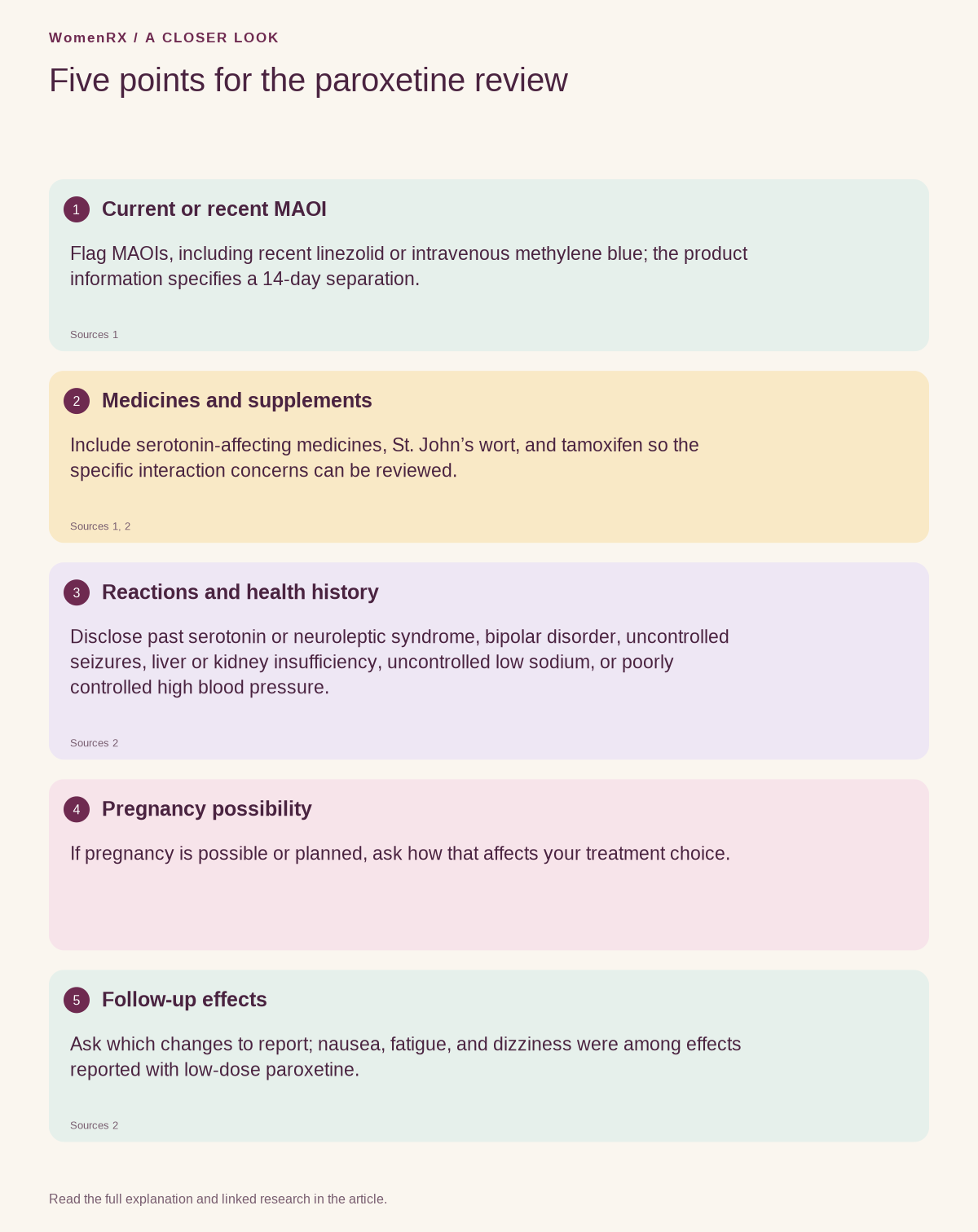
Five points for the paroxetine review
Current or recent MAOI: Flag MAOIs, including recent linezolid or intravenous methylene blue; the product information specifies a 14-day separation.1
Medicines and supplements: Include serotonin-affecting medicines, St. John’s wort, and tamoxifen so the specific interaction concerns can be reviewed.12
Reactions and health history: Disclose past serotonin or neuroleptic syndrome, bipolar disorder, uncontrolled seizures, liver or kidney insufficiency, uncontrolled low sodium, or poorly controlled high blood pressure.2
Pregnancy possibility: If pregnancy is possible or planned, ask how that affects your treatment choice.
Follow-up effects: Ask which changes to report; nausea, fatigue, and dizziness were among effects reported with low-dose paroxetine.2
Read the figure as text
Use these prompts to organize a conversation before treatment. They are not a diagnostic score or a list of automatic disqualifiers.- Current or recent MAOI: Flag MAOIs, including recent linezolid or intravenous methylene blue; the product information specifies a 14-day separation.1
- Medicines and supplements: Include serotonin-affecting medicines, St. John’s wort, and tamoxifen so the specific interaction concerns can be reviewed.12
- Reactions and health history: Disclose past serotonin or neuroleptic syndrome, bipolar disorder, uncontrolled seizures, liver or kidney insufficiency, uncontrolled low sodium, or poorly controlled high blood pressure.2
- Pregnancy possibility: If pregnancy is possible or planned, ask how that affects your treatment choice.
- Follow-up effects: Ask which changes to report; nausea, fatigue, and dizziness were among effects reported with low-dose paroxetine.2
More questions, answered
Does a condition on the caution list mean I can’t take paroxetine?
Not necessarily. The clinical review identifies several conditions that call for closer consideration, but does not present each as an automatic restriction. MAOI use, by contrast, is a specific contraindication in the product information. 12
Sources you can check
- BRISDELLE (PAROXETINE) CAPSULE [LEGACY PHARMA USA, INC.] | US prescribing information and patient instructionsAccessed 2026-09-25Return to first citation
- A Clinical Review on Paroxetine and Emerging Therapies for the Treatment of Vasomotor Symptoms.David PS, Smith TL, Nordhues HC, Kling JM. · International journal of women's health · 2022Return to first citation