Hot Flashes and Thyroid Symptoms: What to Check
A heat episode alone can’t identify its cause; cycle changes and other symptoms may help guide a discussion about thyroid testing.
Hot flashes alone can’t tell you whether your thyroid is involved. Periods may become irregular as menopause approaches, and thyroid problems can also affect menstrual patterns. Note what the heat feels like, what other symptoms come with it, and how your cycle has changed. A clinician can use that context to decide whether thyroid blood tests make sense. 23
Start with the pattern, not one symptom
A heat episode by itself can’t tell you whether your thyroid is involved. Irregular periods become more likely as menopause approaches, and thyroid problems can also cause irregular periods. The timing of a cycle change and what else is happening in your body can help guide a conversation about whether testing is appropriate. 2
It may help to distinguish a heat episode that comes and goes from feeling unusually hot much of the time. That distinction isn’t a diagnostic test. It gives your clinician a clearer description to consider alongside other symptoms and your health history.
Look for symptoms that travel together
An overactive thyroid can be associated with heat intolerance and sweating, as well as palpitations, tremor, anxiety, disturbed sleep, and weight loss. An underactive thyroid is more often associated with fatigue, feeling cold, weight gain, constipation, and dry skin. These are tendencies, not a checklist: any one symptom can have other causes, and symptoms alone can’t confirm a thyroid disorder. 3
Changes in periods need context, too. Irregular cycles can occur as menopause approaches, and thyroid problems can also contribute. If your cycle has changed, note what changed rather than assuming it points to one cause. 2
Make a short, useful record
You don’t need a detailed diary. For a few representative episodes, jot down:
- What happened: a sudden wave of heat, ongoing heat intolerance, sweating, or both.
- When and how often: when it started, how often it occurs, and whether anything seemed to bring it on.
- What came with it: for example, palpitations or tremor, or fatigue, constipation, and feeling cold at other times. These symptoms can help describe the pattern, but they don’t diagnose thyroid disease. 3
- What changed in your cycle: whether periods are less predictable or your usual pattern has changed. Irregular periods can occur near menopause and can also have causes such as thyroid problems. 2
This is practical context, not a validated scoring tool. You can also mention any known thyroid condition or thyroid tests you’ve had, if applicable. The goal is to make the pattern easier to explain, not to decide the cause on your own.
What thyroid testing can clarify
Thyroid blood tests measure hormone levels and help diagnose or investigate thyroid disease. TSH, or thyroid-stimulating hormone, is usually the first test ordered; T4 measures a thyroid hormone in the blood. The right tests depend on the clinical situation, so a hot flash by itself doesn’t establish that testing is needed. 1
A useful question is: “Given my cycle changes and these other symptoms, would a thyroid test help check for a cause?” You can ask which test is being considered and what the result would help clarify. That keeps the discussion focused on your symptoms rather than on trying to match yourself to a list.
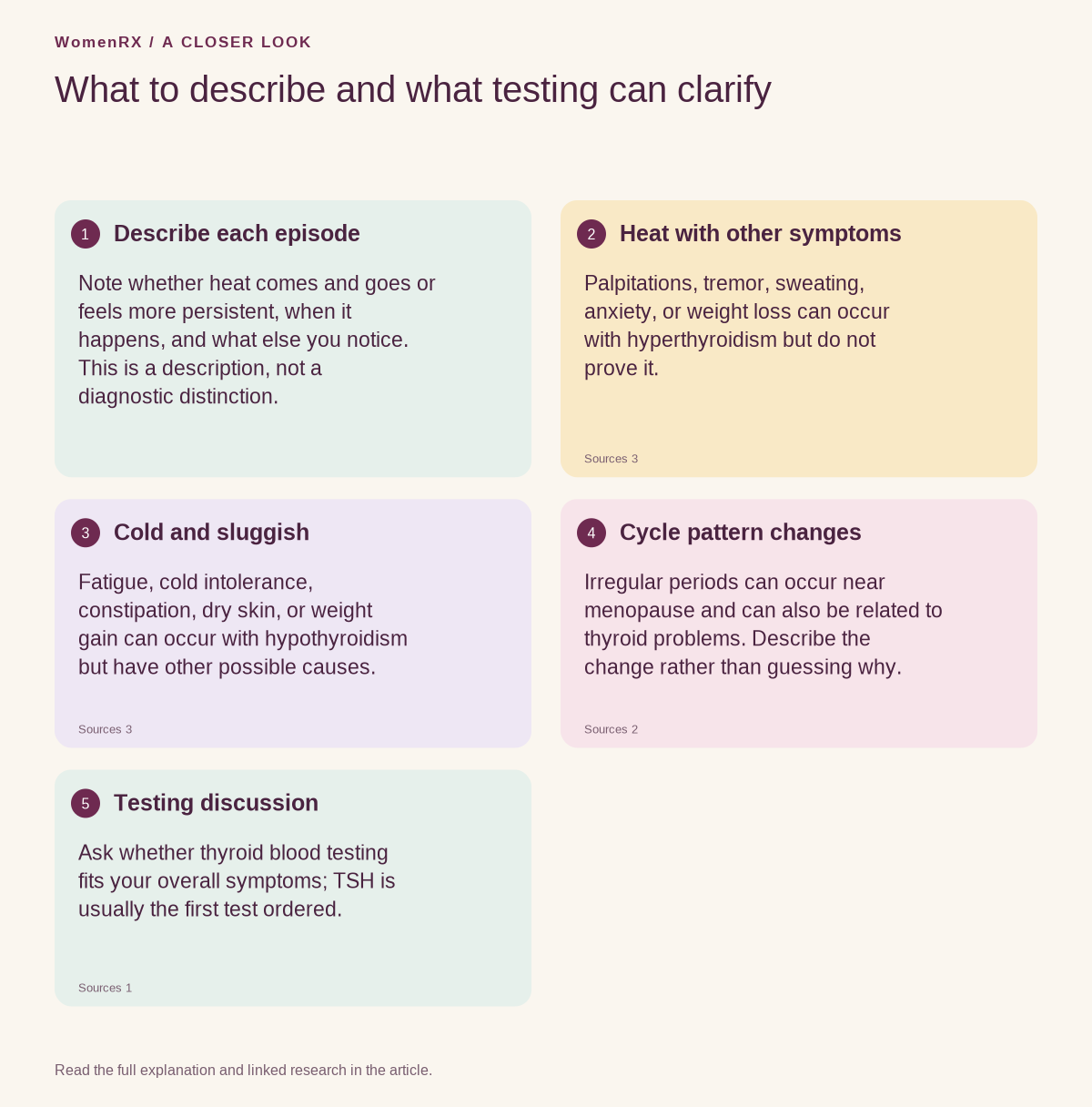
What to describe and what testing can clarify
Describe each episode: Note whether heat comes and goes or feels more persistent, when it happens, and what else you notice. This is a description, not a diagnostic distinction.
Heat with other symptoms: Palpitations, tremor, sweating, anxiety, or weight loss can occur with hyperthyroidism but do not prove it.3
Cold and sluggish: Fatigue, cold intolerance, constipation, dry skin, or weight gain can occur with hypothyroidism but have other possible causes.3
Cycle pattern changes: Irregular periods can occur near menopause and can also be related to thyroid problems. Describe the change rather than guessing why.2
Testing discussion: Ask whether thyroid blood testing fits your overall symptoms; TSH is usually the first test ordered.1
Read the figure as text
Organize these different pieces of information for a conversation about your symptoms. None identifies the cause on its own.- Describe each episode: Note whether heat comes and goes or feels more persistent, when it happens, and what else you notice. This is a description, not a diagnostic distinction.
- Heat with other symptoms: Palpitations, tremor, sweating, anxiety, or weight loss can occur with hyperthyroidism but do not prove it.3
- Cold and sluggish: Fatigue, cold intolerance, constipation, dry skin, or weight gain can occur with hypothyroidism but have other possible causes.3
- Cycle pattern changes: Irregular periods can occur near menopause and can also be related to thyroid problems. Describe the change rather than guessing why.2
- Testing discussion: Ask whether thyroid blood testing fits your overall symptoms; TSH is usually the first test ordered.1
More questions, answered
Does a hot flash mean I have a thyroid problem?
No. A hot flash by itself can’t diagnose thyroid disease. Thyroid blood tests are used to investigate thyroid function; whether testing fits depends on your symptoms and clinical context. 13
What is TSH?
TSH stands for thyroid-stimulating hormone. It is usually the first thyroid blood test ordered; T4 testing measures a thyroid hormone and may also be part of the evaluation. 1
Sources you can check
- Thyroid Tests: MedlinePlusAccessed 2026-09-25Return to first citation
- Irregular periods - NHSAccessed 2026-09-25Return to first citation
- Local symptoms of Hashimoto's thyroiditis: A systematic review.Yuan J, Qi S, Zhang X, Lai H, Li X, Xiaoheng C, Li Z, Yao S, Ding Z. · Frontiers in endocrinology · 2022Return to first citation