Can Telehealth Handle Your Concern, or Just Start Care?
A remote visit may settle your question, help you choose a treatment, or reveal that you need an exam, test, or another clinician.
Telehealth can be useful for discussing symptoms, reviewing treatment options, and, in some cases, getting a prescription. It can’t always provide the exam or lab test needed to make a diagnosis. Before choosing a service labeled “hormones” or “weight loss,” look at what your concern requires and how the service handles care it can’t complete remotely. 1
A service’s headline tells you what it talks about, not necessarily what it can finish. The better way to judge a remote visit is by the task: Do you need a conversation and plan, a physical exam or test, a treatment decision, or a handoff to someone else?
When a conversation may be enough
Telehealth can include general care, discussions about symptoms, and prescriptions. A virtual visit may be particularly useful when you can describe the concern, share relevant history, and make a plan with the clinician without a hands-on examination. That doesn’t mean every remote visit ends with a diagnosis or prescription. Sometimes the useful result is learning what information is missing. 1
For example, if you’re seeking help with bothersome hot flashes, a remote conversation can cover how much they affect your sleep and daily life and which treatments might fit your health history. Menopause hormone therapy is the most effective treatment for hot flashes and night sweats, but the choice depends on individual benefits and risks. Evidence-based nonhormone options for these symptoms also exist. A “hormones” service that discusses only one type of treatment may not cover the full decision you’re trying to make. 34
The symptom can change the menopause discussion
“Menopause symptoms” isn’t one care task. Hot flashes and night sweats raise different treatment questions from vaginal dryness or discomfort. For bothersome vaginal and urinary symptoms of menopause that haven’t improved with over-the-counter measures, the Menopause Society recommends considering low-dose vaginal estrogen or certain other treatments when systemic hormone therapy isn’t otherwise indicated. Systemic hormone therapy has a different benefit-risk discussion, shaped by factors including when treatment starts, its route, and whether a progestogen is used. 3
That distinction helps you assess a remote service before booking. Can it discuss the symptom you actually have and the relevant options, or does it offer a single, broad “hormone” pathway? If an exam or more information is needed to understand your symptoms, the remote visit can begin the evaluation without completing it. 13
A weight-loss visit and a medication decision aren’t the same task
A remote weight-loss appointment may give you room to discuss your goals and health history. If you’re seeking a particular medication, find out whether the service evaluates whether it fits you, whether it can arrange any information the clinician needs, and who provides follow-up. Telehealth can include prescriptions, but an appointment under a “weight loss” label doesn’t promise one. 1
One detail worth raising early is whether you’re pregnant or planning pregnancy. The US prescribing information for Wegovy (semaglutide) says weight loss offers no benefit during pregnancy and may cause fetal harm. That is a specific consideration for Wegovy used for weight reduction, not a rule to assume applies identically to every medication. 2
When the next step is elsewhere
A clinician may need to examine you in person or order a lab test before answering the question you brought to a virtual visit. The practical difference between services is what happens next: one may help arrange that step, while another may leave you to coordinate it with your regular care team. A remote clinician who doesn’t know you may also lack parts of your medical history. 1
Some concerns call for ongoing or more specialized care rather than a one-time virtual answer. For example, recurrent urinary tract infections, bladder symptoms, and pelvic organ prolapse can be persistent concerns for women; a review of rural women’s urologic care describes the need for longitudinal management and the access barriers that can stand in its way. A remote visit could help identify the next care task, but don’t assume a general telehealth service provides the exam, continuing care, or specialist handoff you may need. 51
Before booking, match the service to the likely outcome you need. If the concern can be addressed through discussion, ask how you’ll receive the plan and follow-up. If it may need a test or exam, ask whether the service arranges it and who explains the findings. If the clinician decides the concern is outside the service’s scope, ask whether they can make a referral or send a clear handoff to your usual clinician. Those answers tell you more than the service category does. 1
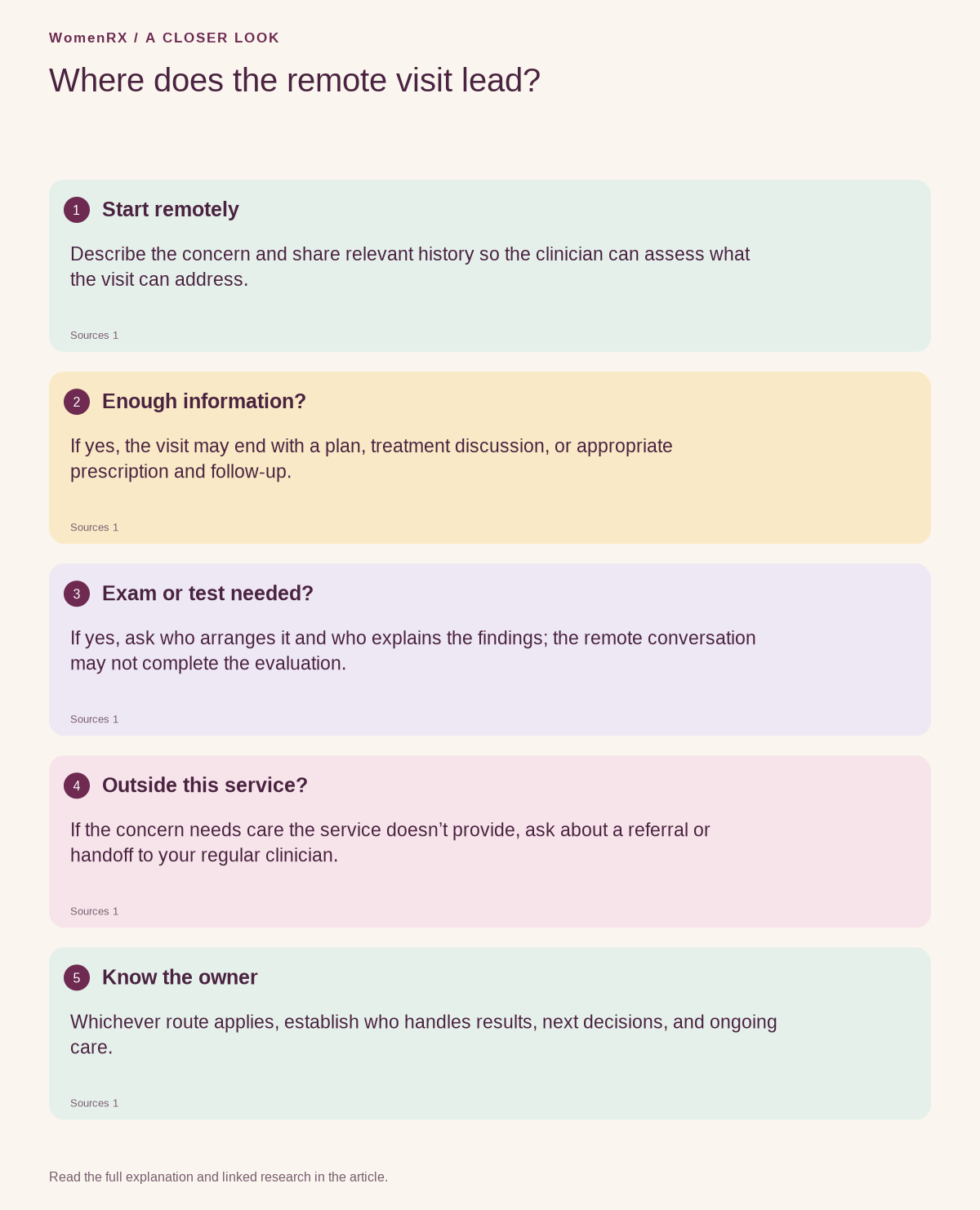
Where does the remote visit lead?
Start remotely: Describe the concern and share relevant history so the clinician can assess what the visit can address.1
Enough information?: If yes, the visit may end with a plan, treatment discussion, or appropriate prescription and follow-up.1
Exam or test needed?: If yes, ask who arranges it and who explains the findings; the remote conversation may not complete the evaluation.1
Outside this service?: If the concern needs care the service doesn’t provide, ask about a referral or handoff to your regular clinician.1
Know the owner: Whichever route applies, establish who handles results, next decisions, and ongoing care.1
Read the figure as text
Start with the question you need answered, then follow the route that fits what the clinician can establish remotely.- Start remotely: Describe the concern and share relevant history so the clinician can assess what the visit can address.1
- Enough information?: If yes, the visit may end with a plan, treatment discussion, or appropriate prescription and follow-up.1
- Exam or test needed?: If yes, ask who arranges it and who explains the findings; the remote conversation may not complete the evaluation.1
- Outside this service?: If the concern needs care the service doesn’t provide, ask about a referral or handoff to your regular clinician.1
- Know the owner: Whichever route applies, establish who handles results, next decisions, and ongoing care.1
More questions, answered
Should I tell a telehealth clinician about care I receive elsewhere?
Yes. A clinician who isn’t your regular provider may not have your full medical history, and coordinating care after a virtual visit can fall to you. Share relevant diagnoses, medications, and recent evaluation, and find out how the visit plan will reach the person providing your ongoing care. 1
Sources you can check
- Telehealth: MedlinePlusAccessed 2026-09-25Return to first citation
- WEGOVY (SEMAGLUTIDE) INJECTION, SOLUTION WEGOVY (SEMAGLUTIDE) TABLET [NOVO NORDISK PHARMACEUTICAL INDUSTRIES, LP] | US prescribing information and patient instructionsAccessed 2026-09-25Return to first citation
- The 2022 hormone therapy position statement of The North American Menopause Society.“The 2022 Hormone Therapy Position Statement of The North American Menopause Society” Advisory Panel. · Menopause (New York, N.Y.) · 2022Return to first citation
- The 2023 nonhormone therapy position statement of The North American Menopause Society.Menopause (New York, N.Y.) · 2023Return to first citation
- Bridging the gap: health equity in women's urologic care across rural settings.Rebullar K, Sebesta EM. · Current opinion in urology · 2026Return to first citation