Telehealth: Choose the Visit, Check the Cost, Plan What’s Next
A remote visit can save a trip, but the right choice depends on what you need assessed and what happens after the call.
Telehealth can mean a video or phone visit, a message to your care team, or monitoring from home. It can make care easier to reach, but some concerns still need an exam or lab test. Before booking, check that the service handles your concern, what you’ll pay beyond the visit, and who will arrange any follow-up.1

Start with the care you need, not the app
Telehealth is a way to deliver care at a distance, not a single kind of appointment. A live phone or video visit lets you discuss a concern with a clinician. A portal message may work for a question between visits. Remote monitoring can send information, such as a heart-rate reading, to a care team. Those options do different jobs.1
The first decision is whether the service actually handles your concern. A broad women’s-health label tells you less than its stated scope, assessment process and available follow-up. Check the service’s current information for the specific concern you want help with.
Know what a remote visit can and can’t finish
Telehealth may spare you travel or help you reach a clinician who isn’t nearby. It can also be a useful part of ongoing care. But a clinician may need an in-person examination or a lab test to make the right diagnosis, and a clinician new to you may not have your full medical history.1
That distinction matters more than whether a service offers video. Research on telehealth for selected people with non-acute headache has found outcomes generally comparable to in-person care in structured settings. That doesn’t establish that a remote visit is equally suitable for a new, urgent, or different concern. A review of primary-care trials involving telemedicine or AI also found that the pooled clinical effect across ten included trials did not reach statistical significance, despite favorable results in some individual studies. Neither finding provides a women-specific answer for every type of visit.65
Ask what the visit is meant to accomplish: an initial assessment, a treatment decision, or a follow-up with a clinician who already knows your history. If the answer may depend on testing or an exam, find out how the service helps you take that next step.
Compare the whole cost, not just the first visit
A virtual visit may cost less than an in-person visit, but that isn’t a promise about your bill. Insurance may not cover a telehealth visit, and a posted visit price may not include additional care.14
Compare visit charges separately from medication, lab work and follow-up. Check the amount due at the first appointment and the cost of returning visits rather than assuming a single advertised price covers all care.
Before paying, check the price of the first visit, whether follow-up visits are separate, and how any needed tests or prescriptions would be handled. Check coverage with your own plan if you intend to use insurance. A low entry price is less useful if the service can’t provide or coordinate the next part of your care.14
Make the handoff part of your choice
The end of a call isn’t necessarily the end of the care. If you see someone outside your usual practice, that clinician may not have your records, and you may need to coordinate the next step with your regular care team. A lost connection can interrupt a visit, too.1
Think of the choice as four linked questions: Does this service address my concern? Can this visit do enough remotely? What could the full course of care cost? Who takes responsibility for the next step? The answers may point you toward a one-time virtual visit, a service that offers ongoing care, or an in-person assessment instead. For a sensitive concern, you may also want to ask what enters your clinical record and what may appear in billing.
Find the guide that fits your next decision
The reading paths below split these questions by task. If you’re comparing services, start with Choose a service. For an online prescription or questions about your information, use Prescribing and privacy. If you already have a particular treatment in mind, Treatment-specific online visits helps you focus the conversation. PCOS and menopause service fit is for checking whether a service’s actual scope matches a broader care need.
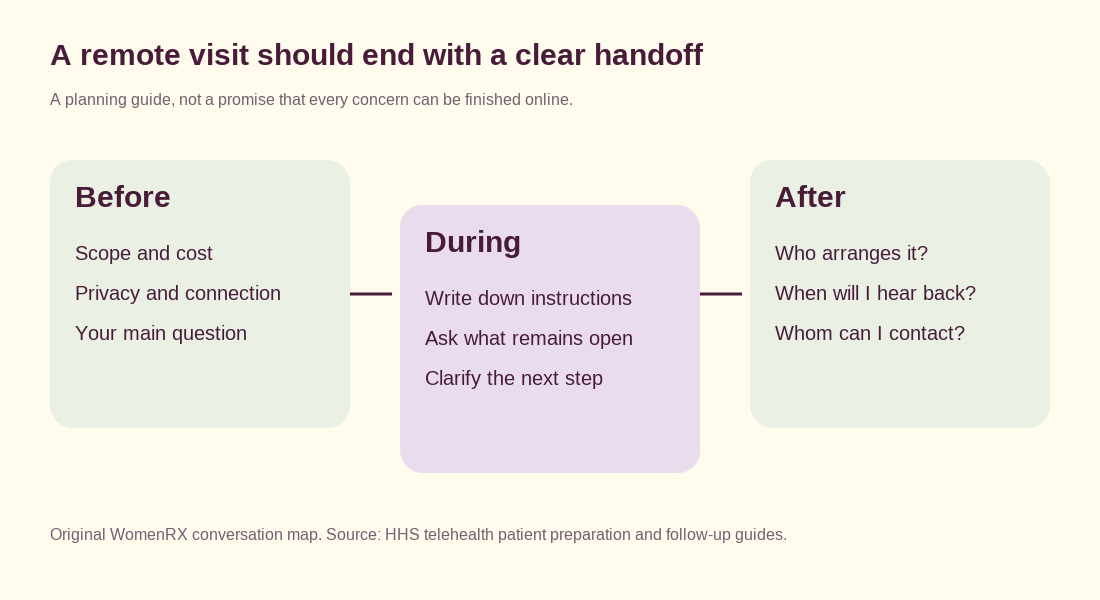
Make the follow-up explicit
Before: check scope, cost, privacy and connection. During: record instructions and ask what remains open. After: confirm who arranges any next step, when you will hear back and whom to contact.
Sources you can check
- Telehealth: MedlinePlusAccessed 2026-09-25Return to first citation
- Midi menopause telehealth visit pricesAccessed 2026-09-25Return to first citation
- Telemedicine and artificial intelligence in family medicine practice: a systematic review and meta-analysis of barriers and enablers in routine primary care.Albarqi MN. · Frontiers in digital health · 2026Return to first citation
- Telemedicine for headache disorders in real-world practice: from patient experience to health system impact.Grasso R, Carapelle E, Raunich G, Avolio C. · Neurological sciences : official journal of the Italian Neurological Society and of the Italian Society of Clinical Neurophysiology · 2026Return to first citation