How to Choose a Supplement That Fits Your Needs
Start with what you want a supplement to do, then check whether its ingredients, evidence, and safety fit your situation.
A supplement is most useful when it addresses a specific need, such as folic acid before and during early pregnancy, rather than a broad promise of better health. Vitamins, minerals, herbs, and other products can all be supplements, but they aren’t tested the way drugs are. Check the evidence for your goal, your total intake, and the product itself before choosing one. 14

Start with the reason, not the bottle
The supplement aisle puts very different products side by side. A vitamin can help meet a nutrient need. Herbs and powders can also be sold as dietary supplements. All can be sold as dietary supplements, but belonging to the same category tells you little about whether a particular product will help you. Supplements do not go through the testing that drugs do. 1
Name the result you’re looking for before comparing labels. “I eat few foods that contain iodine” is a different question from “Will this blend balance my hormones?” The first points toward a nutrient and an assessment of what you already get from food. The second needs a clearer outcome: Which symptom or condition is the product supposed to change, and was that result studied in people like you? A nutrient’s essential role in the body does not, by itself, show that taking more will treat a symptom. Most people can get the minerals they need from a varied diet, although a supplement may be appropriate in some circumstances. 3
Your life stage changes the question
If you could become pregnant or are planning a pregnancy, folic acid deserves attention before a pregnancy test is positive. Evidence shows that folic acid before and during early pregnancy reduces the risk of neural tube defects. Other forms of folate sold in supplements have not been shown in clinical trials to provide that same protection. This is a reason to check the form on a label, not just the word “folate.” 4
If you’re pregnant, a prenatal supplement is not interchangeable with an ordinary multivitamin, and one prenatal is not interchangeable with another. Nutrient needs change during pregnancy; professional groups recommend a prenatal supplement, yet formulations vary. Some leave out iodine or choline, and gummy versions often contain no iron or calcium. More isn’t automatically better, either: excessive preformed vitamin A can cause birth defects. Review what your prenatal contains before adding separate nutrients or herbs. 45
If you have menstrual or metabolic concerns, keep nutrient needs separate from treatment claims. For example, evidence about a supplement tested for outcomes in women with PCOS would not establish a benefit for everyone with irregular periods, nor would a change in a lab measure necessarily mean a change in symptoms. Choose a reading route for the condition and outcome you actually mean.
If you’re in perimenopause or postmenopause, look past phrases such as “hormone balance.” Ask whether a study measured your concern, such as hot flashes or sleep, in people at a comparable life stage. Menopause is not, on its own, proof that you need the same supplement as every other woman. The menopause routes below help narrow that question rather than offering one all-purpose shopping list.
Make four checks before you buy
1. What, exactly, is the claim? Separate getting enough of a nutrient from treating a condition. Calcium and vitamin D have roles in bone health; that fact alone does not establish that any particular combination product will improve every outcome advertised on its label. 1
2. Does the evidence match the product? Compare the ingredient and form, the people studied, and the result measured. This matters especially for multi-ingredient blends: evidence for one ingredient is not automatically evidence for the finished blend. For pregnancy, the distinction between folic acid and other forms of folate is a concrete example of why the form matters. 4
3. What else are you taking? Read the amounts on every supplement you use, including a multivitamin or prenatal, before adding a stand-alone product. High doses of some vitamins can cause problems, and MedlinePlus advises against taking more than a supplement label recommends. There can be practical conflicts between nutrients, too: calcium can interfere with iron absorption. During pregnancy, that is one reason to raise a plan involving separate calcium and iron supplements with your prenatal care team rather than guessing at a schedule. 124
4. How has the product been checked? For prenatal supplements, NIH notes that independent quality testing can help verify labeled ingredients and amounts and check for harmful levels of contaminants. It names ConsumerLab.com, NSF, and U.S. Pharmacopeia as organizations that offer such testing. A quality mark addresses product quality; it does not prove that the supplement will work for your goal. 4
If you take medicines or have a condition that affects nutrient intake, include those details when checking a supplement. During pregnancy, herbs and supplements also belong in conversations about medicines: a product being sold without a prescription doesn’t establish that it’s safe for pregnancy. 35
Pick the reading route that matches your concern
You don’t need to research the entire supplement shelf. If pregnancy nutrition is your question, begin with food sources and label gaps. If periods or PCOS brought you here, compare studies by the outcome they tested. For menopause symptoms, start with the symptom rather than the word “hormones.” The gut, sleep, and fitness routes below offer the same narrower starting point for their respective goals. Each route leads to a specific question you can investigate before deciding whether a product belongs in your routine.
More questions, answered
Is a multivitamin the same thing as a prenatal vitamin?
No. Pregnancy changes nutrient needs, and an ordinary multivitamin may provide too much or too little of what’s needed. Prenatal formulas also differ from one another, so check the ingredients and amounts rather than relying on the word “prenatal.” 45
Does independent quality testing prove a supplement works?
No. For prenatal supplements, independent testing can help check whether a product is properly manufactured and matches its label. Whether an ingredient helps your particular goal is a separate evidence question. 4
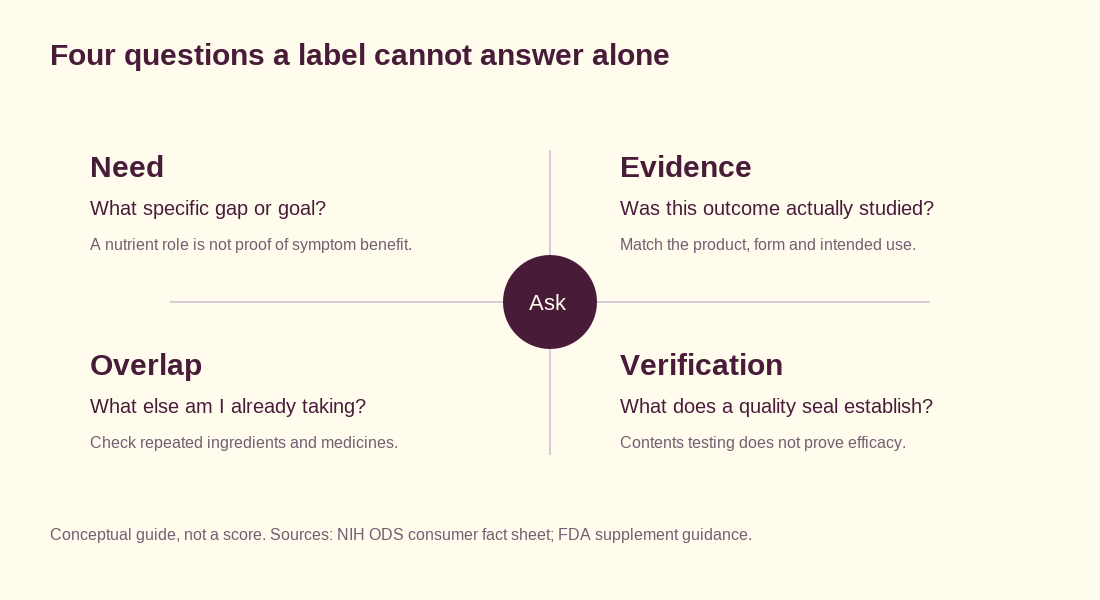
Four different supplement questions
Ask what specific need you want to address, what evidence supports the intended outcome, what ingredients or medicines overlap, and what quality verification actually establishes. A quality seal does not prove safety or effectiveness for you.
Sources you can check
- Dietary Supplements: MedlinePlusAccessed 2026-09-25Return to first citation
- Vitamins: MedlinePlusAccessed 2026-09-25Return to first citation
- Minerals: MedlinePlusAccessed 2026-09-25Return to first citation
- Dietary Supplements and Life Stages: Pregnancy - Health Professional Fact SheetAccessed 2026-09-25Return to first citation
- Pregnancy and Medicines | MedlinePlusAccessed 2026-09-25Return to first citation