How to Choose a Psyllium Supplement That Fits
The useful choice is a product that adds the fiber you want and has directions you can comfortably follow.
Psyllium can be a practical way to add fiber and may help with constipation because it forms a water-holding gel that affects stool consistency. 23 To choose one, compare the dietary fiber per labeled serving, confirm that it contains psyllium, and read the preparation directions. Your ability to take it with fluid, swallow it comfortably, and fit it around medicines matters too. 2
Start with your fiber goal, not the front of the package
If you want more fiber in your diet, a supplement is one option alongside foods such as whole grains, fruits, and vegetables. Add fiber gradually: increasing it too quickly can bring gas, bloating, or cramps. 1
If your main concern is constipation, psyllium has a more specific reason to consider it. Made from Plantago ovata husk, it forms a gel when hydrated and can affect stool consistency. A review of dietary approaches to chronic constipation found that psyllium supplements may help, though that doesn’t tell you why your bowel habits have changed. 23
Compare what a serving actually gives you
Start with the dietary fiber amount on the label, then check what the package calls one serving. For example, if a serving means several capsules, compare that full serving with a powder’s labeled serving, not one capsule with one scoop. This is a usability check, not a reason to choose the product with the biggest number.
Next, read the ingredient list. Look for “psyllium,” “psyllium husk,” or Plantago ovata. A product labeled simply “fiber” may contain a different fiber or a blend. Psyllium’s gel-forming behavior is relevant to the bowel-regularity goal, so the specific ingredient matters. 2
Finally, look at the directions and other ingredients. Would you rather prepare a powder, or does the labeled number of capsules feel more workable? Do you want the other ingredients listed? A “for women” label doesn’t answer those questions or establish a different effect.
Make sure the directions fit your day
Psyllium’s water-holding action makes preparation and fluid intake part of the decision, not fine print. Read the product’s directions before buying. If you have difficulty swallowing or can’t reliably take it with the fluid the directions call for, don’t assume that changing to another psyllium format solves the concern. A review of viscous fibers identifies hydration and swallowing ability as safety considerations. 2
Check medicine timing as well. Fiber supplements taken at the same time as some medicines may affect their absorption, but the right timing depends on the medicine. If you take medication regularly, a pharmacist can help you check the timing for your particular list rather than relying on one rule for every drug. 2
Know when a product choice won’t answer the problem
Severe constipation or a known problem with how food moves through your gut calls for more than choosing a fiber label. Reduced fluid intake and swallowing difficulty also change whether psyllium is a suitable choice. 2 If bowel symptoms keep troubling you, getting help with the symptoms themselves is more useful than repeatedly adding fiber.
Pregnancy, postpartum changes, or difficulty emptying your bowels may make a generic “for women” recommendation feel especially unhelpful. If any of those describes you, explain what’s happening when you seek individual advice rather than assuming a women-marketed supplement addresses the cause. The practical test is whether the ingredient, serving, directions, and your circumstances fit together.
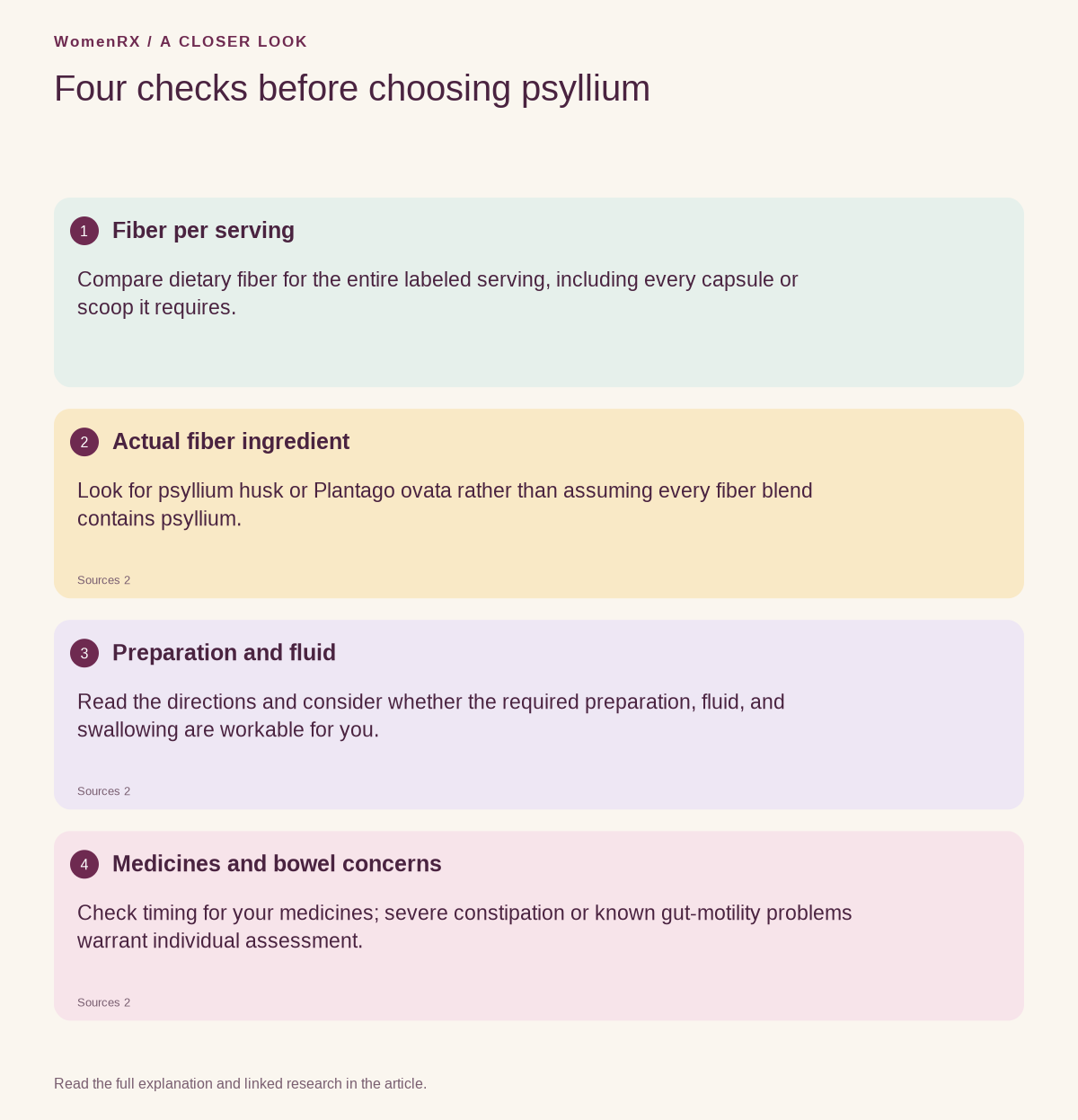
Four checks before choosing psyllium
Fiber per serving: Compare dietary fiber for the entire labeled serving, including every capsule or scoop it requires.
Actual fiber ingredient: Look for psyllium husk or Plantago ovata rather than assuming every fiber blend contains psyllium.2
Preparation and fluid: Read the directions and consider whether the required preparation, fluid, and swallowing are workable for you.2
Medicines and bowel concerns: Check timing for your medicines; severe constipation or known gut-motility problems warrant individual assessment.2
Read the figure as text
Use the label to compare products, then consider whether the directions work for you.- Fiber per serving: Compare dietary fiber for the entire labeled serving, including every capsule or scoop it requires.
- Actual fiber ingredient: Look for psyllium husk or Plantago ovata rather than assuming every fiber blend contains psyllium.2
- Preparation and fluid: Read the directions and consider whether the required preparation, fluid, and swallowing are workable for you.2
- Medicines and bowel concerns: Check timing for your medicines; severe constipation or known gut-motility problems warrant individual assessment.2
Sources you can check
- Dietary Fiber: MedlinePlusAccessed 2026-09-25Return to first citation
- Psyllium and Glucomannan as Viscous Fiber Modulators of the Gut-Microbiome-Incretin Axis: Molecular Links to Metabolic Inflammation, Barrier Function, and GLP-1 Receptor Agonist Therapy.Yoon Y, Hwang J, Yang CM, Moon M, Lee JJ, Lam KHS, Castro JC, Suryadi T, Suhaimi A, Lee J. · International journal of molecular sciences · 2026Return to first citation
- Dietary management of chronic constipation: a review of evidence-based strategies and clinical guidelines.Dimidi E. · The Proceedings of the Nutrition Society · 2025Return to first citation