How to Compare Psyllium Products Without Picking a Best Brand
The useful comparison is what each serving contains, how you take it, and what the directions say.
Psyllium is a well-supported fiber option for adults with functional constipation, but that evidence doesn’t identify a best retail brand. 7 Compare the stated psyllium amount and dietary fiber per serving, then read the form-specific directions, ingredients, and any medicine-timing instructions. One distinction matters especially in the US: an FDA rule found that over-the-counter psyllium laxatives in granular dosage forms were not generally recognized as safe and effective. 4
Compare what one serving actually provides
Start with the serving size, not the number on the front of the container. Write down how many scoops, capsules, tablets, or wafers make one labeled serving. Then look for two separate figures: the amount of psyllium or psyllium husk stated for that serving, and the amount listed as dietary fiber. If the label gives only total dietary fiber, don’t treat it as an exact measure of psyllium content.
This distinction matters when a product combines psyllium with other ingredients. It also makes a side-by-side comparison more useful: you’re comparing what each label says about one serving, rather than assuming two similarly sized containers provide the same thing. A larger stated amount isn’t, by itself, proof that a finished product will work better for you.
There’s a reason to look for psyllium rather than treating every fiber supplement as interchangeable. In a review of chronic idiopathic constipation, psyllium and wheat bran differed in their effects on stool output and stool water content. A separate scoping review of dietary approaches for adults with functional constipation identified psyllium as its strongest-supported fiber supplement. Neither review ranked retail brands. 5 7
Form is more than a convenience choice
Before buying, read how that particular product is meant to be taken, including its liquid instructions. A powder you mix, a tablet, and a wafer shouldn’t be treated as though they share one set of directions.
There’s also a specific US distinction worth knowing. An FDA rule found that over-the-counter psyllium laxative drugs in granular dosage forms were not generally recognized as safe and effective and were misbranded. The agency cited reports of esophageal obstruction. The rule did not apply to nongranular forms such as powders, tablets, and wafers. That exclusion isn’t a finding that every nongranular product is risk-free; it means the rule addressed a particular dosage form. 4
For the forms you’re comparing, choose based on the actual serving and directions you can use as written, rather than assuming that a convenient-looking form provides the same psyllium amount as another.
Check the rest of the label for fit, not promises
Scan the ingredient list for sweeteners, flavors, and anything else you prefer to avoid. Note any quality or testing disclosure, including what it says was checked. These details can help you decide which product fits your preferences. They don’t establish that its constipation benefit is greater than another brand’s.
If you take medicines, check the product’s directions and warnings for timing information before settling on a routine. Don’t invent a universal separation interval: the relevant question is about your specific medicine and product. If the directions leave that question unanswered, a pharmacist can help you check the combination. Medication timing is a recognized consideration with psyllium, but it isn’t a reason to assume every medicine has the same instructions. 6
Put the product in the context of your constipation
Psyllium is a gel-forming fiber derived from Plantago ovata husk. Its ability to hold water helps explain why it’s studied for stool hydration and bowel regularity. 6 More fiber isn’t always more comfortable right away, though. Increasing dietary fiber too quickly can cause gas, bloating, and cramps, so factor gradual changes into any comparison of serving directions. 1
If you’re pregnant or recently gave birth, constipation may be part of what prompted this search; it’s common in both periods. Check whether a psyllium product is suitable for your circumstances with your pregnancy or postpartum care clinician rather than assuming that general adult findings answer that question. The constipation research cited here doesn’t establish a different psyllium effect by sex. 3 5 7
Finally, a supplement comparison won’t explain a new change in bowel habits. If that’s what you’re dealing with, raise the change with your care team instead of relying on a product choice to answer it. 2
A five-line buying worksheet
For each product, record serving size; stated psyllium amount and dietary fiber; dosage form and complete taking directions; other ingredients and testing disclosures; and any unanswered medicine-timing question. Keep the granular-laxative distinction in mind as you compare forms. This worksheet helps you see what the label does and doesn’t tell you, without turning a brand claim into evidence of a better result. 4 5 7
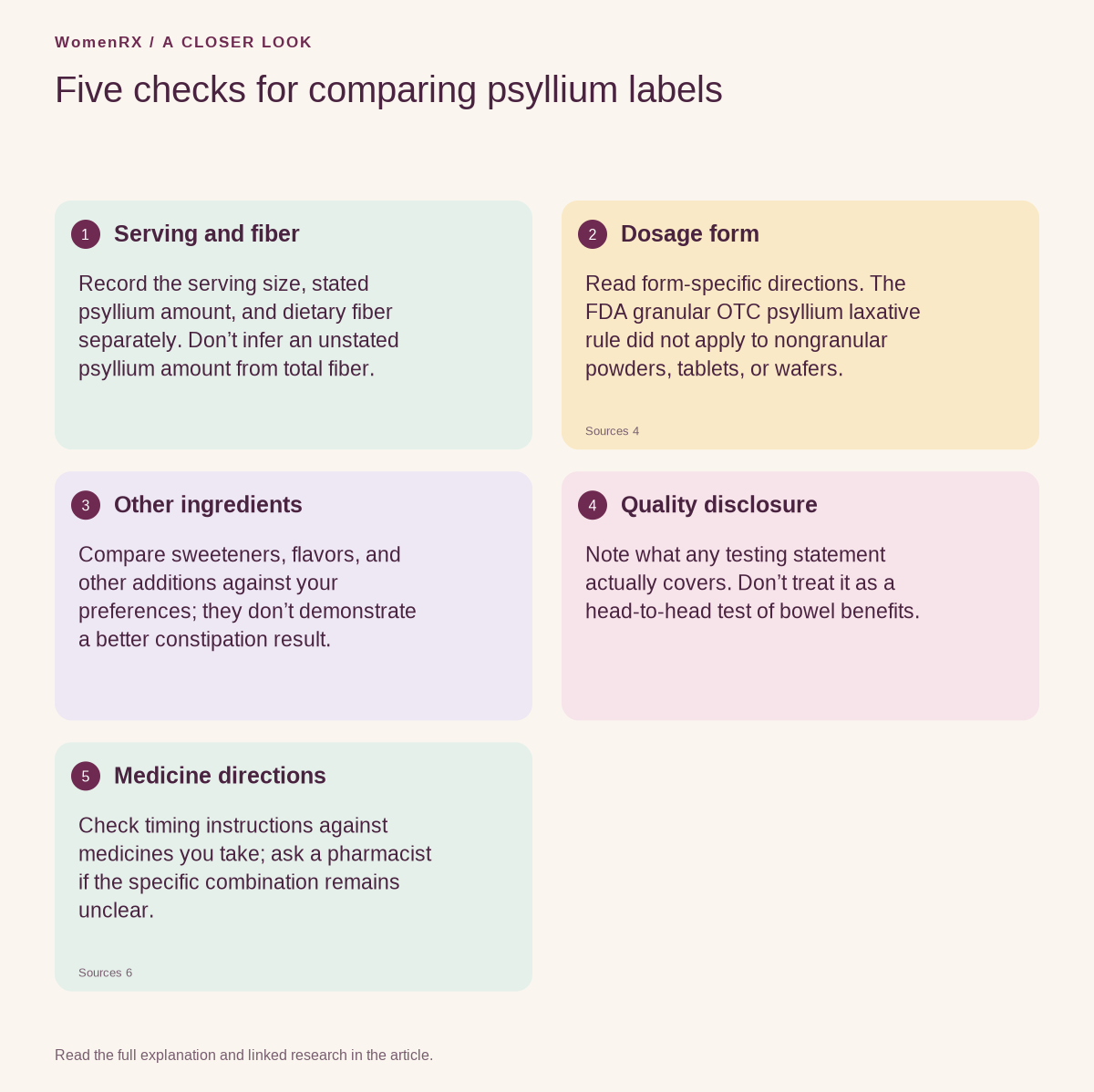
Five checks for comparing psyllium labels
Serving and fiber: Record the serving size, stated psyllium amount, and dietary fiber separately. Don’t infer an unstated psyllium amount from total fiber.
Dosage form: Read form-specific directions. The FDA granular OTC psyllium laxative rule did not apply to nongranular powders, tablets, or wafers.4
Other ingredients: Compare sweeteners, flavors, and other additions against your preferences; they don’t demonstrate a better constipation result.
Quality disclosure: Note what any testing statement actually covers. Don’t treat it as a head-to-head test of bowel benefits.
Medicine directions: Check timing instructions against medicines you take; ask a pharmacist if the specific combination remains unclear.6
Read the figure as text
Use the same checks on each product; they clarify what you’re buying, not which brand will work best.- Serving and fiber: Record the serving size, stated psyllium amount, and dietary fiber separately. Don’t infer an unstated psyllium amount from total fiber.
- Dosage form: Read form-specific directions. The FDA granular OTC psyllium laxative rule did not apply to nongranular powders, tablets, or wafers.4
- Other ingredients: Compare sweeteners, flavors, and other additions against your preferences; they don’t demonstrate a better constipation result.
- Quality disclosure: Note what any testing statement actually covers. Don’t treat it as a head-to-head test of bowel benefits.
- Medicine directions: Check timing instructions against medicines you take; ask a pharmacist if the specific combination remains unclear.6
More questions, answered
Does the dietary fiber number tell me exactly how much psyllium is in a serving?
No. Record any stated psyllium or psyllium-husk amount separately from total dietary fiber. If the label doesn’t state a psyllium amount, the fiber number alone doesn’t supply one.
Sources you can check
- Dietary Fiber: MedlinePlusAccessed 2026-09-25Return to first citation
- Constipation | MedlinePlusAccessed 2026-09-25Return to first citation
- Constipation - NHSAccessed 2026-09-25Return to first citation
- Laxative drug products for over-the-counter human use; psyllium ingredients in granular dosage forms. Final rule.Food and Drug Administration, HHS. · Federal register · 2007Return to first citation
- Laxative effects of wheat bran and psyllium: Resolving enduring misconceptions about fiber in treatment guidelines for chronic idiopathic constipation.McRorie JW, Fahey GC, Gibb RD, Chey WD. · Journal of the American Association of Nurse Practitioners · 2020Return to first citation
- Psyllium and Glucomannan as Viscous Fiber Modulators of the Gut-Microbiome-Incretin Axis: Molecular Links to Metabolic Inflammation, Barrier Function, and GLP-1 Receptor Agonist Therapy.Yoon Y, Hwang J, Yang CM, Moon M, Lee JJ, Lam KHS, Castro JC, Suryadi T, Suhaimi A, Lee J. · International journal of molecular sciences · 2026Return to first citation
- Dietary management of functional constipation in disorders of gut-brain interaction - A scoping review.Quan V, Carey S. · Clinical nutrition ESPEN · 2026Return to first citation