How to Compare NAC Supplements Without Picking a Brand
A useful NAC comparison starts with the ingredient and serving size, then separates quality evidence from claims about what the supplement can do.
Compare products by checking that the ingredient is named N-acetylcysteine or NAC, reading the amount per serving alongside the serving size, and noting every added ingredient. Look for independent quality testing, but don’t treat it as proof that NAC will help your particular concern. If you take nitroglycerin, pause before buying: NAC can intensify its blood-pressure-lowering effect and cause severe headaches.5 Quality and benefit are separate questions.24
Two NAC bottles can look similar on the front and be quite different choices once you read the back. One may list NAC alone; another may combine it with vitamins or other ingredients. A quality claim may tell you something about how a supplement was made, but nothing about whether it’s likely to help with the reason you’re considering it.
First, compare what’s actually in the serving
Look for N-acetylcysteine, often shortened to NAC, in the ingredient information. NAC is derived from the amino acid L-cysteine; it’s used both in dietary supplements and, in different clinical forms, as a medicine. A supplement capsule shouldn’t be confused with the medical treatment used for an acetaminophen overdose.5
Next, read the serving size and NAC amount together. If one label gives an amount for one capsule and another gives an amount for a serving of multiple capsules, the front-of-bottle numbers aren’t a like-for-like comparison. The point is to understand what each label says, not to choose the largest number. None of this evidence establishes a single NAC supplement amount that’s right for every intended use.
Finally, read the full ingredient list. For example, if you wanted a product containing only NAC but the label also lists other active ingredients, you’re now evaluating a combination product. Consider why each addition is there and whether it fits what you’re trying to do. Supplement formulations can vary, and ingredients that deserve attention during pregnancy may not have been thoroughly studied in pregnant women.2
Ask what a quality claim covers
An independent testing claim is more useful when you can tell who did the testing, which product it covers, and what was checked. Depending on its scope, quality testing can help assess whether a supplement was properly manufactured, contains its labeled ingredients and amounts, and avoids harmful levels of contaminants. The NIH Office of Dietary Supplements identifies ConsumerLab, NSF, and U.S. Pharmacopeia as independent organizations offering supplement quality testing.2 Check the testing organization’s own information rather than assuming a logo, a manufacturer’s test report, or a statement about a facility verifies the bottle in your hand.
That check has limits. A quality assessment doesn’t establish that NAC improves ovulation, fertility, immunity, or another health outcome. In the US, companies are responsible for supplement safety and truthful labeling, but dietary supplements generally aren’t reviewed for effectiveness before marketing in the way drugs are. Treat a health promise on the package as a claim to examine, not a result of quality testing.4
Match the evidence to your reason for buying
If you’re considering NAC for polycystic ovary syndrome (PCOS), there’s a meaningful distinction between NAC alongside fertility treatment and NAC bought as a stand-alone supplement. In a double-blind randomized trial of 180 infertile women with PCOS, researchers compared clomiphene plus NAC with clomiphene plus placebo during ovulation induction. They reported higher ovulation and pregnancy rates in the NAC group. That finding concerns NAC as an addition to a specific supervised treatment, not evidence that an over-the-counter product on its own improves fertility.7
Other PCOS research has explored NAC within different ovulation-induction approaches, and results haven’t been uniform. A later study discussing these trials notes one trial in which adding NAC to a clomiphene-and-letrozole approach did not improve clinical pregnancy rates. The treatment combination and the outcome being measured matter when you compare claims.6 If a product advertises itself as a general fertility aid, ask whether the research behind that claim studied women like you, used NAC alone or with fertility medicines, and measured pregnancy or only an intermediate outcome such as follicle development.
Broader claims about antioxidants and female fertility also need care. A Cochrane review described the evidence as limited and varied. Its editors later flagged problems with several included studies, while stating that removing those studies did not meaningfully change its overall conclusions. That review isn’t a ranking of NAC products.8
Check the safety question before the checkout
One specific medicine interaction is worth putting near the top of your list: Memorial Sloan Kettering Cancer Center warns that, in humans taking nitroglycerin, NAC can further lower blood pressure and cause severe headaches. If that medicine is part of your care, ask the prescriber or pharmacist about NAC before using a supplement.5 Bring the exact product label to that conversation, especially if it has additional active ingredients.
If you’re pregnant or planning a pregnancy, don’t assume that a supplement sold for fertility is suitable once pregnancy begins. MedlinePlus advises checking before starting medicines, including supplements, during pregnancy; the decision depends on the reason for use and the risks and benefits.3 If you’re breastfeeding, ask about the specific product and its ingredients rather than assuming that a pregnancy or fertility claim answers the breastfeeding question. Some medicines can pass into breast milk, and the general breastfeeding guidance does not establish the safety of NAC supplements for a nursing infant.1
A sensible final comparison is therefore not “Which bottle makes the biggest promise?” It’s “Can I identify the NAC amount and other ingredients, understand what the quality claim verifies, and find evidence that fits my intended use?” If you can’t answer one of those from the label and the testing organization’s information, you have a concrete question to put to the seller before you buy.
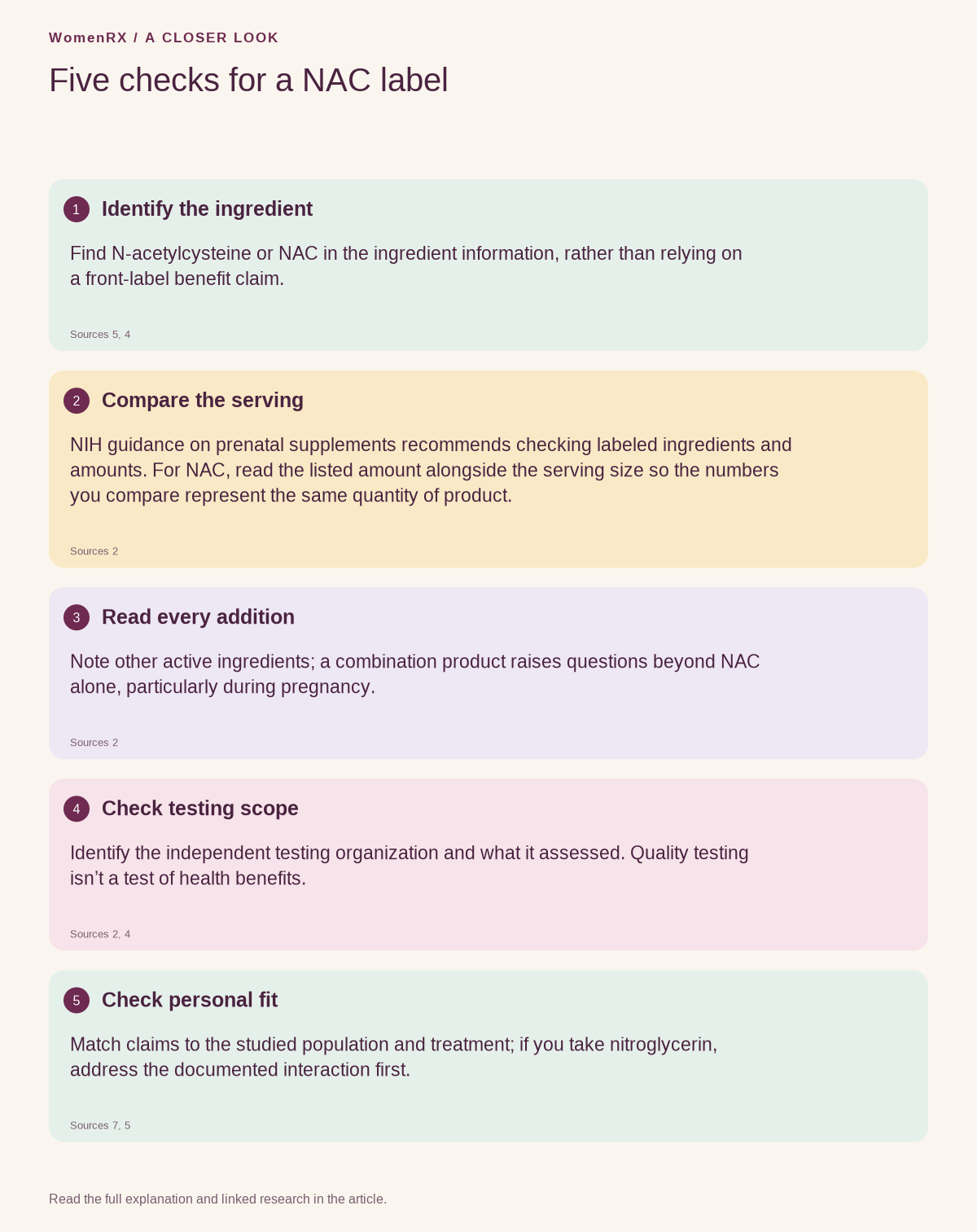
Five checks for a NAC label
Identify the ingredient: Find N-acetylcysteine or NAC in the ingredient information, rather than relying on a front-label benefit claim.54
Compare the serving: NIH guidance on prenatal supplements recommends checking labeled ingredients and amounts. For NAC, read the listed amount alongside the serving size so the numbers you compare represent the same quantity of product.2
Read every addition: Note other active ingredients; a combination product raises questions beyond NAC alone, particularly during pregnancy.2
Check testing scope: Identify the independent testing organization and what it assessed. Quality testing isn’t a test of health benefits.24
Check personal fit: Match claims to the studied population and treatment; if you take nitroglycerin, address the documented interaction first.75
Read the figure as text
Use these prompts to compare bottles without treating a quality claim as proof of benefit.- Identify the ingredient: Find N-acetylcysteine or NAC in the ingredient information, rather than relying on a front-label benefit claim.54
- Compare the serving: NIH guidance on prenatal supplements recommends checking labeled ingredients and amounts. For NAC, read the listed amount alongside the serving size so the numbers you compare represent the same quantity of product.2
- Read every addition: Note other active ingredients; a combination product raises questions beyond NAC alone, particularly during pregnancy.2
- Check testing scope: Identify the independent testing organization and what it assessed. Quality testing isn’t a test of health benefits.24
- Check personal fit: Match claims to the studied population and treatment; if you take nitroglycerin, address the documented interaction first.75
More questions, answered
Does a third-party quality mark mean NAC is effective?
No. Independent quality testing can help assess manufacturing, labeled contents, or contaminants, depending on what was tested. It does not show that NAC treats a condition or that one tested product works better than another.24
Do PCOS studies tell me which NAC brand to buy?
No. A randomized trial reported improved ovulation and pregnancy outcomes when NAC was added to clomiphene for infertile women with PCOS. It did not compare retail NAC brands or establish that NAC alone has the same effect.7
Sources you can check
- Breastfeeding | Benefits of Breastfeeding | MedlinePlusAccessed 2026-09-25Return to first citation
- Dietary Supplements and Life Stages: Pregnancy - Health Professional Fact SheetAccessed 2026-09-25Return to first citation
- Pregnancy and Medicines | MedlinePlusAccessed 2026-09-25Return to first citation
- Using Dietary Supplements Wisely | NCCIHAccessed 2026-09-25Return to first citation
- N-Acetylcysteine | Memorial Sloan Kettering Cancer CenterAccessed 2026-09-25Return to first citation
- N-acetylcysteine supplementation improves endocrine-metabolism profiles and ovulation induction efficacy in polycystic ovary syndrome.Fang YQ, Ding H, Li T, Zhao XJ, Luo D, Liu Y, Li Y. · Journal of ovarian research · 2024Return to first citation
- N-Acetylcysteine as an adjuvant to clomiphene citrate for successful induction of ovulation in infertile patients with polycystic ovary syndrome.Salehpour S, Sene AA, Saharkhiz N, Sohrabi MR, Moghimian F. · The journal of obstetrics and gynaecology research · 2012Return to first citation
- Antioxidants for female subfertility.Showell MG, Mackenzie-Proctor R, Jordan V, Hart RJ. · The Cochrane database of systematic reviews · 2020Return to first citation