How to Evaluate Weight-Management Products Without Brand Rankings
A product is most worth considering when it supports a realistic plan, makes its costs and limits clear, and doesn’t promise more than the evidence can show.
Start by asking whether you’re buying a support tool or a product claiming to cause weight loss. Apps, coaching, and wearables may help organize or reinforce a plan, but a tracker alone isn’t proof of results. Be especially cautious with supplements: they aren’t reviewed like drugs before sale, and evidence for an ingredient may not apply to the finished product. 15
First, separate support from a weight-loss claim
A scale, app, wearable, meal plan, or supplement can all be sold as a weight-management product, but they don’t do the same job. Some help you plan, learn, or keep track. Others claim that taking or buying the product itself will cause weight loss. Ask which kind you’re considering before comparing features or prices.
That distinction matters because weight management can involve different approaches depending on a person’s health and needs. MedlinePlus lists healthy eating patterns and regular physical activity, medicines, and procedures among possible treatments; it doesn’t suggest that one consumer product suits everyone. 2
Apps and wearables: look for support, not just tracking
A wearable can record activity, but measurement by itself isn’t the same as an effective weight-management program. A systematic review and meta-analysis of 21 randomized trials in adults with hypertension, type 2 diabetes, or overweight or obesity found that wearable-based interventions did not produce statistically significant improvements in body weight, blood pressure, blood glucose, or A1c at the reported intervention durations. The review abstract doesn’t report a women-specific result. 5
So when comparing an app or device, check what happens after it collects information. Does it offer useful feedback, coaching, or a plan you can realistically follow, or is the main feature a dashboard? A separate review of 27 studies in adults with metabolic syndrome or its components described digital interventions that commonly combined technology with coaching, feedback, or remote support. Those results concern varied interventions and outcomes, not a guarantee that a particular app will help you lose weight. 6
Also consider the practical tradeoff: ongoing fees, the time needed to enter information, device compatibility, privacy terms, and whether the tool works for your schedule and access needs. A feature you won’t use is not a benefit just because it looks impressive in an advertisement.
Food plans and meal replacements: inspect the actual offer
A food plan or meal replacement needs evidence of its own to support a weight-loss claim. Instead of relying on the product category or a before-and-after image, look at what you would actually receive: the food or plan details, what costs extra, how much flexibility it allows, and whether it fits your preferences, budget, and daily routine. Check whether claims are tied to research on that exact product or merely to general statements about weight loss.
Weight alone also doesn’t tell the whole story: it includes muscle, bone, fat, and water, and everyday factors can affect it. Consider what outcome matters to you, rather than treating a scale reading as the only measure of value. 3
Supplements: ingredient evidence isn’t product evidence
Dietary supplements are not subject to the same premarket review and approval as drugs. The manufacturer is responsible for safety and truthful label claims, and regulators may take action against unsafe products or unsubstantiated claims. 1
The NIH Office of Dietary Supplements describes a common problem with weight-loss supplements: products may combine several ingredients, use different amounts, or rely on blends whose active components aren’t fully clear. Research on one ingredient may not show that a particular combination works or is safe. 1
Before buying, look for a complete ingredient list and amounts, not just a proprietary blend or a dramatic promise. Ask whether human studies tested the finished product, for how long, and in whom. “Natural,” “detox,” or “metabolism boosting” does not establish effectiveness or safety. A mini-review of diet and detox teas found limited support for weight-loss benefits and described safety concerns, including reports of serious harms and discrepancies between labeled and actual contents. 7
Specific ingredients can have specific risks. The NIH fact sheet, for example, reports that green tea extract has been associated with liver damage, and that bitter orange can raise safety concerns, particularly in combinations with other stimulants. These examples are reasons to check the actual ingredients and warnings, not a complete safety screen. 1
A short buying check
Before paying, answer four questions:
- What is it meant to do? Is it a support tool, or does it claim to produce weight loss on its own?
- What evidence matches this product? Look for studies of the finished product and the people it is meant for, not just a related ingredient or broad claim.
- What will it cost in practice? Include subscriptions, refills, required equipment, shipping, or add-ons, and decide what you can sustain.
- What could make it a poor fit? Check ingredients, safety information, privacy, accessibility, and whether the plan feels workable rather than punishing.
For women-specific claims, ask whether women were actually included and whether results for women were reported. A general adult study isn’t automatically evidence for a special “women’s” formula. The wearable review and the digital-intervention review cited here do not report women-specific outcomes in their abstracts. 56
If you’re pregnant or breastfeeding, ask whether the seller provides information for your situation; general adult results don’t answer that question. MedlinePlus notes that some medicines can pass into breast milk, but that does not establish whether any particular weight-loss product is suitable while breastfeeding. 4
If you have a history of disordered eating, consider whether a product built around frequent weigh-ins, calorie tracking, or restrictive food rules fits how you want to care for yourself. That’s a product-fit question, not a measure of whether the product works.
A product doesn’t have to be necessary to be useful. If it fits your goal, budget, access, and safety needs, it may support a broader plan. If the evidence is vague, the costs keep growing, or the promise sounds effortless, it’s reasonable to pass.
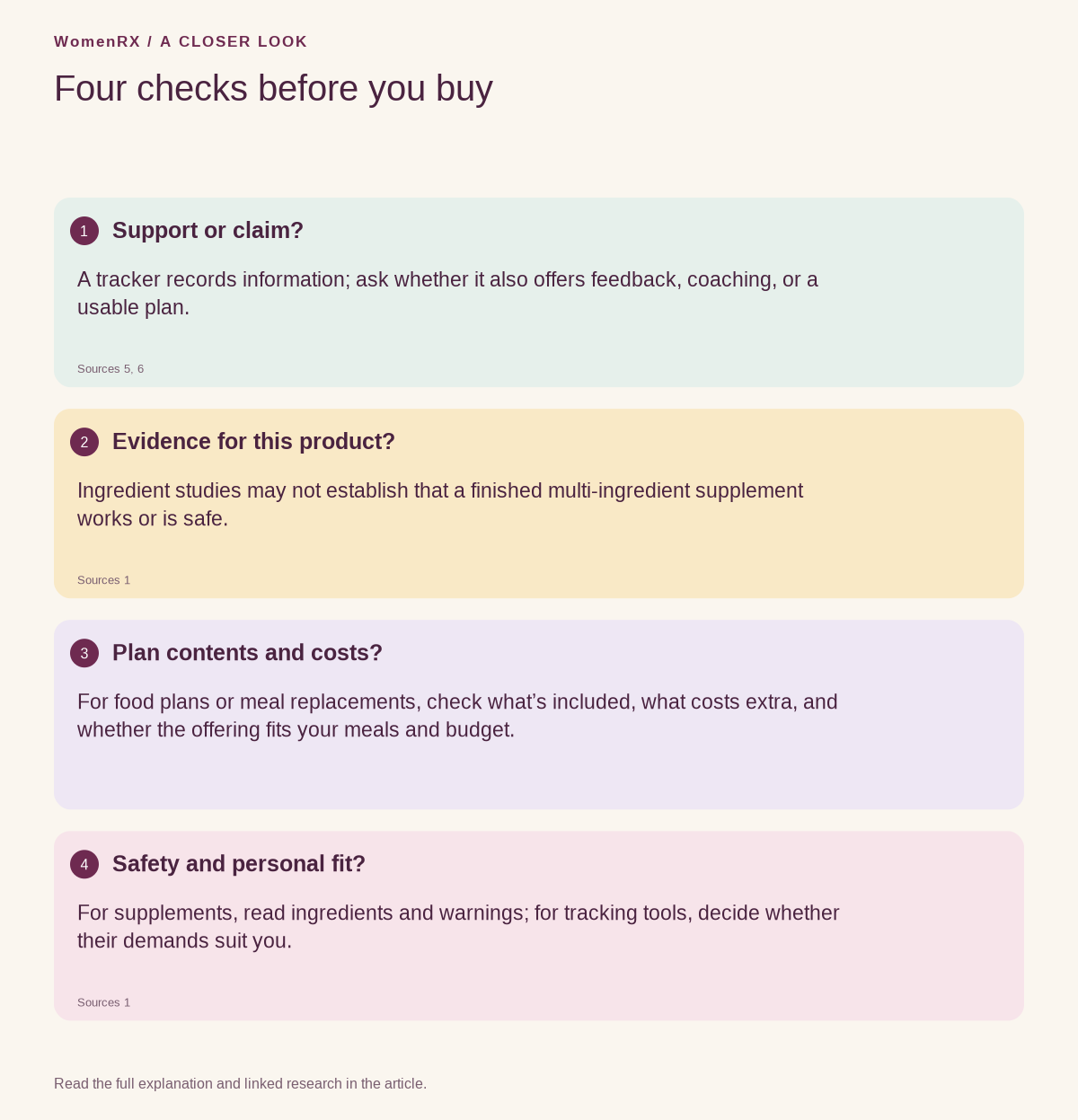
Four checks before you buy
Support or claim?: A tracker records information; ask whether it also offers feedback, coaching, or a usable plan.56
Evidence for this product?: Ingredient studies may not establish that a finished multi-ingredient supplement works or is safe.1
Plan contents and costs?: For food plans or meal replacements, check what’s included, what costs extra, and whether the offering fits your meals and budget.
Safety and personal fit?: For supplements, read ingredients and warnings; for tracking tools, decide whether their demands suit you.1
Read the figure as text
Use these questions to separate practical support from a product’s weight-loss promise, then check fit, cost, and safety.- Support or claim?: A tracker records information; ask whether it also offers feedback, coaching, or a usable plan.56
- Evidence for this product?: Ingredient studies may not establish that a finished multi-ingredient supplement works or is safe.1
- Plan contents and costs?: For food plans or meal replacements, check what’s included, what costs extra, and whether the offering fits your meals and budget.
- Safety and personal fit?: For supplements, read ingredients and warnings; for tracking tools, decide whether their demands suit you.1
More questions, answered
Does a supplement label mean the product has been proven to work?
No. Dietary supplements aren’t reviewed and approved by the FDA before sale in the same way as drugs, and evidence about an individual ingredient may not apply to a multi-ingredient product. Check the full formula and whether research tested that finished product. 1
Are women-specific weight-loss products better?
A women-focused name or formula isn’t proof of a benefit. Look for evidence that includes women and reports outcomes for women; the wearable and digital-intervention reviews summarized here don’t provide women-specific results in their abstracts. 56
Sources you can check
- Dietary Supplements for Weight Loss - Health Professional Fact SheetAccessed 2026-09-25Return to first citation
- Obesity: MedlinePlusAccessed 2026-09-25Return to first citation
- Body Weight: MedlinePlusAccessed 2026-09-25Return to first citation
- Breastfeeding | Benefits of Breastfeeding | MedlinePlusAccessed 2026-09-25Return to first citation
- Effects of physical activity-promoting wearable devices on blood pressure in adults: a systematic review and meta-analysis.Koyama M, Himuro N, Nakata K, Oyatani K, Shinohara Y, Ohnishi H, Arima H. · Hypertension research : official journal of the Japanese Society of Hypertension · 2025Return to first citation
- Telemedicine and Digital Health Interventions for the Management of Metabolic Syndrome: A Systematic Review of Clinical Outcomes.Bertini A, Bahamondes M, Rojas J, Puebla P, Rodriguez S, Quijada J. · Telemedicine journal and e-health : the official journal of the American Telemedicine Association · 2026Return to first citation
- Safety and effectiveness of diet and detox teas for weight loss: a mini-review.Noor F, Chalise R, Tran A. · Frontiers in nutrition · 2026Return to first citation