Which Gut Supplement Fits Your Symptoms?
A probiotic may help some IBS symptoms or lower antibiotic-associated diarrhea risk, but the evidence depends on the problem and the product.
There isn’t one gut supplement that fits every digestive symptom. For IBS, probiotics may improve average symptom-severity scores, but the evidence is low certainty and doesn’t identify a best product. One trial of a specific probiotic blend reported fewer cases of antibiotic-associated diarrhea. That doesn’t prove probiotics as a group work the same way, or establish a supplement for constipation specifically. 6 4
A supplement labeled “gut health” may sound like a simple fix, but constipation, IBS symptoms, and diarrhea during antibiotics are different problems. The useful question is not whether a product changes the microbiome. It’s whether it has been shown to help the symptom you’re dealing with.
For IBS: a possible benefit, not a sure bet
IBS can involve abdominal pain, bloating, constipation, diarrhea, or a mix of bowel changes. It affects women more often than men, but that difference in how common IBS is doesn’t show that a supplement works better for women. 1
A 2026 systematic review and meta-analysis of 40 randomized trials in adults with IBS found that probiotics improved average IBS symptom-severity scores compared with placebo. It did not find a significant improvement in IBS-related quality of life, and the authors rated the evidence as low certainty because results varied between studies. Their trial-sequential analysis also found that the evidence had not reached the amount needed for a firm conclusion. 6
A separate 2025 network meta-analysis also found signs of symptom relief with probiotics. These results don’t settle which product is best: probiotic studies use different products and comparisons, and the overall findings remain uncertain. No sex-specific benefit is established by these findings, so they shouldn’t be treated as proof of a women-specific effect. 6 7
If constipation is your main IBS symptom, keep the distinction clear: results for overall IBS symptoms don’t establish that a probiotic treats constipation specifically. If you think you may have IBS and symptoms have lasted more than four weeks, arrange an evaluation rather than relying on a broad “gut health” claim. 6 2
IBS symptoms can also coincide with pelvic pain or urinary problems, such as urgency or difficulty feeling that you’ve emptied your bladder. Those symptoms shouldn’t automatically be attributed to IBS; mention them when describing what’s going on, especially if they’re new or changing. 2
During antibiotics: prevention isn’t treatment
One double-blind, placebo-controlled trial tested a particular proprietary probiotic blend during antibiotic treatment and for 14 days afterward. An editorial describing the trial reported a lower incidence of antibiotic-associated diarrhea. That’s a promising result for that specific blend and setting, not proof that any probiotic will prevent diarrhea. The broader research varies by strain, population, and outcome, making general recommendations difficult. 4
It also matters whether you’re trying to prevent diarrhea or treat it once it starts. In a randomized trial of 72 hospitalized patients with diarrhea who tested negative for C. difficile, adding Saccharomyces boulardii did not improve stool weight, frequency, or consistency compared with standard care over five days. This study applies to hospitalized patients, not every person with diarrhea, but it cautions against assuming that a probiotic will treat an ongoing episode. 5
Pregnancy, breastfeeding, and peppermint oil
If you’re pregnant or breastfeeding, don’t assume that safety information for one ingredient applies to every “gut health” blend. Guidance on peppermint oil says there’s limited information in pregnancy and breastfeeding; it does not expect problems in pregnancy, and says only tiny amounts are likely to reach breast milk. That’s specific to peppermint oil, not proof that every product containing it, or other supplements, is appropriate for you. 3
When a supplement isn’t the next step
IBS symptoms can come and go, and other conditions can cause bowel changes too. If you think you may have IBS and symptoms have lasted more than four weeks, arrange a medical evaluation. Seek prompt care for rectal bleeding or bloody diarrhea, substantial weight loss for no clear reason, or a hard lump or swelling in your abdomen. 2
A practical way to choose is to start with the symptom: IBS overall, diarrhea prevention while taking antibiotics, or diarrhea that has already begun. Then check whether the research actually studied that situation and that specific product. If the match is unclear, a supplement label alone can’t fill the evidence gap.
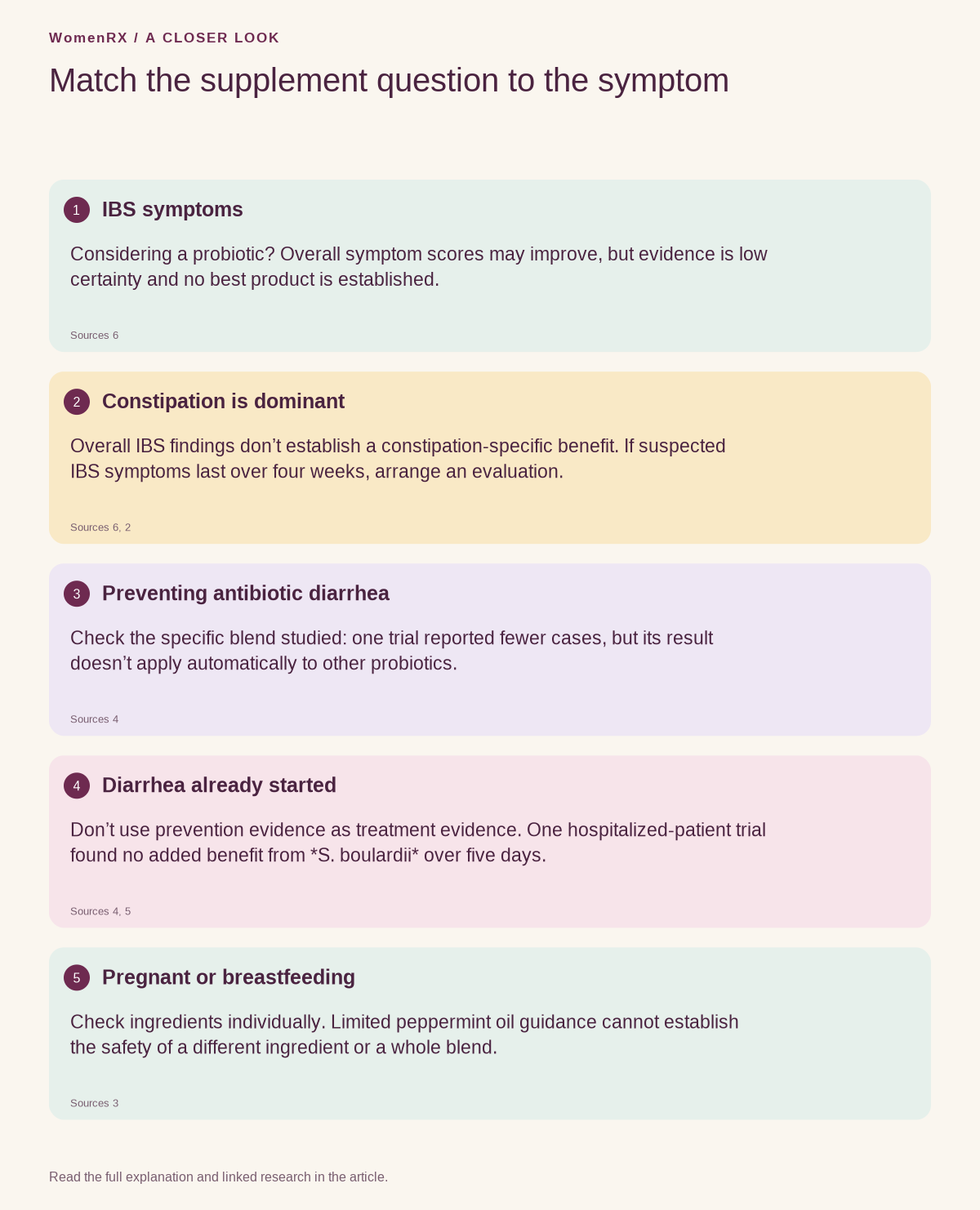
Match the supplement question to the symptom
IBS symptoms: Considering a probiotic? Overall symptom scores may improve, but evidence is low certainty and no best product is established.6
Constipation is dominant: Overall IBS findings don’t establish a constipation-specific benefit. If suspected IBS symptoms last over four weeks, arrange an evaluation.62
Preventing antibiotic diarrhea: Check the specific blend studied: one trial reported fewer cases, but its result doesn’t apply automatically to other probiotics.4
Diarrhea already started: Don’t use prevention evidence as treatment evidence. One hospitalized-patient trial found no added benefit from *S. boulardii* over five days.45
Pregnant or breastfeeding: Check ingredients individually. Limited peppermint oil guidance cannot establish the safety of a different ingredient or a whole blend.3
Read the figure as text
Start with the problem you want to address. Evidence for one symptom, setting, or ingredient should not be assumed to apply to another.- IBS symptoms: Considering a probiotic? Overall symptom scores may improve, but evidence is low certainty and no best product is established.6
- Constipation is dominant: Overall IBS findings don’t establish a constipation-specific benefit. If suspected IBS symptoms last over four weeks, arrange an evaluation.62
- Preventing antibiotic diarrhea: Check the specific blend studied: one trial reported fewer cases, but its result doesn’t apply automatically to other probiotics.4
- Diarrhea already started: Don’t use prevention evidence as treatment evidence. One hospitalized-patient trial found no added benefit from *S. boulardii* over five days.45
- Pregnant or breastfeeding: Check ingredients individually. Limited peppermint oil guidance cannot establish the safety of a different ingredient or a whole blend.3
More questions, answered
Are all probiotics interchangeable?
No. Probiotic effects can depend on the strain or blend and the condition being studied. A result for one product, such as a particular blend tested for antibiotic-associated diarrhea, doesn’t establish that other products will have the same effect. 4
Does the IBS probiotic evidence show a different effect in women?
The reported meta-analysis findings don’t establish a women-specific benefit. IBS is more common in women, but that doesn’t mean probiotics work differently by sex. 1 6
Sources you can check
- Irritable Bowel Syndrome | IBS | MedlinePlusAccessed 2026-09-25Return to first citation
- Symptoms of IBS (irritable bowel syndrome) - NHSAccessed 2026-09-25Return to first citation
- Pregnancy, breastfeeding and fertility while taking peppermint oil - NHSAccessed 2026-09-25Return to first citation
- From Chaos to Clarity? The Quest for Effective Probiotics in Antibiotic-Associated Diarrhea.Rao K, Garey KW. · Open forum infectious diseases · 2024Return to first citation
- Adjunctive use of Saccharomyces boulardii versus bismuth subsalicylate in the management of non-Clostridioides difficile nosocomial diarrhea in severely ill patients: a three-arm randomized controlled trial.Preechakawin N, Suttikulsombat M, Kiratisin P, Weeranawin P, Maneerattanaporn M. · Translational gastroenterology and hepatology · 2026Return to first citation
- Probiotics for Irritable Bowel Syndrome: An Updated Systematic Review and Meta-Analysis With Trial Sequential Analysis.Tang ASP, Quek J, Sulaimi F, Sim B, Kai TOS, Soon EY, Goh CN, Hsu JLJ, Lee CKL, Chong SKS, Sule AA, Ling RR, Siah KTH, Ng QX. · Journal of gastroenterology and hepatology · 2026Return to first citation
- Effects of Probiotics and Diet Management in Patients With Irritable Bowel Syndrome: A Systematic Review and Network Meta-analysis.Lei Y, Sun X, Ruan T, Lu W, Deng B, Zhou R, Mu D. · Nutrition reviews · 2025Return to first citation