Gut Supplements: Match the Product to Your Symptom
Psyllium, probiotics, and peppermint oil aren’t interchangeable: the most useful choice depends on whether you’re trying to ease constipation, cramps, or another specific symptom.
Start with the symptom, not a broad promise to improve “gut health.” Psyllium has the strongest dietary evidence here for functional constipation; peppermint oil is used for IBS-related cramps and bloating; probiotic effects depend on the exact strain and condition. Pregnancy and breastfeeding add a separate safety question, and evidence about possible benefits doesn’t establish that a particular product is safe for your situation. 4 1 2 6
First, name the change you want
“Gut health” can mean regular bowel movements, less cramping, less bloating, or something else. A supplement studied for one of those outcomes may not help another. Choose by the symptom you want to change, and check whether the evidence concerns the specific ingredient or strain in the product you’re considering.
That distinction matters especially with probiotics. They’re identified by genus, species, and strain, and effects can be specific to a strain. A label that says “probiotic” alone doesn’t tell you whether the product matches research on a particular symptom. 1
If constipation is the main problem
Psyllium is the clearest starting point among these supplement categories. A 2026 scoping review of dietary approaches for functional constipation in adults described psyllium fiber as the strongest current dietary recommendation. The review found signs of benefit from some probiotics, prebiotics, and synbiotics too, but said their effects couldn’t be confidently determined because studies were limited or conflicting. 4
That doesn’t mean every fiber product will suit every person or symptom. The evidence discussed is for functional constipation in adults; it doesn’t establish that psyllium treats abdominal pain, diarrhea, or every cause of constipation. If your bowel symptoms are new, persistent, or part of a diagnosed condition, the cause matters as much as the product.
If cramps or bloating are the target
Peppermint oil is used as an antispasmodic: it relaxes bowel muscle, which can ease cramping and bloating, particularly in IBS. A systematic review of phytotherapeutic recommendations in medical guidelines reports strong recommendations for peppermint oil for IBS symptoms, especially pain and flatulence. 2 5
The tradeoff is that peppermint oil can cause heartburn or indigestion, which may be unwelcome if reflux is already bothering you. Evidence about peppermint oil capsules shouldn’t automatically be treated as evidence for every product labeled “peppermint” or for a blend containing it. 2 3
If you’re considering a probiotic
A probiotic isn’t one uniform treatment. Benefits, when shown, may depend on the strain and the condition being studied. The NIH Office of Dietary Supplements notes that not all products labeled as probiotics have proven health benefits and that clinical recommendations need to be strain-specific. 1
There are signals of possible benefit for some digestive symptoms, but that’s not the same as a reliable effect from probiotics as a category. For example, a recent scoping review of adults with functional constipation found that some probiotic studies reported improvement, while concluding that the overall evidence was difficult to determine because of limited or conflicting research. 4
So, before choosing one, look for a product that identifies its strain and ask whether evidence for that strain matches your particular symptom. A product with more strains or a larger-sounding label isn’t shown by these sources to work better.
Pregnancy and breastfeeding change the question
Research has examined probiotics and prebiotics during pregnancy and lactation, including possible effects on several maternal and infant outcomes. But a 2025 review also called for better long-term and randomized studies to establish their safety, efficacy, and place in practice. Those findings don’t establish that a particular supplement is safe for a pregnant or breastfeeding person, or that it will treat her digestive symptoms. 6
The practical distinction is between evidence that a product may affect an outcome in a study and evidence that the product is appropriate for you at this life stage. Before starting a gut supplement while pregnant or breastfeeding, show your obstetric care clinician or pharmacist the exact product label, including all ingredients. This is particularly useful for multi-ingredient blends, where the evidence for one ingredient may not answer questions about the whole product.
A simple way to narrow the choice
Write down the symptom you want to change, then match it to the type of evidence: constipation points most clearly to psyllium; IBS-related cramps or bloating may point to peppermint oil; probiotics require a strain-and-condition match. If you’re pregnant or breastfeeding, treat life-stage safety as a separate decision rather than assuming that general adult research applies. 4 2 1 6
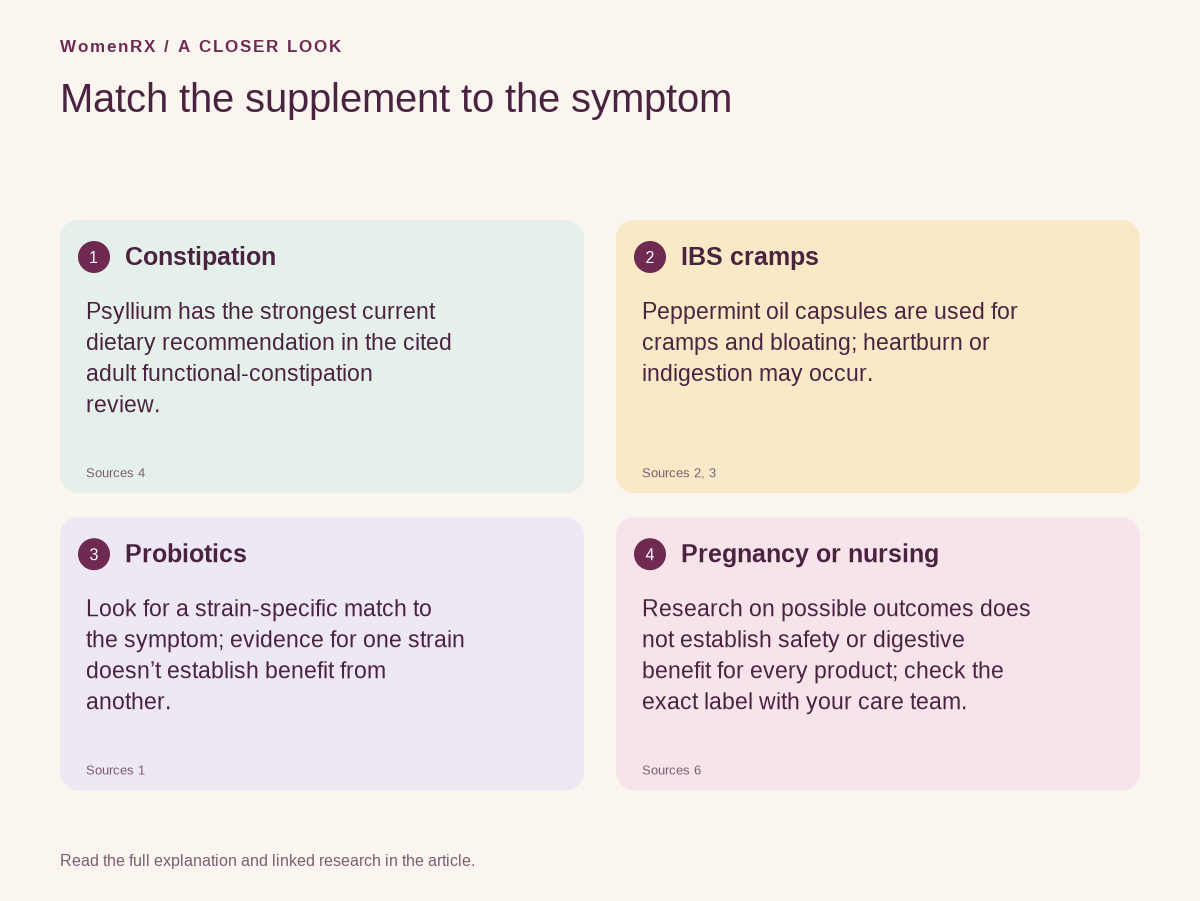
Match the supplement to the symptom
Constipation: Psyllium has the strongest current dietary recommendation in the cited adult functional-constipation review.4
IBS cramps: Peppermint oil capsules are used for cramps and bloating; heartburn or indigestion may occur.23
Probiotics: Look for a strain-specific match to the symptom; evidence for one strain doesn’t establish benefit from another.1
Pregnancy or nursing: Research on possible outcomes does not establish safety or digestive benefit for every product; check the exact label with your care team.6
Read the figure as text
These categories have different targets and evidence limits; pregnancy and breastfeeding call for a separate product-safety check.- Constipation: Psyllium has the strongest current dietary recommendation in the cited adult functional-constipation review.4
- IBS cramps: Peppermint oil capsules are used for cramps and bloating; heartburn or indigestion may occur.23
- Probiotics: Look for a strain-specific match to the symptom; evidence for one strain doesn’t establish benefit from another.1
- Pregnancy or nursing: Research on possible outcomes does not establish safety or digestive benefit for every product; check the exact label with your care team.6
More questions, answered
Are probiotics and prebiotics the same thing?
No. Probiotics are live microorganisms; prebiotics are typically carbohydrates that gut microorganisms use as fuel. Products containing both are often called synbiotics. 1
Does evidence for one probiotic apply to every probiotic?
No. Probiotic effects may be strain-specific, so evidence for one strain and condition doesn’t establish that another product will have the same effect. 1
Sources you can check
- Probiotics - Health Professional Fact SheetAccessed 2026-09-25Return to first citation
- About peppermint oil - NHSAccessed 2026-09-25Return to first citation
- Common questions about peppermint oil - NHSAccessed 2026-09-25Return to first citation
- Dietary management of functional constipation in disorders of gut-brain interaction - A scoping review.Quan V, Carey S. · Clinical nutrition ESPEN · 2026Return to first citation
- [Phytotherapeutic recommendations in medical guidelines for the treatment of gastroenterological diseases - a systematic review].Utz S, Bittel M, Langhorst J. · Zeitschrift fur Gastroenterologie · 2024Return to first citation
- Gut Health for Two: the Critical Role of Probiotics and Prebiotics in Pregnancy and Lactation.Açar Kuru Y, Aksu S, Gökler AF, Somuncu Eİ, Yassıbaş E, Ayyıldız F. · Current nutrition reports · 2025Return to first citation