Which Gut Supplements Have Evidence for Your Symptom?
Psyllium has a clearer role in IBS than a generic “gut health” blend, while probiotic findings depend on the strain and symptom studied.
Start with the symptom, not the supplement aisle. Psyllium may help overall irritable bowel syndrome (IBS) symptoms, and whole kiwifruit has trial evidence for constipation. Some specific probiotics have promising results for particular types of IBS, but those results don’t transfer to every product. If you have rectal bleeding or unexplained weight loss, get assessed rather than trying supplements first. 1 3 4 5 6
First, separate constipation from IBS
Constipation can happen on its own. IBS involves recurrent abdominal pain associated with bowel movements or a change in bowel habits; it may come with constipation, diarrhea, or both. That difference matters when you read a product claim: more bowel movements doesn’t necessarily mean less pain. An IBS guideline describes diagnosis as based on symptoms, a history, and a relevant examination, with selective rather than blanket testing. 4
If constipation is the main problem
Psyllium is the supplement with the clearest place to start in the IBS guideline: it may reduce IBS symptoms, while wheat bran does not have the same support. That finding doesn’t extend to every fiber powder or “prebiotic” blend. 4
There’s also an option outside the supplement aisle. In a multicenter randomized crossover trial, adults with functional constipation or constipation-predominant IBS (IBS-C) tried whole green kiwifruit and psyllium in separate four-week periods. During the kiwifruit period, complete spontaneous bowel movements increased from baseline by an average of 1.53 per week in the functional constipation group and 1.73 per week in the IBS-C group. Those are within-treatment changes, not proof that kiwifruit outperformed psyllium. The study tested fruit, not a kiwifruit extract. 3
A smaller crossover trial also found improvement in constipation measures with whole gold kiwifruit and with psyllium. It included 11 adults with functional constipation and 13 with IBS-C, alongside healthy controls. The researchers noted that their fiber-matched psyllium amount was below the therapeutic amount they described, which limits how much this comparison can settle about psyllium. 2
If pain, bloating, or diarrhea leads the picture
Probiotics aren’t one intervention. Their effects can depend on the genus, species, and strain. The NIH Office of Dietary Supplements notes that many commercial probiotic products haven’t been tested in research studies. A high CFU count or a long list of strains doesn’t tell you whether a product matches one studied for your symptom. 1
An IBS guideline suggests probiotics as a possible option. Individual trials show why the exact product and type of IBS matter. In a randomized, placebo-controlled trial involving 200 adults with diarrhea-predominant IBS (IBS-D), researchers tested Bifidobacterium longum CECT 7347 in two forms: a live probiotic and a heat-treated postbiotic. Both groups had greater improvements in IBS symptom-severity scores than the placebo group over 12 weeks. This doesn’t establish a benefit for other Bifidobacterium strains or for diarrhea with another cause. 4 5
For IBS-C, a separate placebo-controlled trial of 30 participants reported improvements in bowel-related discomfort and some bloating measures with Lacticaseibacillus rhamnosus IDCC 3201 over eight weeks. A result from that small IBS-C trial can’t answer whether the strain helps IBS-D, or whether a different probiotic helps bloating on its own. 6
If a probiotic label doesn’t give the full strain name used in a relevant trial, you can’t make a meaningful match. And if diarrhea keeps recurring, don’t assume an IBS-D study explains your symptoms. The diagnosis comes from the overall pattern, not from whether a supplement seems to help. 1 4
Where do prebiotics fit?
Prebiotics are typically carbohydrates that gut microorganisms use as fuel; probiotics are live microorganisms. A product may contain both, but those definitions aren’t evidence that it will relieve your particular symptom. The guideline finding for psyllium should not be read as an endorsement of all fibers or prebiotics. 1 4
Know when the next step isn’t a supplement
A recurring pattern of pain and changed bowel habits is worth assessing rather than working through a series of products. Rectal bleeding and unexplained weight loss are warning signs that should move assessment ahead of supplement trial-and-error. An IBS guideline also suggests considering a blood test for celiac disease during the diagnostic workup, rather than assuming every recurring bowel symptom is IBS. 4 6
These findings don’t establish whether the supplements work differently for women than for men. The reported results above do not provide a women-specific effect, and the gold kiwifruit and IBS-C probiotic trials excluded people who were pregnant or breastfeeding. They therefore can’t establish how those interventions perform in pregnancy or while breastfeeding. 2 6
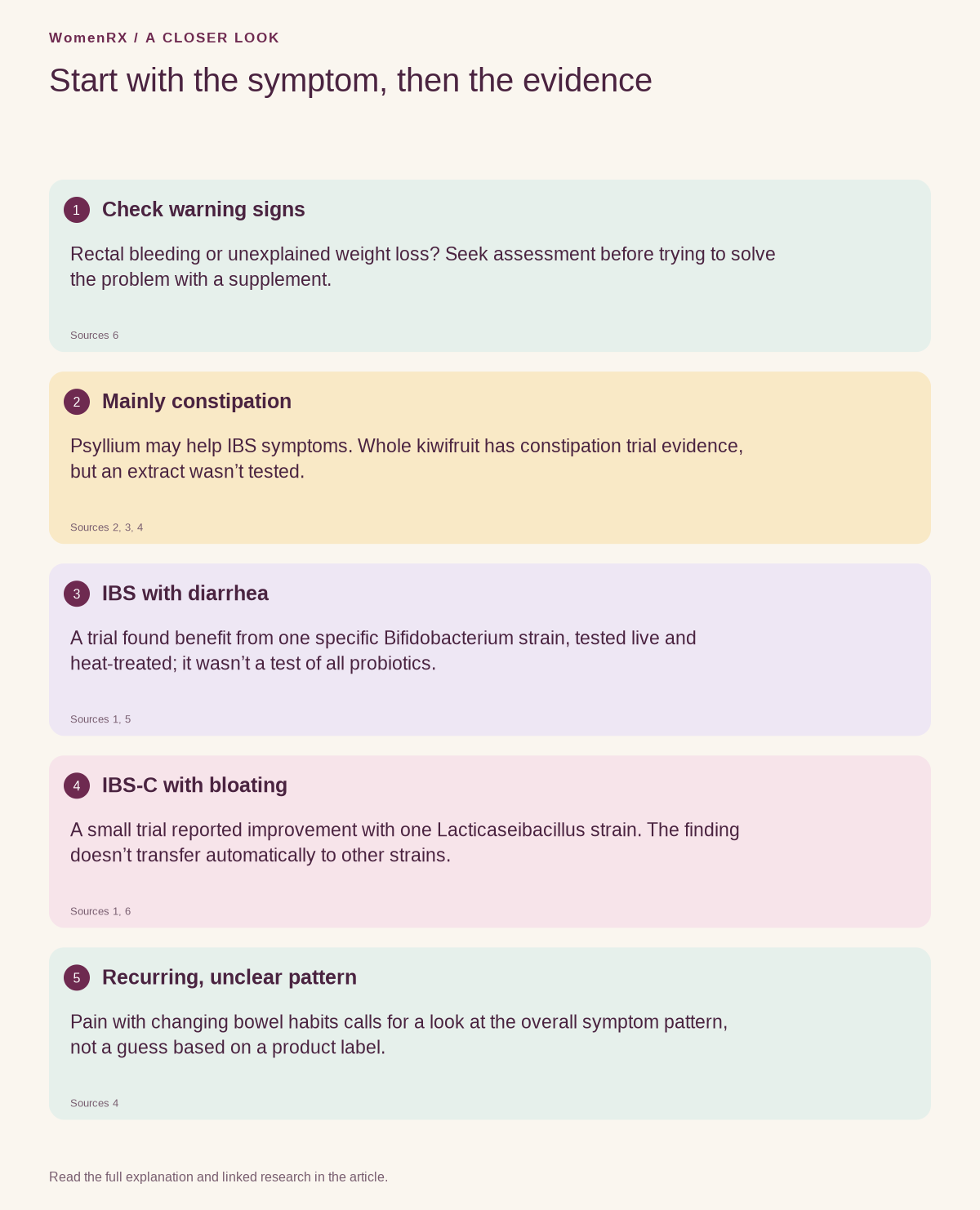
Start with the symptom, then the evidence
Check warning signs: Rectal bleeding or unexplained weight loss? Seek assessment before trying to solve the problem with a supplement.6
Mainly constipation: Psyllium may help IBS symptoms. Whole kiwifruit has constipation trial evidence, but an extract wasn’t tested.234
IBS with diarrhea: A trial found benefit from one specific Bifidobacterium strain, tested live and heat-treated; it wasn’t a test of all probiotics.15
IBS-C with bloating: A small trial reported improvement with one Lacticaseibacillus strain. The finding doesn’t transfer automatically to other strains.16
Recurring, unclear pattern: Pain with changing bowel habits calls for a look at the overall symptom pattern, not a guess based on a product label.4
Read the figure as text
This route separates findings for constipation and IBS subtypes from reasons to seek assessment first.- Check warning signs: Rectal bleeding or unexplained weight loss? Seek assessment before trying to solve the problem with a supplement.6
- Mainly constipation: Psyllium may help IBS symptoms. Whole kiwifruit has constipation trial evidence, but an extract wasn’t tested.234
- IBS with diarrhea: A trial found benefit from one specific Bifidobacterium strain, tested live and heat-treated; it wasn’t a test of all probiotics.15
- IBS-C with bloating: A small trial reported improvement with one Lacticaseibacillus strain. The finding doesn’t transfer automatically to other strains.16
- Recurring, unclear pattern: Pain with changing bowel habits calls for a look at the overall symptom pattern, not a guess based on a product label.4
More questions, answered
Does a higher CFU count mean a probiotic is more likely to help?
Not by itself. CFU indicates viable cells listed on the label; it doesn’t show that the product’s specific strains have been studied for your symptom. 1
Is the green kiwifruit trial evidence for kiwifruit supplements?
No. The trial studied whole green kiwifruit alongside psyllium in adults with functional constipation or IBS-C. Its results can’t be assumed to apply to an extract or capsule. 3
Sources you can check
- Probiotics - Health Professional Fact SheetAccessed 2026-09-25Return to first citation
- Two Gold Kiwifruit Daily for Effective Treatment of Constipation in Adults-A Randomized Clinical Trial.Bayer SB, Heenan P, Frampton C, Wall CL, Drummond LN, Roy NC, Gearry RB. · Nutrients · 2022Return to first citation
- Consumption of 2 Green Kiwifruits Daily Improves Constipation and Abdominal Comfort-Results of an International Multicenter Randomized Controlled Trial.Gearry R, Fukudo S, Barbara G, Kuhn-Sherlock B, Ansell J, Blatchford P, Eady S, Wallace A, Butts C, Cremon C, Barbaro MR, Pagano I, Okawa Y, Muratubaki T, Okamoto T, Fuda M, Endo Y... · The American journal of gastroenterology · 2023Return to first citation
- Canadian Association of Gastroenterology Clinical Practice Guideline for the Management of Irritable Bowel Syndrome (IBS).Moayyedi P, Andrews CN, MacQueen G, Korownyk C, Marsiglio M, Graff L, Kvern B, Lazarescu A, Liu L, Paterson WG, Sidani S, Vanner S. · Journal of the Canadian Association of Gastroenterology · 2019Return to first citation
- A randomized double-blind, placebo-controlled trial to evaluate the safety and efficacy of live Bifidobacterium longum CECT 7347 (ES1) and heat-treated Bifidobacterium longum CECT 7347 (HT-ES1) in participants with diarrhea-predominant irritable bowel syndrome.Srivastava S, Basak U, Naghibi M, Vijayakumar V, Parihar R, Patel J, Jadon PS, Pandit A, Dargad RR, Khanna S, Kumar S, Day R. · Gut microbes · 2024Return to first citation
- Effect of Lacticaseibacillus rhamnosus IDCC 3201 on irritable bowel syndrome with constipation: a randomized, double-blind, and placebo-controlled trial.Kwon H, Nam EH, Kim H, Jo H, Bang WY, Lee M, Shin H, Kim D, Kim J, Kim H, Lee J, Jung YH, Yang J, Won DD, Shin M. · Scientific reports · 2024Return to first citation