Prebiotics, Probiotics, and Postbiotics: What’s in Each?
The categories describe what a product contains, but evidence applies to a particular ingredient or microbial strain, formulation, and health outcome.
A prebiotic is a substrate that selected microbes can use; a probiotic is a live microorganism; and a postbiotic is a preparation of inactivated microbes, their components, or microbial metabolites. To judge a product for your goal, match its specific ingredient or strain and formulation to studies measuring that outcome in a relevant population and body site. The categories aren’t interchangeable, and none is generally best.
Start with what the product contains
These three terms describe different kinds of products, not three levels of strength. A prebiotic is a substance selectively used by host microorganisms. A probiotic is a live microorganism intended to provide a health benefit when given in an adequate amount. A postbiotic is made from inactivated microorganisms, their components, or microbial metabolites. A product that combines a live microbe with a substrate may be described as a synbiotic. 123
A label’s category is a starting point, not evidence that the product will help with a particular concern. Two products in the same category may contain different ingredients, strains, or preparations. Studies also test particular outcomes, such as a change in bowel symptoms, acne lesions, or dental cavities. Evidence for one product and outcome doesn’t automatically apply to another.
Match the evidence to the product
For a probiotic, look for the specific microorganism tested, including its strain when that information is available. “Probiotic” alone doesn’t tell you which organism the study used. For a prebiotic, check the actual substrate or ingredient rather than assuming all fibers work alike. For a postbiotic, look for the specific preparation tested: the category can include different inactivated microbes, cell components, or metabolites. Research reviews identify variability in strains, formulations, and study design as barriers to comparing results. 12
Then check what the study measured and in whom. Did it assess the outcome you care about, using a similar product, in people like you? A study measuring a change in bacteria or another laboratory marker may not show that symptoms or disease improved. And a gut result doesn’t establish a vaginal or urinary benefit. When your goal relates to pregnancy or the vaginal or urinary tract, look for evidence on that life stage or body site, rather than carrying over a finding from general gut research. These are distinct contexts in research on microbiome-directed products. 23
One example of why the details matter
A review of dental-caries studies found different results for probiotics depending on the population studied. In children, a meta-analysis of 12 randomized trials, with about 2,300 participants, found fewer new or progressing cavities with probiotics than with control (relative risk 0.80; 95% confidence interval 0.68 to 0.95). In adults, six trials with about 1,100 participants did not show a significant benefit (relative risk 0.95; 95% confidence interval 0.80 to 1.12). These findings concern probiotics for dental caries, not every probiotic product or a gut, vaginal, or urinary outcome. 2
That same review found the evidence for prebiotics and postbiotics in caries prevention sparse and varied, with much of it focused on microbiological measures rather than clinical outcomes. The practical lesson isn’t that one category wins. It’s that the product, population, and outcome determine what a finding can tell you. 2
A quick way to assess a claim
Before relying on a product’s promise, ask:
- What is the specific ingredient, strain, or preparation?
- Does the study use a comparable product or formulation?
- Was the outcome a meaningful health result or only a lab marker?
- Did the study include people with your relevant goal, life stage, or body site?
If those details don’t line up, the study may still be interesting, but it’s a weaker basis for expecting that product to help you.
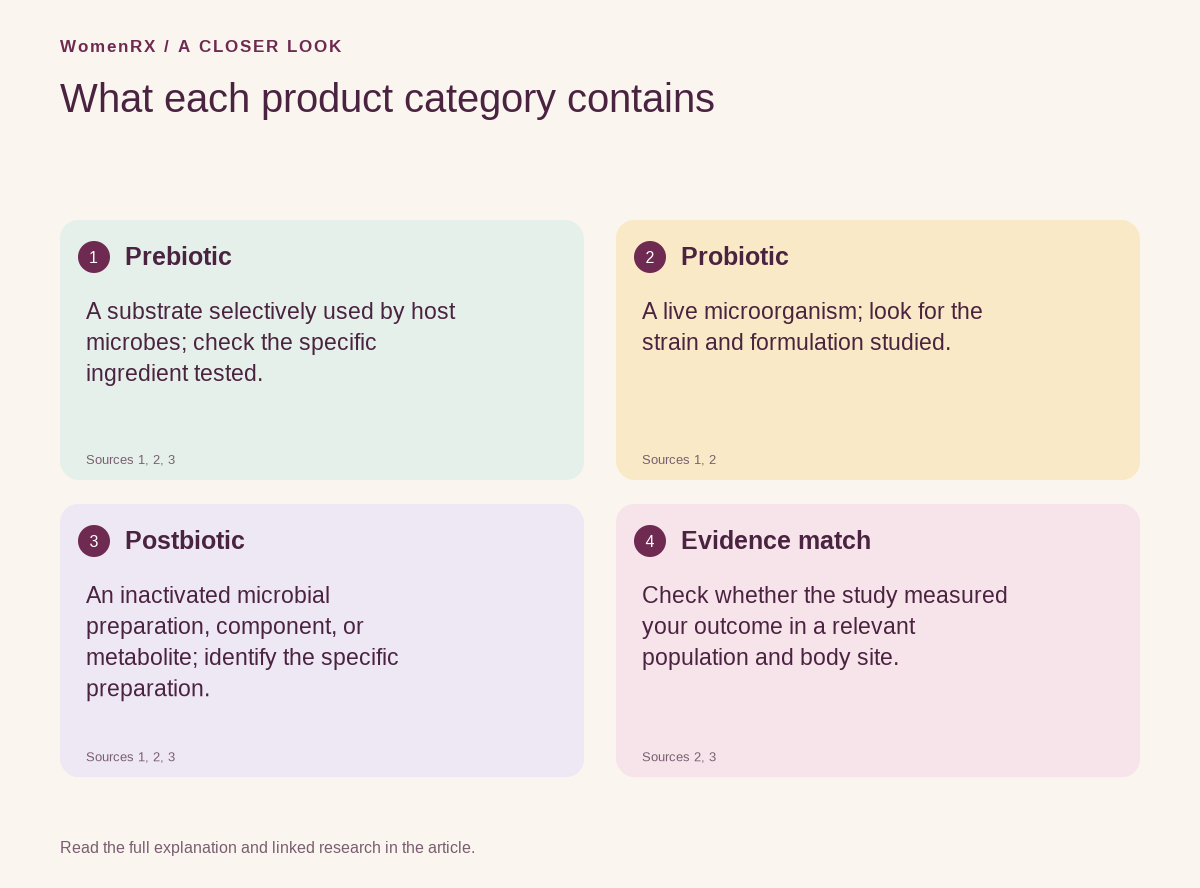
What each product category contains
Prebiotic: A substrate selectively used by host microbes; check the specific ingredient tested.123
Probiotic: A live microorganism; look for the strain and formulation studied.12
Postbiotic: An inactivated microbial preparation, component, or metabolite; identify the specific preparation.123
Evidence match: Check whether the study measured your outcome in a relevant population and body site.23
Read the figure as text
The category identifies the kind of material in a product. To judge a health claim, also match the tested ingredient or strain, population, body site, and outcome.- Prebiotic: A substrate selectively used by host microbes; check the specific ingredient tested.123
- Probiotic: A live microorganism; look for the strain and formulation studied.12
- Postbiotic: An inactivated microbial preparation, component, or metabolite; identify the specific preparation.123
- Evidence match: Check whether the study measured your outcome in a relevant population and body site.23
More questions, answered
Does a probiotic study about the gut support a vaginal-health claim?
Not by itself. Evidence needs to match the intended body site and outcome. Research on microbiome-directed products considers gut and vaginal or urogenital contexts separately, so a gut finding shouldn’t be treated as proof of a vaginal or urinary benefit. 3
Is one of these categories generally better than the others?
There’s no basis here to rank the categories overall. Results depend on the specific product and the outcome studied; even probiotic findings can differ across populations, as the child and adult dental-caries results illustrate. 2
Sources you can check
- Prebiotics, Probiotics, and Postbiotics for Acne Vulgaris: A Systematic Review.Warp PV, Bilik SM, Ferrari LM, Keri JE. · Dermatology and therapy · 2026Return to first citation
- Comparative effectiveness of probiotics, prebiotics, synbiotics, and postbiotics in preventing dental caries: a meta-analysis from an oral microbiota modulation perspective.Lu C, Zhang S, Hong G. · BMC oral health · 2026Return to first citation
- Impact of prebiotics, probiotics, and postbiotics on maternal and fetal health: mechanisms, efficacy, and safety across pregnancy.Cheong KL, Pan T, Wang M, Wang D, Zhong S. · Pediatric research · 2026Return to first citation