What May Help With Bloating, and When to Seek Care
The right next step depends on whether bloating comes with IBS-like pain, constipation, or symptoms that keep getting worse.
No supplement is a universal fix for bloating. Peppermint oil is sometimes used for IBS symptoms, but its support is clearer for IBS-related abdominal pain than for bloating alone. Probiotics aren’t recommended for bloating and distention in AGA guidance. If constipation is part of the pattern, addressing constipation may help; persistent or concerning symptoms deserve assessment rather than more supplement trials. 4 6
Bloating can feel like uncomfortable fullness, and your abdomen may feel swollen. It can occur alongside constipation, diarrhea, or cramps, but the symptom alone doesn’t tell you what’s causing it. IBS is one possible context, especially when bloating comes and goes with abdominal pain and changes in bowel habits. 1 2 3
That context matters when weighing supplements. An option discussed for IBS-related pain is not automatically a proven remedy for bloating by itself.
Match the approach to the pattern
Bloating with IBS-like pain: Peppermint oil is used as an antispasmodic in IBS care. A review describes it as a treatment option for IBS abdominal pain, but that doesn’t establish that it reliably relieves bloating on its own. A separate pharmacy survey found that peppermint-oil users reported symptom improvement, but it was a real-world survey, not a controlled trial showing that peppermint oil caused the improvement. Treat that result as suggestive, not proof. 5 6
Bloating with constipation or difficult emptying: It may be more useful to address the constipation than to reach for a general “bloating” supplement. AGA guidance says constipation treatments should be considered when constipation symptoms are present; it also suggests testing for a pelvic-floor disorder when bloating is linked to constipation or difficult evacuation. 4
Psyllium, also called ispaghula, has limited evidence in a review of IBS treatments, which notes it may help somewhat. That does not show that it treats bloating specifically. 6
Probiotics: AGA guidance advises against using probiotics to treat abdominal bloating and distention. Probiotic findings can vary across strains and studies, so a result involving one product or condition shouldn’t be treated as proof that probiotics in general relieve bloating. 4 6
Track a pattern, not every detail
For a short period, note when bloating happens, whether you also have pain or changes in bowel movements, and whether it follows a recurring pattern. This simple record can help distinguish bloating that travels with constipation or IBS-like symptoms from symptoms that are persistent or changing. IBS symptoms can flare and settle, and may be triggered by food or drink. 2 3
If you notice bloating around your period, include that timing in your notes alongside bowel changes rather than assuming hormones explain it. If you’re pregnant, don’t assume persistent or worsening bloating has a routine explanation; bring it up with your prenatal care team. Persistent or recently worsening symptoms warrant assessment rather than repeated supplement trials. 3 4
If you try a supplement, change one thing at a time and keep track of whether the symptom you’re targeting actually changes. That makes it easier to judge a product without confusing its effect with other changes. This is a practical tracking approach, not a validated test.
When self-treatment isn’t the right next step
Arrange an assessment if bloating is persistent, worsening, or accompanied by other concerning changes. Seek prompt medical attention for unexplained weight loss, blood in your stool, or a new hard lump or swelling in your abdomen. These symptoms need evaluation rather than repeated supplement trials. 3 4
If symptoms have lasted for weeks, a clinician can assess whether IBS fits and whether other causes need to be considered. Bloating has more than one possible cause, and AGA guidance recommends further testing selectively, including when there are alarm features, recent worsening, or an abnormal examination. 2 3 4
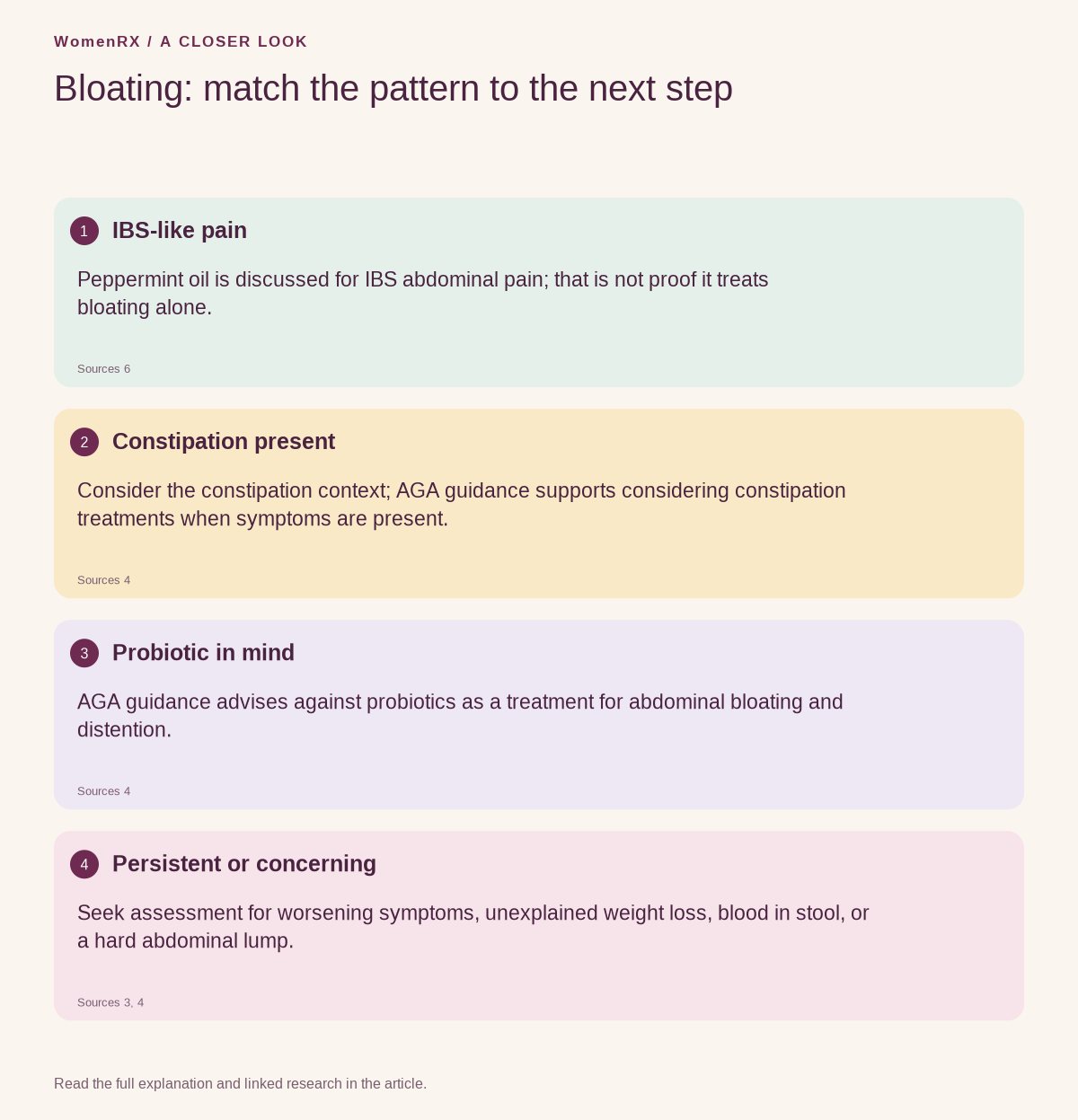
Bloating: match the pattern to the next step
IBS-like pain: Peppermint oil is discussed for IBS abdominal pain; that is not proof it treats bloating alone.6
Constipation present: Consider the constipation context; AGA guidance supports considering constipation treatments when symptoms are present.4
Probiotic in mind: AGA guidance advises against probiotics as a treatment for abdominal bloating and distention.4
Persistent or concerning: Seek assessment for worsening symptoms, unexplained weight loss, blood in stool, or a hard abdominal lump.34
Read the figure as text
This guide separates symptom patterns with different evidence and shows when supplement self-treatment may not be enough.- IBS-like pain: Peppermint oil is discussed for IBS abdominal pain; that is not proof it treats bloating alone.6
- Constipation present: Consider the constipation context; AGA guidance supports considering constipation treatments when symptoms are present.4
- Probiotic in mind: AGA guidance advises against probiotics as a treatment for abdominal bloating and distention.4
- Persistent or concerning: Seek assessment for worsening symptoms, unexplained weight loss, blood in stool, or a hard abdominal lump.34
More questions, answered
Does peppermint oil help bloating?
It may be considered in the context of IBS, but the evidence cited here is clearer for IBS-related abdominal pain than for bloating alone. A pharmacy survey reported improvement among users, but it cannot establish that peppermint oil caused the improvement. 5 6
Are probiotics a good choice for bloating?
AGA guidance advises against probiotics as a treatment for abdominal bloating and distention. Results from one probiotic strain or condition don’t establish a general benefit for bloating. 4 6
Sources you can check
- Irritable Bowel Syndrome | IBS | MedlinePlusAccessed 2026-09-25Return to first citation
- What is IBS (irritable bowel syndrome) - NHSAccessed 2026-09-25Return to first citation
- Symptoms of IBS (irritable bowel syndrome) - NHSAccessed 2026-09-25Return to first citation
- AGA Clinical Practice Update on Evaluation and Management of Belching, Abdominal Bloating, and Distention: Expert Review.Moshiree B, Drossman D, Shaukat A. · Gastroenterology · 2023Return to first citation
- Self-Medication for the Treatment of Abdominal Cramps and Pain-A Real-Life Comparison of Three Frequently Used Preparations.Storr M, Weigmann H, Landes S, Michel MC. · Journal of clinical medicine · 2022Return to first citation
- Treatment of abdominal pain in irritable bowel syndrome.Vanuytsel T, Tack JF, Boeckxstaens GE. · Journal of gastroenterology · 2014Return to first citation