Fezolinetant or Hormone Therapy? A Decision Worksheet
Start with the symptoms you want to ease, then weigh your preferences, health history, and the follow-up each option involves.
Fezolinetant is a nonhormonal prescription treatment for moderate to severe hot flashes and night sweats. Hormone therapy is the most effective treatment for those symptoms and may address other menopause concerns, depending on the type used. The choice depends on what you want treated, your health history and preferences, and whether the required fezolinetant liver tests fit your care. 1 2
If you’re weighing fezolinetant (Veozah) against hormone therapy, begin with the symptoms you most want to change. Then discuss what each option can address, how your health history affects the tradeoffs, and what follow-up you’re willing and able to manage. The goal isn’t to pick a winner in the abstract. It’s to have a useful conversation about what fits your circumstances.
1. Which symptoms are you trying to treat?
Fezolinetant is a nonhormonal prescription medicine for moderate to severe vasomotor symptoms: hot flashes and night sweats. 1 Hormone therapy is the most effective treatment for vasomotor symptoms. Depending on the formulation, hormone therapy may also address other menopause-related concerns: the Menopause Society recommends low-dose vaginal estrogen or certain other treatments for bothersome genitourinary symptoms when over-the-counter options haven’t helped and systemic hormone therapy isn’t indicated. Hormone therapy has also been shown to prevent bone loss and fractures. 2
So if hot flashes are only one part of what’s bothering you, ask about each symptom separately. For example: “Which of these options could help my night sweats, and what would address vaginal dryness?” Fezolinetant’s listed use is for vasomotor symptoms, not vaginal or urinary symptoms. 1
2. How do you feel about hormones?
You might want to avoid hormones, feel open to them, or be unsure and want to understand the tradeoffs first. Say that directly. Personal preference is a valid part of this discussion, and nonhormonal treatments are also considered for people who are not good candidates for hormone therapy. 3
For hormone therapy, risk depends on factors including type, dose, route, duration, timing of initiation, and whether a progestogen is used. The Menopause Society’s 2022 statement describes the benefit-risk balance as generally favorable for people younger than 60 or within 10 years of menopause onset who have no contraindications. It describes the balance as less favorable when starting later or after age 60. These are general recommendations, not an individual risk estimate. 2
Try asking: “How do my age, timing, health history, and preferences affect the benefits and risks of hormone therapy for me?”
3. Review health conditions and medicines
Bring a current list of prescription medicines, over-the-counter medicines, vitamins, and supplements. Fezolinetant should not be used with cirrhosis, severe kidney problems or kidney failure, or certain medicines called CYP1A2 inhibitors. Ask your prescriber or pharmacist to check your full medication list for interactions. 1
Share health conditions that could affect either option. The Menopause Society identifies estrogen-dependent cancers and cardiovascular disease as examples of circumstances that can make someone a poor candidate for hormone therapy. That doesn’t determine your individual options on its own, but it makes a history-specific discussion especially relevant. 3
Questions to bring:
- “Does anything in my medical history change which treatments are suitable?”
- “Could any of my medicines interact with fezolinetant?”
- “Are there hormone therapy options that fit my health history?”
4. Decide whether the monitoring fits
Fezolinetant can cause serious liver problems. The prescribing information calls for a liver blood test before starting, monthly tests during the first three months, and tests at months six and nine. Testing is also called for if symptoms suggest liver problems. 1
Ask where the blood tests would happen and how you’d arrange them. If you develop signs such as unusual tiredness, loss of appetite, nausea or vomiting, itching, yellowing of the eyes or skin, pale stools, dark urine, or abdominal pain while taking fezolinetant, stop taking it right away and call your healthcare provider. 1
5. Keep the evidence comparison fair
Hormone therapy is identified as the most effective treatment for vasomotor symptoms in the Menopause Society’s guidance. Fezolinetant is an evidence-supported nonhormonal option. 2 3 But the randomized trial described here compared fezolinetant with placebo, not with hormone therapy: it enrolled 453 people ages 40 to 65 who were considered unsuitable for hormone therapy, and reported reduced symptom frequency and severity with fezolinetant compared with placebo over 24 weeks. It can support a discussion of fezolinetant as an option; it cannot tell you which treatment works better for you than the other. 4
Take a short worksheet to your appointment
Choose the questions that match your priorities:
- Symptoms: Which symptoms matter most to me, and which options address them?
- Preference: Do I want to avoid hormones, consider them, or hear more before deciding?
- Health history: How do my conditions affect the options and their risks?
- Medicines: Can you or a pharmacist check my medication and supplement list for fezolinetant interactions?
- Monitoring: If we discuss fezolinetant, how would I complete the liver tests and follow-up?
- Practical fit: What would my coverage and out-of-pocket cost be for each option?
A useful final question is: “Based on what matters most to me, what are the reasonable options, and what would we do if the first one doesn’t help enough?”
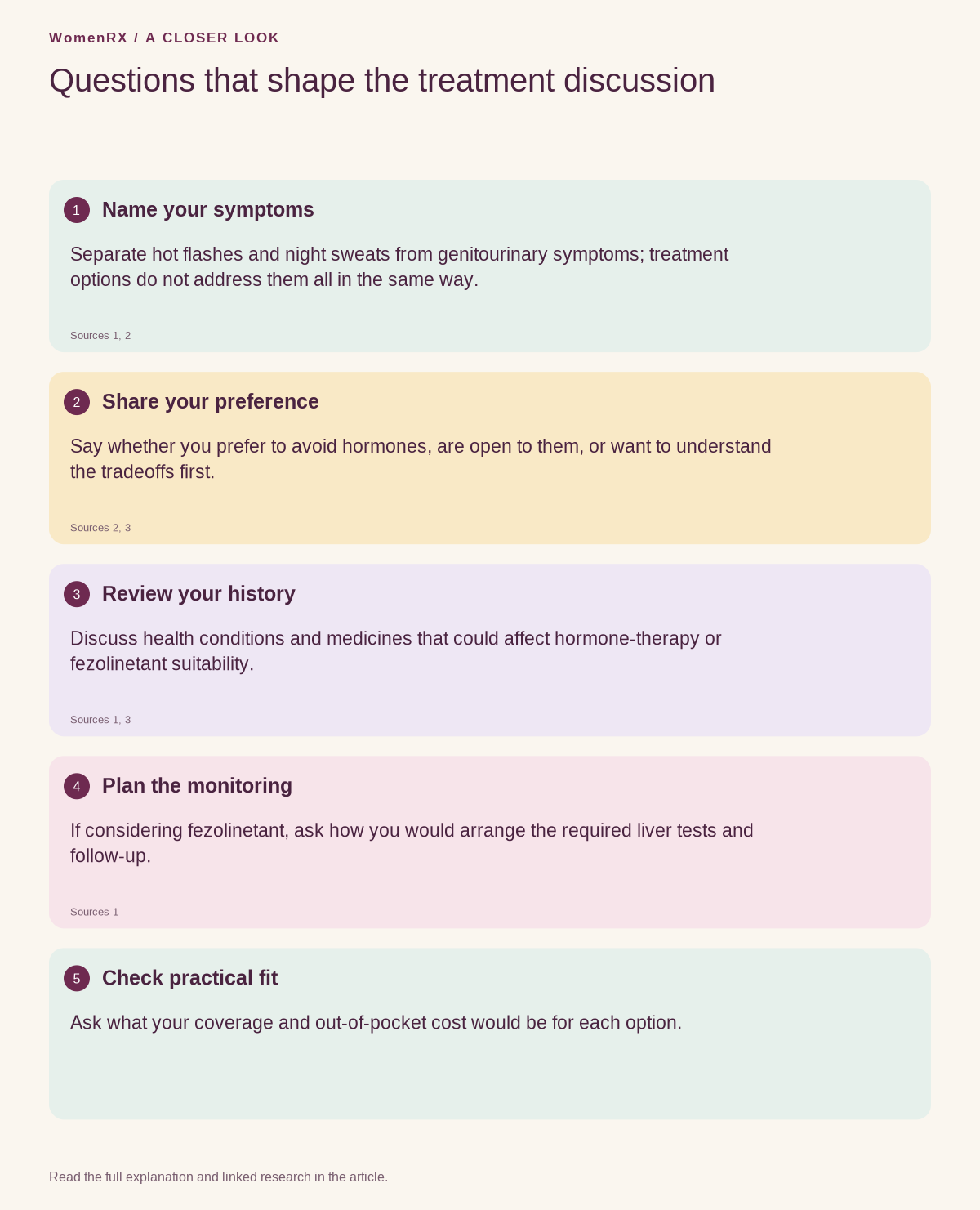
Questions that shape the treatment discussion
Name your symptoms: Separate hot flashes and night sweats from genitourinary symptoms; treatment options do not address them all in the same way.12
Share your preference: Say whether you prefer to avoid hormones, are open to them, or want to understand the tradeoffs first.23
Review your history: Discuss health conditions and medicines that could affect hormone-therapy or fezolinetant suitability.13
Plan the monitoring: If considering fezolinetant, ask how you would arrange the required liver tests and follow-up.1
Check practical fit: Ask what your coverage and out-of-pocket cost would be for each option.
Read the figure as text
Follow these steps to organize a conversation with your prescriber, not to choose a treatment on your own.- Name your symptoms: Separate hot flashes and night sweats from genitourinary symptoms; treatment options do not address them all in the same way.12
- Share your preference: Say whether you prefer to avoid hormones, are open to them, or want to understand the tradeoffs first.23
- Review your history: Discuss health conditions and medicines that could affect hormone-therapy or fezolinetant suitability.13
- Plan the monitoring: If considering fezolinetant, ask how you would arrange the required liver tests and follow-up.1
- Check practical fit: Ask what your coverage and out-of-pocket cost would be for each option.
Sources you can check
- VEOZAH (FEZOLINETANT) TABLET, FILM COATED [ASTELLAS PHARMA US, INC.] | US prescribing information and patient instructionsAccessed 2026-09-25Return to first citation
- The 2022 hormone therapy position statement of The North American Menopause Society.“The 2022 Hormone Therapy Position Statement of The North American Menopause Society” Advisory Panel. · Menopause (New York, N.Y.) · 2022Return to first citation
- The 2023 nonhormone therapy position statement of The North American Menopause Society.Menopause (New York, N.Y.) · 2023Return to first citation
- Efficacy and safety of fezolinetant for moderate-severe vasomotor symptoms associated with menopause in individuals unsuitable for hormone therapy: phase 3b randomised controlled trial.Schaudig K, Wang X, Bouchard C, Hirschberg AL, Cano A, Shapiro C M M, Stute P, Wu X, Miyazaki K, Scrine L, Nappi RE. · BMJ (Clinical research ed.) · 2024Return to first citation