Estradiol Interactions: Medicines and Supplements to Check
Bring the exact estradiol product and a complete list of what you take, because evidence from one hormone product may not apply to another.
For an interaction check, give your pharmacist or prescriber the exact estradiol product, how you use it, and a current list of prescription medicines, over-the-counter products, supplements, and herbs, including anything you recently stopped. Some research concerns combination hormone products or contraceptives, not estradiol alone, so don’t assume those findings apply to your product. 2 4
Start with the product, not just the word “estradiol”
Write down the product’s full name and form: for example, whether it is a pill, patch, gel, spray, or vaginal product. Include every active ingredient listed on the package or prescription label. If it combines estradiol with another hormone, name that ingredient too. A pharmacist can check the actual product rather than trying to match a broad word like “estrogen” to an interaction list.
The distinction matters because research on one hormone combination may not show what happens with estradiol by itself. In a randomized study of healthy young women, researchers tested oral drospirenone combined with either ethinyl estradiol or estradiol alongside ketoconazole. In the estradiol-combination group, drospirenone exposure increased, while estradiol exposure was largely unaffected. That result describes this particular combination and study; it does not establish that ketoconazole has the same effect with every estradiol product. 2
Hormone therapy’s overall benefits and risks can differ with its type and route, among other factors. That is useful context, but it is not proof that a particular medicine interacts differently with every route. The interaction evidence here is too narrow to make that claim. 1 2
What to put on your inventory
Include products you take regularly and those you use only now and then. For each one, note the name on the package, strength if shown, how often you use it, and when you last used it. Include:
- Prescription medicines, including medicines from other prescribers.
- Over-the-counter medicines, such as pain relievers, allergy products, and sleep aids.
- Vitamins, minerals, and other dietary supplements.
- Herbal products, teas, and menopause or “hormone balance” products.
- Recently stopped products, with the date you stopped if you know it.
Bring the containers or clear photos of the labels when possible. For a blend, include the full ingredient panel: a front-label name alone may not show every ingredient. If you don’t know a dose or ingredient, mark it as unknown rather than guessing.
You don’t need to decide for yourself whether a product is risky. The point is to make sure the person checking has enough detail to identify the exact product and ingredients. Don’t stop or change a prescribed medicine based on a general interaction warning; ask about the specific combination first.
What interaction studies can, and can’t, tell you
A study of St. John’s wort and birth-control pills found changes in exposure to norethindrone and ethinyl estradiol, along with more breakthrough bleeding and signs of ovarian activity. Those results concern a particular oral contraceptive, not menopausal estradiol therapy. They’re a reason to disclose St. John’s wort, not evidence that it has the same effect on every estradiol product. 4
Similarly, laboratory research has tested phytoestrogens and other compounds for activity at an estrogen receptor. An effect in a cell assay does not establish a clinically meaningful interaction in a person taking estradiol. 3 Evidence about estrogen-like activity or use as a menopause supplement is not a substitute for a product-specific interaction check.
This is why a useful question is not simply “Does this interact with estradiol?” It is: “Could any ingredient in this exact product affect my estradiol product, or be affected by it?” Add the estradiol label and your inventory to that question, and ask what to do if the check raises a concern.
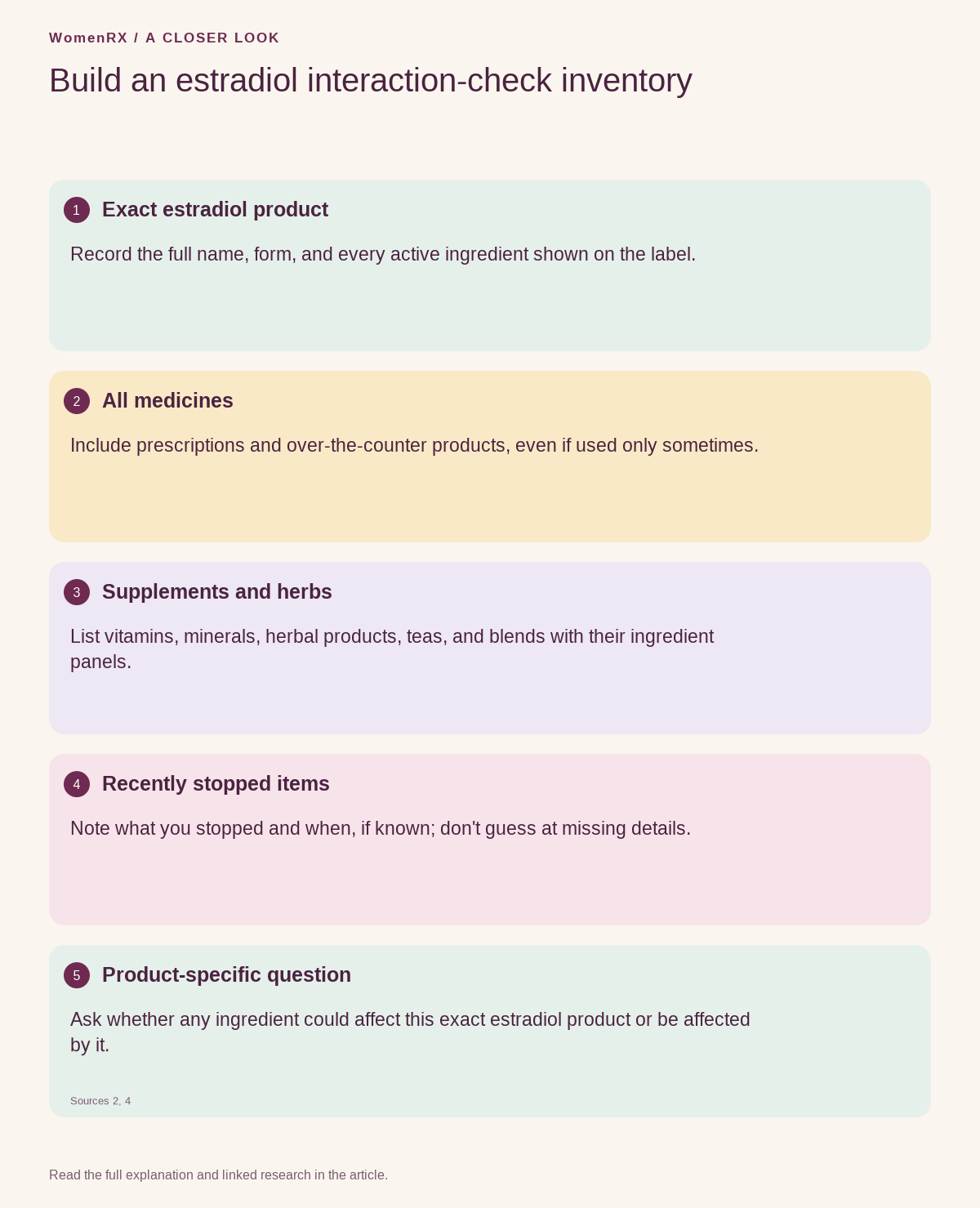
Build an estradiol interaction-check inventory
Exact estradiol product: Record the full name, form, and every active ingredient shown on the label.
All medicines: Include prescriptions and over-the-counter products, even if used only sometimes.
Supplements and herbs: List vitamins, minerals, herbal products, teas, and blends with their ingredient panels.
Recently stopped items: Note what you stopped and when, if known; don't guess at missing details.
Product-specific question: Ask whether any ingredient could affect this exact estradiol product or be affected by it.24
Read the figure as text
Capture the details that let a pharmacist or prescriber check your actual product instead of relying on a broad hormone name.- Exact estradiol product: Record the full name, form, and every active ingredient shown on the label.
- All medicines: Include prescriptions and over-the-counter products, even if used only sometimes.
- Supplements and herbs: List vitamins, minerals, herbal products, teas, and blends with their ingredient panels.
- Recently stopped items: Note what you stopped and when, if known; don't guess at missing details.
- Product-specific question: Ask whether any ingredient could affect this exact estradiol product or be affected by it.24
More questions, answered
Should I include a supplement I only take occasionally?
Yes. Include occasional products and recently stopped ones, and note how often you used them and when you last took them. That gives the person checking a fuller picture without requiring you to judge whether the product matters.
Does a study of birth-control pills tell me whether an herb interacts with menopause hormone therapy?
Not necessarily. The St. John’s wort study involved a specific oral contraceptive containing norethindrone and ethinyl estradiol. Its findings shouldn’t be treated as proof of the same effect with menopausal estradiol products. 4
Sources you can check
- The 2022 hormone therapy position statement of The North American Menopause Society.“The 2022 Hormone Therapy Position Statement of The North American Menopause Society” Advisory Panel. · Menopause (New York, N.Y.) · 2022Return to first citation
- Pharmacokinetic interaction between the CYP3A4 inhibitor ketoconazole and the hormone drospirenone in combination with ethinylestradiol or estradiol.Wiesinger H, Berse M, Klein S, Gschwend S, Höchel J, Zollmann FS, Schütt B. · British journal of clinical pharmacology · 2015Return to first citation
- Prediction and assessment of xenoestrogens mixture effects using the in vitro ERα-CALUX assay.Elskens M, Boonen I, Eisenreich S. · Frontiers in toxicology · 2023Return to first citation
- Interaction of St. John's Wort with oral contraceptives: effects on the pharmacokinetics of norethindrone and ethinyl estradiol, ovarian activity and breakthrough bleeding.Murphy PA, Kern SE, Stanczyk FZ, Westhoff CL. · Contraception · 2005Return to first citation