Low Desire: What to Bring Up at Your Appointment
A useful assessment starts with what changed, whether it troubles you, and what else is happening in your life or body.
Low desire by itself doesn’t tell a clinician what is causing it or whether treatment is needed. Be ready to describe when it began, whether it happens in every situation, how it affects you, and whether pain, medicines, mood, health, or relationship circumstances may be involved. Those details help guide a conversation about next steps and whether a specific treatment fits. 1 2
Start with your experience, not a score
There isn’t one level of sexual desire that everyone should have. A clinician needs to understand whether your desire has changed in a way that bothers you, rather than treating a low number of sexual encounters or a partner’s concern as a diagnosis. Some clinical definitions of low-desire disorders require both a pattern of reduced interest and significant distress. 2 8
You can describe the concern in ordinary language. For example: “I miss wanting sex,” “I’m not bothered by the change, but my partner is,” or “I want closeness, but sex has started to hurt.” Those are different concerns, and they may point to different conversations.
Describe the pattern and what changed
Before the visit, consider a few specifics:
- Onset: Has this been true for as long as you can remember, or did desire change after a period that felt satisfying to you? Clinical descriptions distinguish lifelong from acquired concerns. 8
- Timing: Did the change begin around a particular event, health change, or medication change? Mention menstrual changes, pregnancy or postpartum status, contraception, or menopause if they’re relevant to your situation. These are details for the history, not proof of a cause.
- Where it happens: Is desire low across situations and partners, or does it vary with the setting, kind of intimacy, or relationship circumstances? Some medication indications apply only to a particular, generalized pattern, so this distinction can matter. 2 3
- What you mean by desire: Do you rarely feel interest beforehand but sometimes become interested once intimacy begins? Or do you also have less pleasure, arousal, or physical sensation? Desire and arousal are related, but they aren’t the same experience. 7 8
- How it affects you: Is the change distressing to you, affecting intimacy, or mainly a source of pressure or disagreement? You don’t need to defend your answer.
Low desire can occur alongside other sexual concerns. Pain or discomfort, for instance, may be worth describing directly rather than reporting only “low libido.” A case-control study found more reported sexual difficulties, including pain, among women with recurrent urinary tract infections than among controls; it shows an association in that group, not that UTIs explain low desire for every woman. 9
Bring up medicines, mood, and health
Make a current medication list, including recent changes, and mention supplements or other substances you use. Some medicines and chronic health conditions can affect sexual health. 1 If the change followed starting or changing an antidepressant, say so. A systematic review of trials in women with antidepressant-related sexual dysfunction found possible benefit from bupropion in two studies pooled for analysis, but rated the evidence low certainty. That finding is a reason to discuss options with the prescriber, not to stop or change an antidepressant on your own. 4
Also mention mood, stress, fatigue, ongoing illness, pain, and relationship circumstances if they feel connected. You don’t have to decide which factor is “the cause.” The point is to give the clinician enough context to explore what may be contributing. Low desire and distress are associated with several psychosocial factors in population research, but an association cannot identify the cause in an individual. 5
What an assessment may, and may not, include
Expect questions about your history and the specific parts of sexual function that have changed. A questionnaire may help organize the discussion: for example, the Female Sexual Function Index includes separate domains for desire, arousal, lubrication, orgasm, satisfaction, and pain. A score is one piece of information, not a substitute for your account of what is happening. 6
An exam or test is a reasonable topic to discuss if symptoms or your history raise a specific question. Rather than assuming that a standard lab panel will identify the answer, ask: “What are you checking for?” and “How would the result change what we do?” The relevant assessment depends on the concern being explored.
Make treatment a shared decision
The first step may be addressing a factor identified in your history, such as reviewing a medication concern with its prescriber or discussing pain and other sexual symptoms. If a clinician raises medication for low desire, ask which features of your experience make you a candidate and what benefits, risks, and alternatives apply to you.
In US prescribing information, flibanserin is indicated for women under 65 with acquired, generalized low desire that causes marked distress or interpersonal difficulty, with specified exclusions including alcohol as a cause. Bremelanotide is indicated for premenopausal women with acquired, generalized low desire causing marked distress or interpersonal difficulty when it isn’t due to a co-existing medical or psychiatric condition or a medication or drug substance. These are specific indications, not treatments for every kind of low desire. 2 3
If testosterone comes up, ask whether the conversation concerns a test or a proposed treatment, and what evidence supports it for your particular situation. The information here doesn’t establish testosterone as a general treatment for low desire.
A few questions can keep the visit focused: “What patterns or contributing factors do you see in my history?” “Is there a symptom that should be assessed separately, such as pain?” “What are the reasonable options, and how would we tell whether one is helping?”
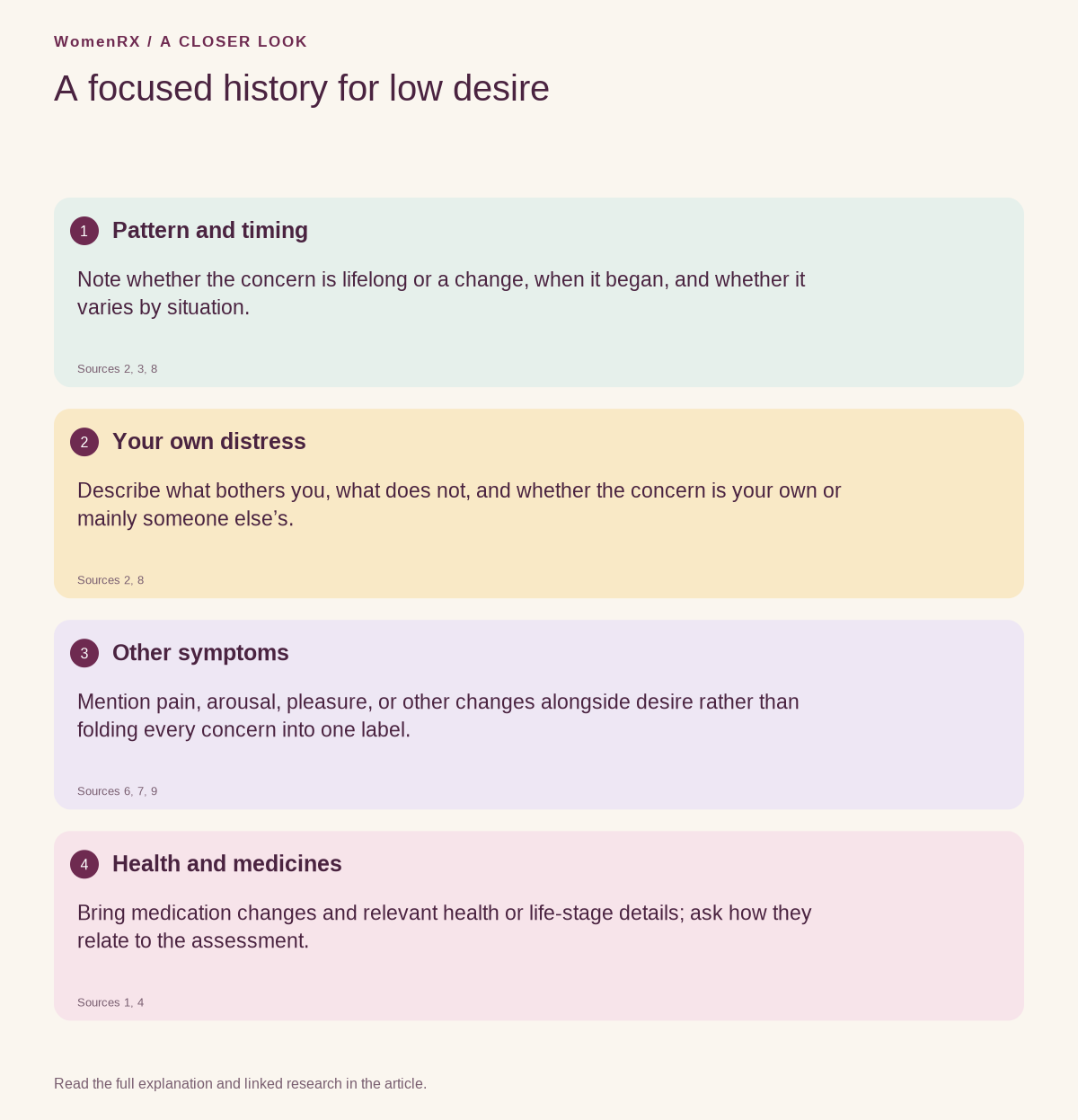
A focused history for low desire
Pattern and timing: Note whether the concern is lifelong or a change, when it began, and whether it varies by situation.238
Your own distress: Describe what bothers you, what does not, and whether the concern is your own or mainly someone else’s.28
Other symptoms: Mention pain, arousal, pleasure, or other changes alongside desire rather than folding every concern into one label.679
Health and medicines: Bring medication changes and relevant health or life-stage details; ask how they relate to the assessment.14
Read the figure as text
Use these prompts to gather the details that can make a conversation about low desire more specific. They are discussion aids, not a diagnostic score.- Pattern and timing: Note whether the concern is lifelong or a change, when it began, and whether it varies by situation.238
- Your own distress: Describe what bothers you, what does not, and whether the concern is your own or mainly someone else’s.28
- Other symptoms: Mention pain, arousal, pleasure, or other changes alongside desire rather than folding every concern into one label.679
- Health and medicines: Bring medication changes and relevant health or life-stage details; ask how they relate to the assessment.14
More questions, answered
Does low desire always mean something is wrong?
No. Low desire alone doesn’t establish a disorder; distress and the person’s own experience matter. Lifelong low desire and asexuality also shouldn’t automatically be treated as the same thing. If you want help with distress or a change, that’s a valid reason to bring it up, without needing to adopt a label. 8
Should I ask for hormone testing?
You can ask whether a test makes sense for your particular history, what it is intended to clarify, and how the result would affect the plan. A test result should be discussed in context rather than treated as an explanation on its own.
Sources you can check
- Sexual Health | MedlinePlusAccessed 2026-09-25Return to first citation
- VYLEESI (BREMELANOTIDE) INJECTION [COSETTE PHARMACEUTICALS, INC.] | US prescribing information and patient instructionsAccessed 2026-09-25Return to first citation
- ADDYI (FLIBANSERIN) TABLET, FILM COATED [SPROUT PHARMACEUTICALS, INC.] | US prescribing information and patient instructionsAccessed 2026-09-25Return to first citation
- Pharmacological treatment of antidepressant-induced sexual dysfunction in women: A systematic review and meta-analysis of randomized clinical trials.de Aquino ACQ, Sarmento ACA, Teixeira RLA, Batista TN, de Freitas CL, Mármol JMP, Lara LAS, Gonçalves AK. · Clinics (Sao Paulo, Brazil) · 2025Return to first citation
- Prevalence of Low Sexual Desire With Associated Distress Across the Adult Life Span: An Australian Cross-Sectional Study.Zheng J, Islam RM, Bell RJ, Skiba MA, Davis SR. · The journal of sexual medicine · 2020Return to first citation
- Sexual Health and Quality of Life in Patients With Low-Risk Early-Stage Cervical Cancer: Results From GCIG/CCTG CX.5/SHAPE Trial Comparing Simple Versus Radical Hysterectomy.Ferguson SE, Brotto LA, Kwon J, Samouelian V, Ferron G, Maulard A, Kroon C, Driel WV, Tidy J, Williamson K, Mahner S, Kommoss S, Goffin F, Tamussino K, Eyjolfsdottir B, Kim JW, Gle... · Journal of clinical oncology : official journal of the American Society of Clinical Oncology · 2025Return to first citation
- Genital arousal and responsive desire among women with and without sexual interest/arousal disorder symptoms.Blumenstock SM, Suschinsky K, Brotto LA, Chivers ML. · The journal of sexual medicine · 2024Return to first citation
- Cognitive processing of sexual cues in asexual individuals and heterosexual women with desire/arousal difficulties.Brown NB, Peragine D, VanderLaan DP, Kingstone A, Brotto LA. · PloS one · 2021Return to first citation
- Assessing the influence of recurrent urinary tract infections on sexual function: a case-control study.Medina-Polo J, Guntiñas-Castillo A, Arrébola-Pajares A, Juste-Álvarez S, de la Calle-Moreno A, Romero-Otero J, Rodríguez-Antolín A. · The journal of sexual medicine · 2025Return to first citation