Ashwagandha and Thyroid Health: What the Evidence Shows
Ashwagandha may shift thyroid blood tests, but the small studies don’t show that it’s a safe or reliable way to treat thyroid disease.
Ashwagandha has been linked to changes in TSH, T3, and T4 in small studies, and case reports describe thyrotoxicosis, a condition involving excess thyroid hormone, in women taking it. That’s a reason for caution if you have a thyroid condition or take thyroid medicine, not evidence that the herb treats thyroid disease. Don’t change your medicine based on supplement use; discuss the product and any lab-monitoring plan with the clinician managing your thyroid care. 1
What thyroid studies have found
The evidence points to a possible effect on thyroid hormone levels, but it’s too limited to predict what will happen for a particular person. In one small, 8-week trial, 50 people with subclinical hypothyroidism received ashwagandha root extract or placebo. Compared with placebo, the ashwagandha group had lower TSH and higher T3 and T4 at the end of the study. The study suggests the herb can affect thyroid measurements; it does not establish ashwagandha as a treatment or show that changing those measurements improves health over time. 1
A separate report looked at thyroid tests collected during an 8-week placebo-controlled trial in people with bipolar disorder. Thyroid function wasn’t the trial’s main question. The report focused on a selected group whose thyroid results were abnormal at the beginning or end of the study; three ashwagandha-treated members of that group were men. All three had an increase in T4 from their baseline. That small, incidental finding can’t establish how often this happens or what it means for women or for people with thyroid disease. 1 3
There are also three case reports of women who developed thyrotoxicosis, a condition involving excess thyroid hormone, while taking ashwagandha extract. The reports don’t show how likely this outcome is: doses weren’t specified in two cases, and the third involved a high dose. Symptoms resolved after the women stopped the extract. Case reports can raise a safety signal, but they can’t prove the supplement caused the problem or estimate the risk. 1
Taken together, the findings are a reason to take possible changes seriously, not a reason to assume ashwagandha will reliably raise or lower thyroid hormones. Studies used different preparations, including root-only and root-and-leaf extracts; they don’t establish whether effects differ by product or predict what a particular person will experience. 1
What this means if you take thyroid medicine
The available evidence doesn’t establish a specific interaction between ashwagandha and levothyroxine, or show what dose, timing, or product would be safe alongside thyroid medicine. But because ashwagandha may affect thyroid measurements and the NIH Office of Dietary Supplements says it might interact with thyroid hormone medications, it’s sensible to bring it up before starting it. 1
The French Agency for Food, Environmental, and Occupational Health and Safety (ANSES) has recommended against ashwagandha use for people with endocrine disorders. That guidance is relevant if you have a thyroid condition, but it isn’t proof of a specific levothyroxine interaction or that harm is inevitable. 1
Levothyroxine treatment needs careful adjustment: its US prescribing information warns that too much or too little can affect several body systems, including cardiovascular, bone, reproductive, and cognitive function. Don’t stop, start, or change your thyroid medicine to accommodate a supplement on your own. 2
If you’re discussing ashwagandha with the clinician managing your thyroid care, bring the bottle or a photo of its label. Share:
- The product name and listed ingredients, including whether it contains root, leaf, or both.
- How much you take, how often, and when you started or stopped.
- Your thyroid medicine and any recent changes to it.
- Any new symptoms or thyroid test results since starting the supplement.
Ask whether your thyroid tests should be checked and when, based on your own diagnosis and treatment. The evidence doesn’t establish a standard monitoring schedule for ashwagandha use. Don’t assume that spacing used for other supplements or medicines applies to ashwagandha; ask specifically about timing with your medication.
What the evidence says about women’s life stages
The case reports of thyrotoxicosis involved women, but they can’t tell us whether the risk differs by age or life stage. They don’t provide a basis for separate conclusions about cycling years, perimenopause, or postmenopause. 1
There is one relevant study in pregnancy: a 12-week randomized, open-label trial enrolled 70 women in their second trimester and assessed thyroid markers while comparing root extract plus standard treatment for anemia with standard treatment alone. The researchers reported no detrimental change in thyroid function. That finding is limited to this small study and doesn’t establish safety for pregnant women with thyroid disease or those taking thyroid medicine. The NIH Office of Dietary Supplements notes that some experts advise against ashwagandha during pregnancy; this study does not settle its overall safety in pregnancy. 4 1
The practical takeaway is straightforward: ashwagandha may affect thyroid levels, but current findings don’t show that it’s a dependable thyroid treatment or define its safety alongside thyroid medicine. If you have a thyroid condition, make the decision with the person managing your thyroid care, using the exact product and your treatment history.
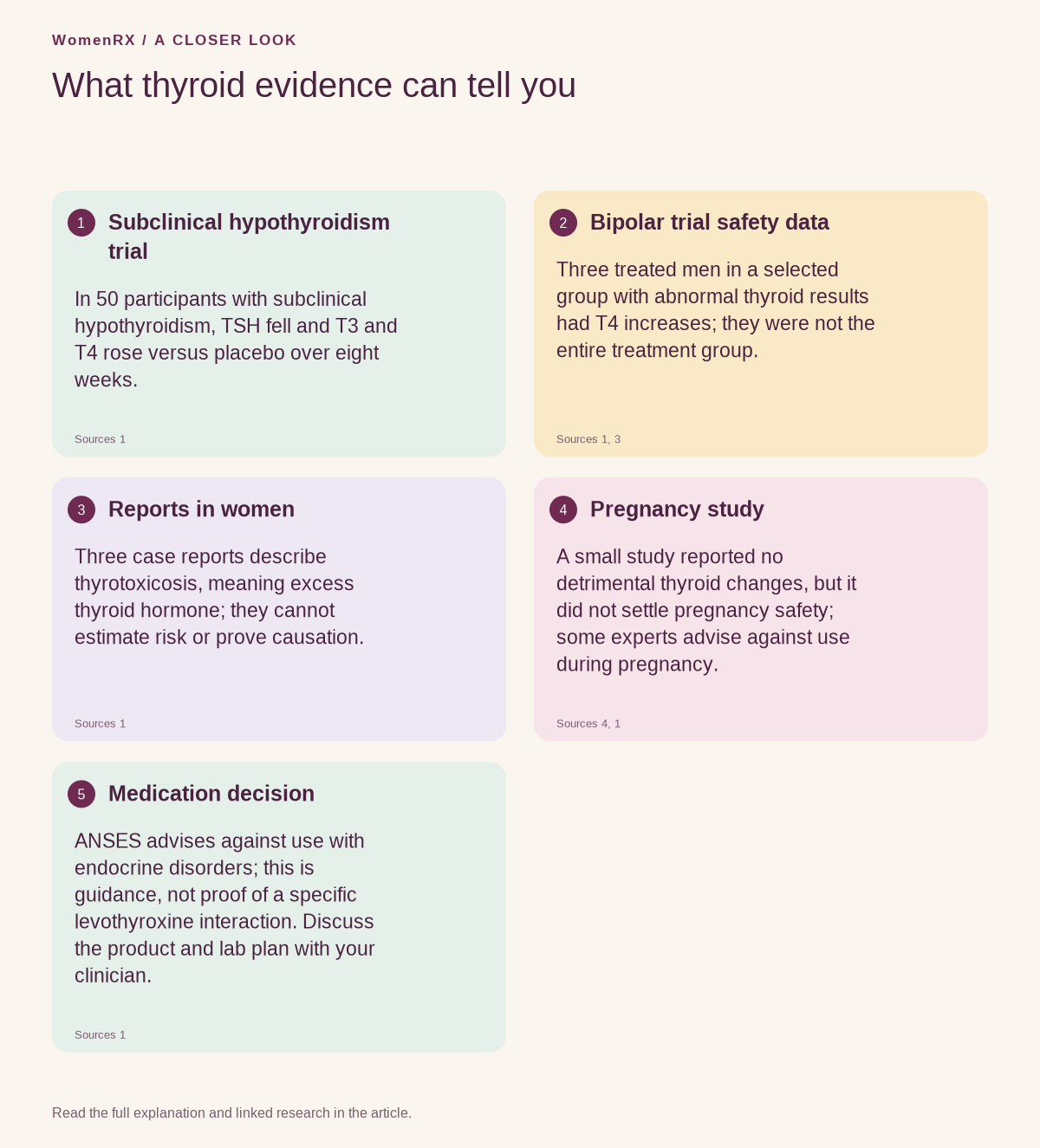
What thyroid evidence can tell you
Subclinical hypothyroidism trial: In 50 participants with subclinical hypothyroidism, TSH fell and T3 and T4 rose versus placebo over eight weeks.1
Bipolar trial safety data: Three treated men in a selected group with abnormal thyroid results had T4 increases; they were not the entire treatment group.13
Reports in women: Three case reports describe thyrotoxicosis, meaning excess thyroid hormone; they cannot estimate risk or prove causation.1
Pregnancy study: A small study reported no detrimental thyroid changes, but it did not settle pregnancy safety; some experts advise against use during pregnancy.41
Medication decision: ANSES advises against use with endocrine disorders; this is guidance, not proof of a specific levothyroxine interaction. Discuss the product and lab plan with your clinician.1
Read the figure as text
The findings range from measured lab changes to case reports; none establishes ashwagandha as a thyroid treatment or defines its safety with thyroid medicine.- Subclinical hypothyroidism trial: In 50 participants with subclinical hypothyroidism, TSH fell and T3 and T4 rose versus placebo over eight weeks.1
- Bipolar trial safety data: Three treated men in a selected group with abnormal thyroid results had T4 increases; they were not the entire treatment group.13
- Reports in women: Three case reports describe thyrotoxicosis, meaning excess thyroid hormone; they cannot estimate risk or prove causation.1
- Pregnancy study: A small study reported no detrimental thyroid changes, but it did not settle pregnancy safety; some experts advise against use during pregnancy.41
- Medication decision: ANSES advises against use with endocrine disorders; this is guidance, not proof of a specific levothyroxine interaction. Discuss the product and lab plan with your clinician.1
More questions, answered
Should I stop taking ashwagandha before a thyroid test?
Tell the person ordering your test that you take ashwagandha, including when you started or stopped it. Ask whether they want you to make any change before the test, rather than stopping it on your own. 1
Sources you can check
- Ashwagandha: Is it helpful for stress, anxiety, or sleep? - Health Professional Fact SheetAccessed 2026-09-25Return to first citation
- LEVOTHYROXINE SODIUM TABLET [CARDINAL HEALTH 107, LLC] | US prescribing information and patient instructionsAccessed 2026-09-25Return to first citation
- Subtle changes in thyroid indices during a placebo-controlled study of an extract of Withania somnifera in persons with bipolar disorder.Gannon JM, Forrest PE, Roy Chengappa KN. · Journal of Ayurveda and integrative medicine · 2014Return to first citation
- Efficacy and safety of Ashwagandha (Withania somnifera) root extract in pregnant women: a prospective, randomized, comparative, open-label, 12-week study.Ajgaonkar A, Tayade H, Nayak A. · Frontiers in global women's health · 2026Return to first citation