What to Know Before Taking a Spermidine Supplement
Human studies have tested different spermidine products and amounts, but they haven’t established a general-purpose dose or long-term safety for every person.
There isn’t an established spermidine supplement dose for general health or for women. Small studies have tested different forms and amounts in older adults, including women, but the results don’t make those study doses interchangeable or prove a benefit for women generally. Check what the label counts as spermidine versus extract, and treat pregnancy, breastfeeding, and long-term safety as unanswered questions.
Start with the benefit you want
Spermidine is a compound found naturally in foods, and supplements have been studied for possible effects on areas such as memory and immune response. But a proposed benefit is not the same as a proven reason to take a supplement. In a 12-month randomized trial of 100 adults aged 60 to 90 with subjective cognitive decline, a wheat-germ supplement providing 0.9 mg of spermidine daily did not improve the main memory measure compared with placebo. Exploratory findings need more study; they don’t establish a memory benefit. 3
A small pilot trial in adults over 65 reported improved vaccine-response measures in some participants with weak responses after a COVID-19 booster. That finding is preliminary and specific to that setting. It doesn’t show that spermidine is a general immune booster or that it prevents illness. 4
Before comparing products, name the intended benefit. Then ask whether human research tested that outcome in people like you, using the same kind of product. Animal findings and a biological explanation for how a supplement might work can guide research, but they don’t establish a benefit in people.
Food exposure and supplements aren’t interchangeable
Spermidine occurs in foods, but the studies summarized here tested supplements, not a comparison of ordinary food intake with concentrated products. One trial used a spermidine-rich wheat-germ extract; another tested high-purity spermidine trihydrochloride. Those study results don’t tell you that a food serving and a supplement serving provide the same amount or effect. 1 2 3
That distinction matters on a label. Look for whether the stated amount refers to spermidine itself, a spermidine salt such as spermidine trihydrochloride, or the weight of a larger extract. Also check the serving size and whether the product includes other ingredients. A label amount can help you identify what a product contains, but it cannot show that the product matches a study unless the form and amount are comparable.
Study amounts are not recommended doses
The human studies used different products and amounts. A three-month safety trial in 30 adults aged 60 to 80 used a wheat-germ extract providing 1.2 mg of spermidine daily. The 12-month memory trial used a wheat-germ extract providing 0.9 mg daily. A separate trial tested 40 mg per day of high-purity spermidine trihydrochloride in 37 healthy men aged 50 to 70, for up to 28 days. 1 2 3
Those figures aren’t a dose range to choose from. The products, study groups, and durations differed, and the reported amount for a salt or extract may not be directly comparable with the amount in another product. One shorter study in 40 adults over 65 also tested 6 mg daily for 13 weeks after a COVID-19 booster, for a specific immune-response question. That doesn’t establish a general dose either. 4
A useful label check is to write down three things: the amount per serving, what that amount measures, and the full ingredient form. Compare those details with a study only when they genuinely match. If the label makes a health claim, look for human evidence for that exact outcome rather than assuming a dose used in one study supports the claim.
What safety studies can and can’t tell you
In the 12-month trial, adverse events were balanced between the spermidine and placebo groups. The three-month trial also found no significant differences in the safety measures it assessed. These are reassuring findings for the studied products and groups, but trials of this size and duration cannot settle safety for all users or establish what happens with use over many years. 1 3
The 40 mg trihydrochloride trial included healthy older men and lasted no more than 28 days. It reported no study-product-related adverse events, but it cannot answer questions about women, longer-term use, or other populations. 2
Women were included in some older-adult research: the 12-month trial included 49 women among 100 participants, and the vaccine-response pilot reported 9 women in the placebo group and 13 in the spermidine group. These studies don’t establish a benefit or safety profile specific to women; the reported results do not provide a basis for a women-specific dose. 3 4
The studies described involved older adults, not people taking spermidine during pregnancy or breastfeeding. They don’t establish effects on pregnancy, breastfeeding, or reproductive outcomes. If one of those situations applies to you, don’t use an older-adult study dose as reassurance; get advice suited to your circumstances before choosing a supplement.
A practical decision check
Before buying or continuing a product, make sure you can answer these questions:
- What specific benefit am I seeking, and was that outcome tested in people?
- Does the label state spermidine itself, a salt, or an extract amount?
- Does the study product match the label’s form and amount?
- Were the participants and study length relevant to my situation?
- What safety questions, especially for long-term or reproductive use, remain open?
If the intended benefit is still uncertain or the product’s amount is hard to interpret, that’s a reason to pause rather than borrow a dose from a study using a different formulation.
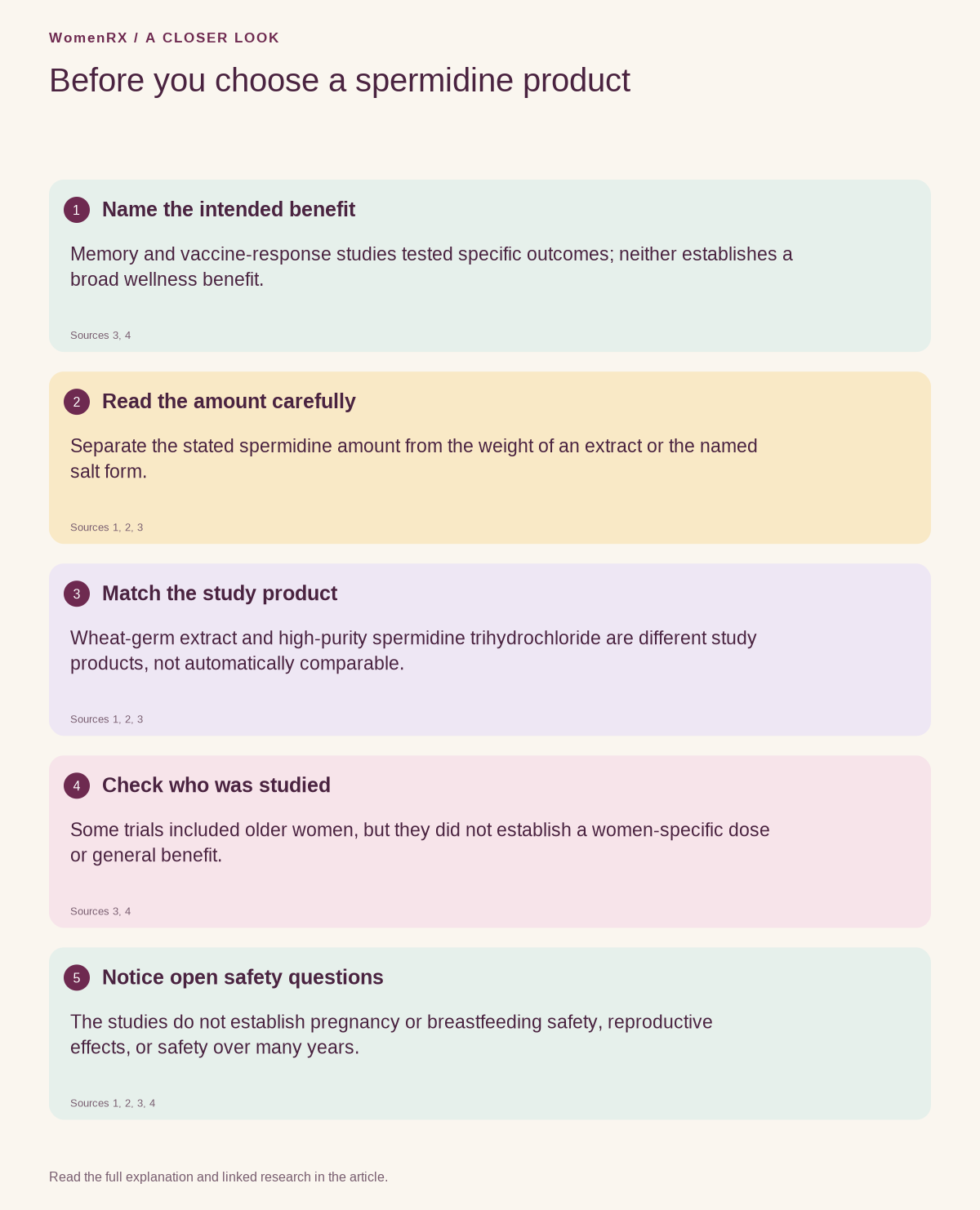
Before you choose a spermidine product
Name the intended benefit: Memory and vaccine-response studies tested specific outcomes; neither establishes a broad wellness benefit.34
Read the amount carefully: Separate the stated spermidine amount from the weight of an extract or the named salt form.123
Match the study product: Wheat-germ extract and high-purity spermidine trihydrochloride are different study products, not automatically comparable.123
Check who was studied: Some trials included older women, but they did not establish a women-specific dose or general benefit.34
Notice open safety questions: The studies do not establish pregnancy or breastfeeding safety, reproductive effects, or safety over many years.1234
Read the figure as text
Use these checks to connect your intended benefit with the product label and the limits of human study evidence.- Name the intended benefit: Memory and vaccine-response studies tested specific outcomes; neither establishes a broad wellness benefit.34
- Read the amount carefully: Separate the stated spermidine amount from the weight of an extract or the named salt form.123
- Match the study product: Wheat-germ extract and high-purity spermidine trihydrochloride are different study products, not automatically comparable.123
- Check who was studied: Some trials included older women, but they did not establish a women-specific dose or general benefit.34
- Notice open safety questions: The studies do not establish pregnancy or breastfeeding safety, reproductive effects, or safety over many years.1234
More questions, answered
Is there a proven spermidine dose for women?
No dose for women generally is established by these studies. Some trials included women, but they tested particular products in older adults and did not establish a women-specific dose or general benefit. 3 4
Does a higher amount mean a stronger benefit?
The studies don’t establish that. They tested different formulations, populations, durations, and outcomes, so their amounts can’t be read as a head-to-head comparison of benefit. 1 2 3 4
Sources you can check
- Safety and tolerability of spermidine supplementation in mice and older adults with subjective cognitive decline.Schwarz C, Stekovic S, Wirth M, Benson G, Royer P, Sigrist SJ, Pieber T, Dammbrueck C, Magnes C, Eisenberg T, Pendl T, Bohlken J, Köbe T, Madeo F, Flöel A. · Aging · 2018Return to first citation
- Supplementation of spermidine at 40 mg/day has minimal effects on circulating polyamines: An exploratory double-blind randomized controlled trial in older men.Keohane P, Everett JR, Pereira R, Cook CM, Blonquist TM, Mah E. · Nutrition research (New York, N.Y.) · 2024Return to first citation
- Effects of Spermidine Supplementation on Cognition and Biomarkers in Older Adults With Subjective Cognitive Decline: A Randomized Clinical Trial.Schwarz C, Benson GS, Horn N, Wurdack K, Grittner U, Schilling R, Märschenz S, Köbe T, Hofer SJ, Magnes C, Stekovic S, Eisenberg T, Sigrist SJ, Schmitz D, Wirth M, Madeo F, Flöel A... · JAMA network open · 2022Return to first citation
- Spermidine Mitigates Immune Cell Senescence and Boosts Vaccine Responses in Healthy Older Adults-A Pilot Study.Alsaleh G, Ali M, Kayvanjoo AH, Liu F, Moreau T, Bibi S, Luo L, Govender M, Carroll M, Hofer SJ, Tobias E, Magnes C, Kell L, Chung C, Deng Y, Bhandari A, Garner LC, Conrad T, Chen ... · Aging cell · 2026Return to first citation