Spermidine Timing: Does Morning or Night Matter?
Human trials have studied daily spermidine use, but this research doesn’t compare morning dosing with evening dosing.
There’s no demonstrated reason to take spermidine in the morning rather than at night, or vice versa: the human trials discussed here report daily schedules, not head-to-head clock-time comparisons. Follow your product’s directions, especially if they specify whether to take it with food. Check that the product matches the form and amount used in any study it cites; a different supplement isn’t automatically comparable. 1 2 3
What the human studies actually tested
The main timing question is whether researchers compared the same spermidine product at different times of day and found a difference. The human trials discussed here don’t report that comparison. Instead, they describe daily use over a set period. That tells you what participants were assigned to take, not whether morning or evening works better.
For example, one 12-month trial in 100 adults aged 60 to 90 with subjective cognitive decline used a wheat-germ extract providing 0.9 mg of spermidine per day. The study included 49 women, but it didn’t report a women-specific timing comparison. 2 A separate short trial tested 40 mg per day of high-purity spermidine trihydrochloride in 37 healthy men aged 50 to 70. Its report gives the daily amount and study periods, but no morning-versus-night test. 1 Another small study gave 15 mg daily to 12 healthy volunteers during two five-day intervention periods; the reported findings don’t establish a preferred time of day either. 3
These are different products and study designs. Taken together, they don’t establish a clock-time rule, and they don’t show that women need a different schedule.
Use the label for practical details
If your product says to take it with food, follow that direction. If it gives a time or a particular daily routine, use the instructions for that product rather than borrowing a schedule from a study that tested something different. The label can guide how to take that specific product; it isn’t proof that its timing improves absorption, sleep, or results.
When a label cites research, compare a few details before treating the study schedule as relevant to your bottle:
- Form: Was the study on wheat-germ extract, purified spermidine, spermidine trihydrochloride, or a blend? The trials above used different preparations. 1 2
- Amount: Does the study’s daily spermidine amount match what the label says? A daily amount in a trial doesn’t tell you when to take it. 1 2 3
- Instructions: Does the study report taking the product with food or at a particular time? The trial reports summarized here don’t give a morning-versus-evening comparison.
For instance, a label that cites a wheat-germ extract study doesn’t make a purified spermidine product the same preparation. And a trial’s daily schedule shouldn’t be recast as evidence for breakfast, bedtime, or taking it on an empty stomach.
A routine can be about consistency, not the clock
If the label doesn’t specify a time, choosing a time that fits your routine may make it easier to remember. That’s a convenience choice, not a proven way to make spermidine work better. There’s also no evidence in these trials that bedtime improves sleep or that morning use improves outcomes.
The evidence has a clear boundary: the reports describe daily use, but don’t tell us whether timing or meal context changes outcomes. So there’s no research-based reason here to set an alarm for a particular hour. During pregnancy or breastfeeding, don’t assume the schedules studied in older or other adult groups apply; the trials described don’t establish a routine for those situations. 1 2 3
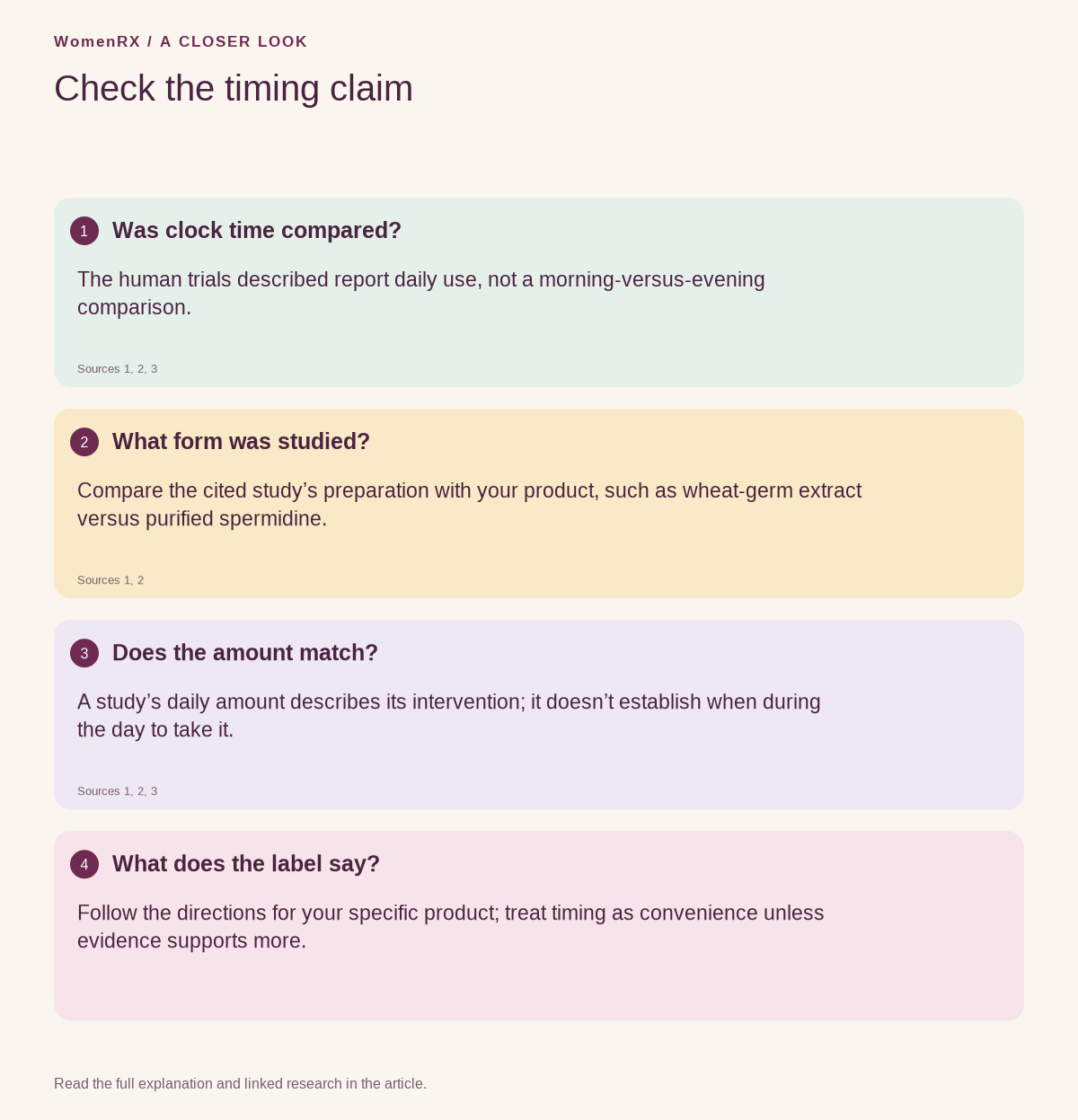
Check the timing claim
Was clock time compared?: The human trials described report daily use, not a morning-versus-evening comparison.123
What form was studied?: Compare the cited study’s preparation with your product, such as wheat-germ extract versus purified spermidine.12
Does the amount match?: A study’s daily amount describes its intervention; it doesn’t establish when during the day to take it.123
What does the label say?: Follow the directions for your specific product; treat timing as convenience unless evidence supports more.
Read the figure as text
Use these checks to separate a tested schedule from product directions and a study that may use a different preparation.- Was clock time compared?: The human trials described report daily use, not a morning-versus-evening comparison.123
- What form was studied?: Compare the cited study’s preparation with your product, such as wheat-germ extract versus purified spermidine.12
- Does the amount match?: A study’s daily amount describes its intervention; it doesn’t establish when during the day to take it.123
- What does the label say?: Follow the directions for your specific product; treat timing as convenience unless evidence supports more.
More questions, answered
Do women need to take spermidine at a different time?
The human studies described here don’t establish a different schedule for women. One trial included 49 women, but it didn’t report a women-specific comparison of morning and evening use. 2
What if I’m pregnant or breastfeeding?
The trials described here don’t establish whether spermidine supplements are suitable or what schedule to use during pregnancy or breastfeeding. Ask a clinician or pharmacist for individualized guidance before using it in those situations. 1 2 3
Sources you can check
- Supplementation of spermidine at 40 mg/day has minimal effects on circulating polyamines: An exploratory double-blind randomized controlled trial in older men.Keohane P, Everett JR, Pereira R, Cook CM, Blonquist TM, Mah E. · Nutrition research (New York, N.Y.) · 2024Return to first citation
- Effects of Spermidine Supplementation on Cognition and Biomarkers in Older Adults With Subjective Cognitive Decline: A Randomized Clinical Trial.Schwarz C, Benson GS, Horn N, Wurdack K, Grittner U, Schilling R, Märschenz S, Köbe T, Hofer SJ, Magnes C, Stekovic S, Eisenberg T, Sigrist SJ, Schmitz D, Wirth M, Madeo F, Flöel A... · JAMA network open · 2022Return to first citation
- High-Dose Spermidine Supplementation Does Not Increase Spermidine Levels in Blood Plasma and Saliva of Healthy Adults: A Randomized Placebo-Controlled Pharmacokinetic and Metabolomic Study.Senekowitsch S, Wietkamp E, Grimm M, Schmelter F, Schick P, Kordowski A, Sina C, Otzen H, Weitschies W, Smollich M. · Nutrients · 2023Return to first citation