What We Know About Long-Term Spermidine Safety
Research on aging pathways hasn’t established whether taking a spermidine supplement for years is safe.
Long-term safety for spermidine supplements isn’t established. A 60-day report involving 15 men included spermidine only as an untested ingredient in an enclomiphene-containing treatment, so it offers little reassurance about a spermidine supplement on its own. A longer study was conducted in rats, not people. Neither finding answers the safety question for women, including during pregnancy or breastfeeding. 123
If you’re deciding whether to keep taking spermidine, the key question isn’t simply whether a study mentions it. It’s whether people took something like your supplement, for roughly as long as you plan to take it, with safety outcomes carefully assessed. This research doesn’t make that match. 123
The human report wasn’t a spermidine safety trial
One report followed 15 men with symptomatic hypogonadism for 60 days while they took a treatment containing enclomiphene, boron, vitamin C, and 10 mg of spermidine trihydrochloride per daily dose. Its main purpose was to describe changes in testosterone, not to test spermidine alone or establish supplement safety. Spermidine was an untested co-ingredient. 2
No serious adverse events were documented during those 60 days. But the study was a retrospective case series with no control group. Adverse-event monitoring was passive, and safety laboratory measurements weren’t systematically obtained for everyone. That means the report could miss problems, cannot separate the effects of spermidine from the other ingredients, and says little about use beyond two months. 2
The amount listed in that report is not a safety threshold for your product. Even if your label lists the same amount, the men took it in a different formulation and alongside other active ingredients. If your product lists a different form or amount, the comparison is weaker still. 2
A longer study followed rats, not people
Researchers gave spermidine to rats in a Parkinson’s disease model for up to 178 days. They reported that the biochemical safety parameters they measured remained within normal ranges, including measures used to assess kidney and liver function. That’s useful animal evidence about those measured outcomes under those study conditions. It doesn’t tell us whether a woman taking a supplement for months or years would have the same result. 1
Spermidine also attracts interest because of its effects on aging-related biological pathways. A review of interventions targeting those pathways says long-term safety and efficacy in healthy populations remain incompletely defined. A plausible mechanism is a reason to study a supplement, not proof that it extends human life or provides an anti-aging benefit for women. 13
What matters for your decision
Spermidine is a naturally occurring compound found in living cells. Natural occurrence, though, doesn’t establish that a particular supplemental form or amount is safe to take long term. 2
When weighing a product’s claims, check whether the cited human research actually tested spermidine on its own, who took it, how long they were followed, and whether adverse events and safety measurements were actively collected. The report identifies its participants as 15 men and its follow-up as 60 days, but those details don’t answer whether a woman can safely take a spermidine-only supplement for years. It also used passive adverse-event monitoring and didn’t systematically collect safety labs for everyone, so it offers limited safety information rather than long-term reassurance. 2
It also involved men, so it provides no results for cycling years, perimenopause, postmenopause, pregnancy, or breastfeeding. If you’re pregnant or breastfeeding, you can’t use that report or the rat study to resolve the safety question. The uncertainty isn’t evidence that spermidine is harmful; it’s a reason not to mistake a short combination-treatment report or an animal result for long-term reassurance. 12
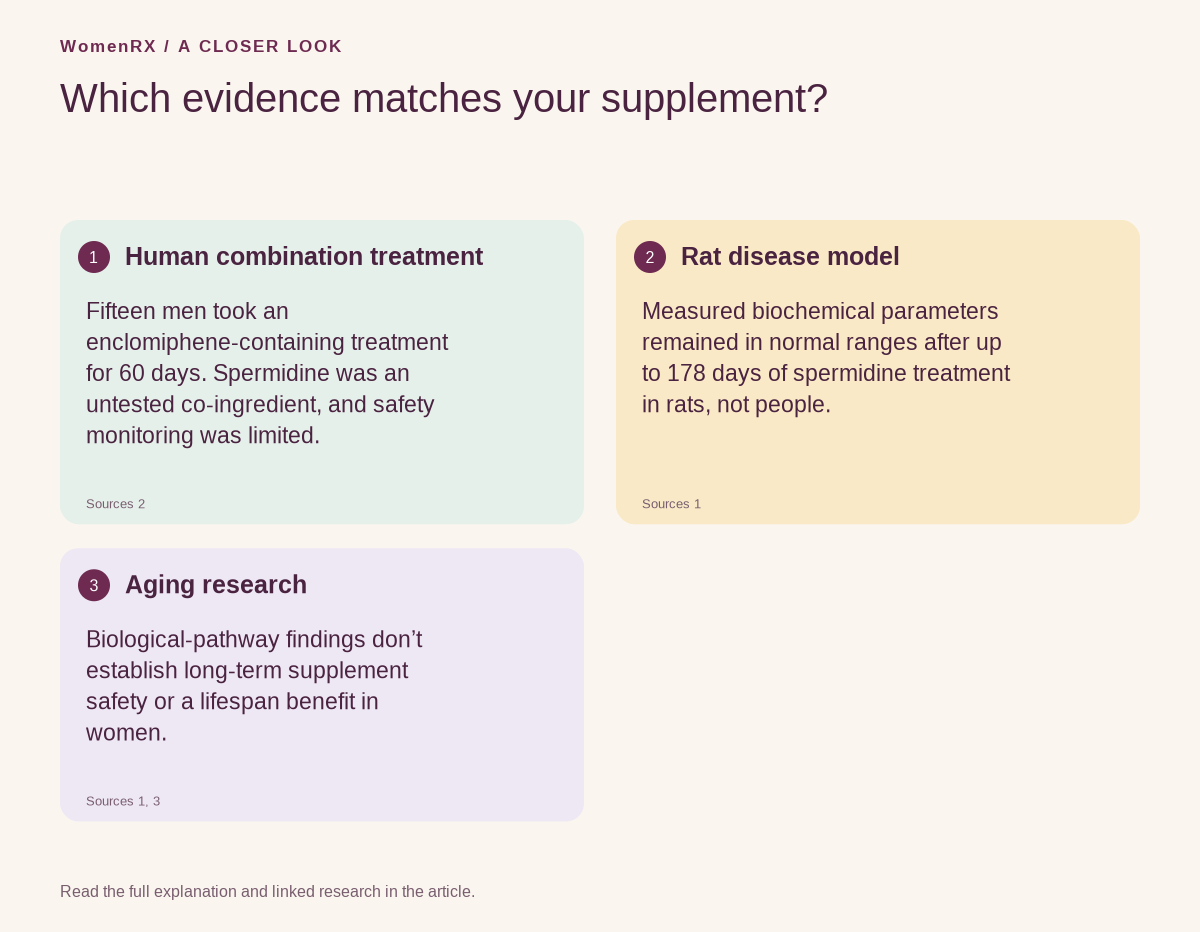
Which evidence matches your supplement?
Human combination treatment: Fifteen men took an enclomiphene-containing treatment for 60 days. Spermidine was an untested co-ingredient, and safety monitoring was limited.2
Rat disease model: Measured biochemical parameters remained in normal ranges after up to 178 days of spermidine treatment in rats, not people.1
Aging research: Biological-pathway findings don’t establish long-term supplement safety or a lifespan benefit in women.13
Read the figure as text
The duration of a study matters, but so do the species, formulation, and purpose of the research.- Human combination treatment: Fifteen men took an enclomiphene-containing treatment for 60 days. Spermidine was an untested co-ingredient, and safety monitoring was limited.2
- Rat disease model: Measured biochemical parameters remained in normal ranges after up to 178 days of spermidine treatment in rats, not people.1
- Aging research: Biological-pathway findings don’t establish long-term supplement safety or a lifespan benefit in women.13
Sources you can check
- Spermidine Suppresses Peripheral Inflammation and Alleviates Non-Motor Symptoms in the 6-OHDA-Induced Rat Model of Parkinson's Disease.Grembecka B, Harackiewicz O, Ruciński J, Korewo-Labelle D, Kurowska-Rucińska E, Majkutewicz I. · Molecules (Basel, Switzerland) · 2026Return to first citation
- Changes in Serum Testosterone After Sublingual Enclomiphene Citrate Combined With a Mineral Oxide Delivery System: A Retrospective Case Series of 15 Men.Warren S. · Cureus · 2026Return to first citation
- Dietary and Pharmacological Modulation of Aging-Related Metabolic Pathways: Molecular Insights, Clinical Evidence, and a Translational Model.Murillo-Cancho AF, Lozano-Paniagua D, Nievas-Soriano BJ. · International journal of molecular sciences · 2025Return to first citation