Spermidine in People: What Have Studies Measured?
Human studies have measured cognition and blood biomarkers, but those findings don’t yet establish better health or longer life.
In people, spermidine research includes observational links between dietary intake and cognition or cardiovascular outcomes, a cognitive intervention in older adults that did not significantly improve memory, and a small supplement pilot that measured blood biomarkers. These are different kinds of evidence: none establishes longer life, and the available findings don’t show a benefit specific to women. 1 3 4
The kind of result matters
Spermidine has biological roles that make it interesting to researchers, including involvement in cellular processes such as autophagy. But a plausible mechanism, a change in a blood test, and a measurable improvement in someone’s health are different findings. Human research so far is limited, and the evidence looks different depending on the outcome being studied. 1 4
Cognition: observational links, uncertain intervention results
Observational studies have associated higher spermidine intake from food with better cognitive outcomes. That tells us the two have been seen together; it doesn’t show that spermidine caused the difference. Other factors may help explain an association. 1 4
For an intervention result, one review describes a randomized dietary study in older adults with subjective cognitive decline that did not find a significant improvement in memory. It notes possible signals in exploratory analyses, but those don’t replace the main memory finding. Reviews differ in how they characterize the early intervention literature: one describes possible benefits in subjective cognitive decline and mild dementia, while another says trials have not shown consistent effects on primary cognitive outcomes. Taken together, the results remain uncertain, not proof that spermidine improves memory or prevents dementia. 1 2 4
Blood markers: measured changes, not proven benefits
A 56-day pilot randomized 12 healthy men and women, average age about 55, to one of two daily amounts of spermidine from rice germ extract. The study measured blood biomarkers related to autophagy, neuroprotection, and cardiometabolic health. In the higher-dose group, the abstract reports changes from baseline in several markers, including Beclin-1, ULK1, BDNF, hs-CRP, VLDL, and triglycerides. 3
These are preliminary measurements, not evidence that participants had better memory, fewer heart problems, or improved health they could feel. The pilot was small and short, and its two groups received different amounts of spermidine rather than a placebo. The abstract reports changes from participants’ starting measurements, which is not the same as showing that spermidine caused a meaningful clinical benefit. 3
The blood markers also don’t establish that spermidine increased autophagy in the human brain. A review says direct evidence for neuronal autophagy in people is limited, and that peripheral biomarkers may not reflect what is happening in the brain. 1
Heart health: associations aren’t supplement results
Reviews describe observational associations between higher dietary spermidine intake and lower blood pressure and cardiovascular mortality. Those findings don’t demonstrate that taking a spermidine supplement lowers blood pressure or prevents cardiovascular events. The pilot’s changes in blood lipids and inflammation markers are not the same as measuring heart attacks, strokes, or cardiovascular deaths. 3 4
Longevity: animal findings don’t answer the human question
Spermidine supplementation has been associated with longer lifespan in animal studies. The human evidence summarized in the reviews does not establish that spermidine extends people’s lives. 4
What’s known about women
The pilot included healthy men and women, but its abstract does not give results separately for women and men or mention analyses by reproductive stage. The cognitive and cardiovascular findings described in the reviews are not presented as evidence of a benefit specific to women. That means the current findings shouldn’t be treated as proof of a women-specific effect, whether you’re cycling, pregnant, postpartum, perimenopausal, or postmenopausal. 1 3 4
A useful way to assess a spermidine claim is to ask what researchers actually measured. A dietary association is not proof of cause; a blood-marker shift is not a demonstrated health improvement; and an animal lifespan result is not a human one. For now, the clearest takeaway is that several outcomes have been explored in people, but clinical benefits remain unestablished.
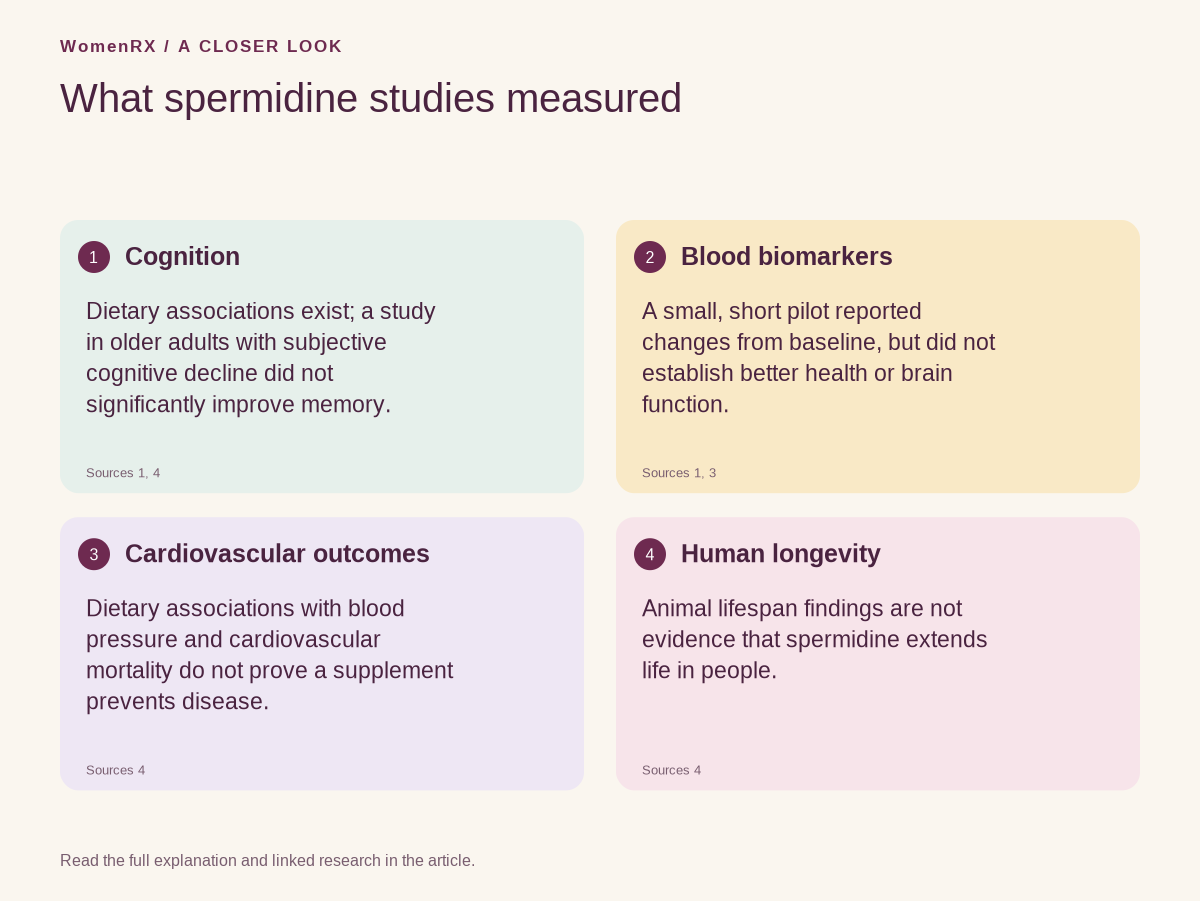
What spermidine studies measured
Cognition: Dietary associations exist; a study in older adults with subjective cognitive decline did not significantly improve memory.14
Blood biomarkers: A small, short pilot reported changes from baseline, but did not establish better health or brain function.13
Cardiovascular outcomes: Dietary associations with blood pressure and cardiovascular mortality do not prove a supplement prevents disease.4
Human longevity: Animal lifespan findings are not evidence that spermidine extends life in people.4
Read the figure as text
The evidence depends on the outcome and study type. This map separates associations and early measurements from demonstrated clinical benefits.- Cognition: Dietary associations exist; a study in older adults with subjective cognitive decline did not significantly improve memory.14
- Blood biomarkers: A small, short pilot reported changes from baseline, but did not establish better health or brain function.13
- Cardiovascular outcomes: Dietary associations with blood pressure and cardiovascular mortality do not prove a supplement prevents disease.4
- Human longevity: Animal lifespan findings are not evidence that spermidine extends life in people.4
More questions, answered
Has spermidine been shown to increase autophagy in the human brain?
Not directly in this evidence. The small pilot measured blood biomarkers associated with autophagy, while a review says evidence for increased neuronal autophagy in people remains limited. Blood markers do not establish what is happening in the brain. 1 3
Does a higher dietary intake mean a supplement will have the same effect?
No. An observational association with dietary intake does not establish cause, and it does not show that a supplement produces the same result. The supplement pilot measured biomarkers rather than clinical outcomes. 3 4
Sources you can check
- Spermidine in Alzheimer's Disease: Evidence from Animal Models and Human Studies.Angelucci F, Cerman J, Amlerova J, Sheardova K, Pavlik J, Hort J. · Degenerative neurological and neuromuscular disease · 2026Return to first citation
- Spermidine in the aging brain: mechanisms, preclinical evidence, and clinical perspectives.Pandolfi S, Björklund G, Ghezzi C, Paone FM, Chirumbolo S. · Molecular biology reports · 2026Return to first citation
- Effects of Spermidine-Rich Rice Germ Extract Supplement on Biomarkers of Healthy Aging and Autophagy-Proof-of-Concept Pilot Study.Bruno G, La Monica M, Ziegenfuss TN. · Alternative therapies in health and medicine · 2025Return to first citation
- Polyamine metabolism as a regulator of cellular and organismal aging.Uemura T, Takayama J, Oguro A, Terui Y. · Amino acids · 2026Return to first citation