How to Track Strength While Taking Ozempic
The scale can’t tell you whether your strength is changing, so pair weight trends with simple, repeatable checks of what your body can do.
A change in measured lean mass isn’t the same as a loss of strength: body-composition measures include lean tissue, and in one observational semaglutide study, measured muscle mass fell while handgrip strength was preserved. Track a few everyday abilities alongside weight, and review any persistent decline with your clinician. The available studies don’t establish a women-specific effect. 2 6
Weight and muscle measurements tell different stories
Weight is useful for following a trend, but it combines fat, muscle, bone, and water. A body-composition reading adds information, but “lean mass” isn’t a direct measurement of muscle strength or physical function. The method matters, too: one semaglutide trial measured lean body mass and extracellular water separately. Extracellular water decreased compared with placebo. The estimated between-group difference in lean body mass was -2.5 kg (95% CI, -6.6 to 1.6 kg), an estimate that ranges from a decrease to an increase and includes no difference. 2 4
That distinction matters because a lower lean-mass reading doesn’t, by itself, show that you’ve become weaker. In a small, single-center observational study of adults with obesity without diabetes, the semaglutide group had reductions in measured skeletal muscle mass and fat-free mass over 12 months, while absolute handgrip strength was preserved. This is useful context, not a guarantee of what will happen for you: the study was not randomized, and its result can’t establish that strength will be preserved in every person. 6
Another study followed adults with chronic kidney disease and overweight or obesity who did not have type 2 diabetes. After 24 weeks, the estimated between-group difference with semaglutide was a decrease of 2.5 kg in lean body mass, but the confidence interval ranged from a 6.6 kg decrease to a 1.6 kg increase. The estimated difference in fat mass was a decrease of 3.9 kg (95% CI, -7.8 to 0.0 kg), with the interval reaching no difference. The study measured body composition, not physical strength, and tested semaglutide at 2.4 mg weekly, so its findings shouldn’t be treated as a direct estimate of what happens with Ozempic. 4
Make function part of your progress check
You don’t need a body-composition scan to notice whether ordinary activities are changing. Choose a few abilities that matter in your life and check them from time to time under similar conditions. For example, you might notice whether getting up from your usual chair, carrying groceries, climbing your usual stairs, or taking your regular walk feels harder than before. These are practical observations, not a validated test or a way to diagnose muscle loss.
Keep the record simple: note your weight trend if you’re already tracking it, the activity you checked, and whether it felt easier, about the same, or harder. Add anything that could affect the comparison, such as illness, a change in activity, or nausea that has made it difficult to eat or drink. As a recordkeeping choice, look back over several entries rather than judging a change from one difficult day.
If you have access to body-composition testing, ask what method was used and what the result actually measures. A number labeled “lean mass” shouldn’t automatically be read as a measure of muscle function. The number is most useful when considered alongside your abilities, health history, and the reason you’re taking the medication. 2 4
Bring the pattern to your care team
A useful review can focus on three things: what you can do, what you’ve been able to eat and drink, and how your weight or measurements have changed. If an everyday activity is persistently getting harder, tell your clinician rather than relying on the scale to explain why. Ask whether a registered dietitian or an activity plan tailored to your health and starting point could help you meet your nutrition and movement needs. Healthy eating plans should account for individual needs and preferences; these studies do not establish whether a particular diet or exercise routine prevents lean-mass loss with semaglutide. 3
Mention ongoing nausea, vomiting, or diarrhea if these are making it difficult to keep fluids down. The Ozempic prescribing information warns that gastrointestinal reactions leading to dehydration have been associated with reports of acute kidney injury and recommends renal-function monitoring for patients reporting reactions that could cause volume depletion. 1
Also clarify which semaglutide product and treatment goal apply to you. The Ozempic prescribing information describes its use to improve blood-sugar control in adults with type 2 diabetes. The body-composition findings above include different populations and study contexts, so they shouldn’t be assumed to predict your individual response or a women-specific effect. 1 4 6
What the studies say about women
The available evidence doesn’t establish a muscle-protection or muscle-loss effect specific to women. One observational study included women and men and adjusted analyses for sex, but the reported results don’t give separate outcomes for women. Another study’s abstract doesn’t report results by sex. For older adults, keeping muscle and strength is especially relevant, but these studies don’t tell us whether semaglutide affects women differently at older ages. 2 4 5 6
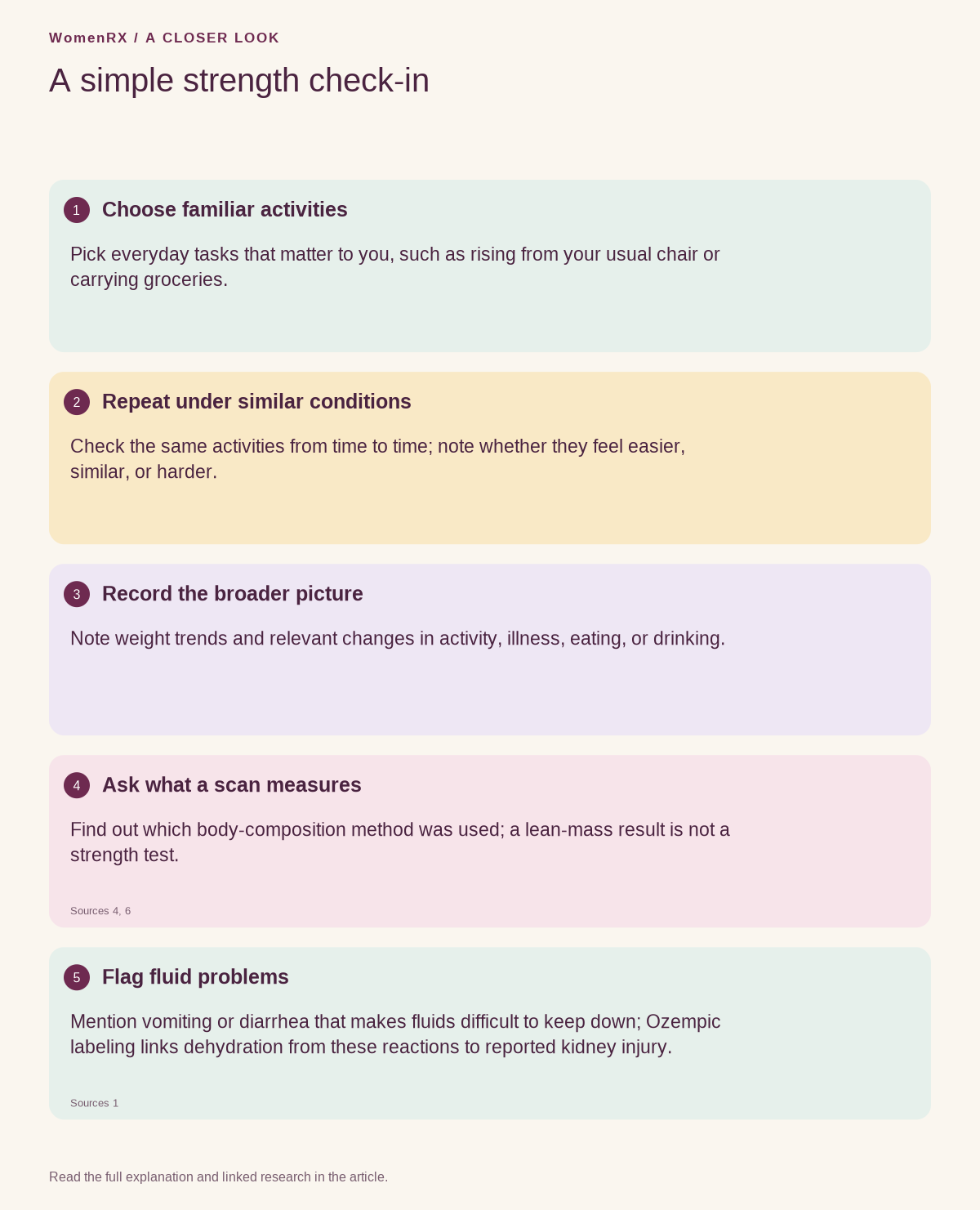
A simple strength check-in
Choose familiar activities: Pick everyday tasks that matter to you, such as rising from your usual chair or carrying groceries.
Repeat under similar conditions: Check the same activities from time to time; note whether they feel easier, similar, or harder.
Record the broader picture: Note weight trends and relevant changes in activity, illness, eating, or drinking.
Ask what a scan measures: Find out which body-composition method was used; a lean-mass result is not a strength test.46
Flag fluid problems: Mention vomiting or diarrhea that makes fluids difficult to keep down; Ozempic labeling links dehydration from these reactions to reported kidney injury.1
Read the figure as text
Use these prompts alongside weight or body-composition trends. They are practical observations, not a scored or validated test.- Choose familiar activities: Pick everyday tasks that matter to you, such as rising from your usual chair or carrying groceries.
- Repeat under similar conditions: Check the same activities from time to time; note whether they feel easier, similar, or harder.
- Record the broader picture: Note weight trends and relevant changes in activity, illness, eating, or drinking.
- Ask what a scan measures: Find out which body-composition method was used; a lean-mass result is not a strength test.46
- Flag fluid problems: Mention vomiting or diarrhea that makes fluids difficult to keep down; Ozempic labeling links dehydration from these reactions to reported kidney injury.1
More questions, answered
Does losing lean mass mean I’m losing strength?
Not necessarily. Lean-mass measurements and strength tests assess different things. In one observational semaglutide study, measured skeletal muscle mass and fat-free mass decreased while absolute handgrip strength was preserved. That finding doesn’t predict every person’s experience, so changes in function still deserve attention. 6
Will a body-composition scan show exactly how much muscle I have?
Not exactly. Body-composition methods estimate different components, and a lean-mass result isn’t itself a strength measurement. Ask which method was used and interpret the result alongside how you’re functioning. 2 4
Sources you can check
- OZEMPIC (SEMAGLUTIDE) INJECTION, SOLUTION [A-S MEDICATION SOLUTIONS] | US prescribing information and patient instructionsAccessed 2026-09-25Return to first citation
- Body Weight: MedlinePlusAccessed 2026-09-25Return to first citation
- Nutrition: MedlinePlusAccessed 2026-09-25Return to first citation
- Effects of Semaglutide on Body Composition and GFR: A Prespecified Analysis of the SMART Trial.Heerspink HJL, Soler M, Beernink JM, Jongs N, Cigarran S, Cigarran S, Cruzado JM, Puchades MJ, López-Martínez M, López-Martínez M, Apperloo E, Waanders F, Laverman GD, van der Aart... · Clinical journal of the American Society of Nephrology : CJASN · 2026Return to first citation
- Weight Loss-Dependent Changes in Body Composition and Bone Health in People With Obesity and Type 1 Diabetes Treated With Liraglutide, Semaglutide, or Tirzepatide.Al Ozairi E, Irshad M, Alkandri J, Mashankar A, Gray SR, le Roux CW. · Diabetes/metabolism research and reviews · 2026Return to first citation
- Longitudinal Changes in Body Composition, Adaptive Thermogenesis and Muscle Strength in Patients with Obesity Treated with Semaglutide.Filippi-Arriaga F, Comas M, Prats A, Juan A, Vidal E, Costa P, Flores V, Oliver-Vila C, Fidilio E, Ciudin A. · Obesity facts · 2026Return to first citation