How to Read Weight Changes After Two Months on Tirzepatide
At eight weeks, the trend matters more than a single weigh-in, especially if your dose is still being increased.
Two months on tirzepatide is a useful check-in, not a pass-or-fail deadline. In one study, the first eight weeks included four weeks at 2.5 mg and four at 5 mg, so some participants were still early in treatment. Compare a pattern of weights, note your dose timing and tolerability, and review the whole picture with your prescriber rather than judging by one number or a fixed target. 4 2
Two months is a checkpoint, not a verdict
If you’re looking at the scale around week eight and wondering whether the medicine is “working,” start with the context: your dose may still be increasing, and a single weight can’t tell you how much of a change is body fat, muscle, or water. MedlinePlus makes this distinction because weight reflects all of those things, not just fat. 2
A useful review asks what the overall direction looks like, what dose you’ve taken and for how long, and whether side effects or missed doses have affected your treatment. It doesn’t require a particular amount of weight loss by a particular date.
Why dose timing changes the picture
In a post hoc analysis of two trials involving Japanese adults with type 2 diabetes, the first eight weeks followed a study schedule of four weeks at 2.5 mg, then four weeks at 5 mg. That gives one example of why a two-month weigh-in may reflect an early treatment phase, not time spent at a later dose. The study schedule is context, not a dosing instruction for you. 4
The same analysis divided participants by whether they had lost at least 5% of their starting weight at week eight. About 23.5% were in that early-loss group. Both groups had weight reductions at week 52, although the group with greater early loss had larger reductions. These results came from Japanese participants with type 2 diabetes; they don’t establish a universal eight-week target or predict an individual result. 4
So if your loss is slower than a number you’ve seen online, that alone doesn’t settle whether treatment is helping. Your prescriber can interpret the trend alongside your dose history, treatment goals, and how well you’re tolerating it.
Read the pattern, not the noisiest day
If you’re weighing yourself, try to compare measurements taken under similar conditions and look across several readings rather than making a decision from one. Day-to-day weight includes water as well as fat and muscle, so a short-term rise or plateau doesn’t necessarily mean that fat loss has stopped. 2
You can make the check-in more useful by bringing a brief record of:
- Your starting weight and recent weights, with dates.
- The dose you were taking during each stretch and when it changed.
- Doses you missed or couldn’t take as planned, if any.
- Symptoms that affected meals, fluids, or day-to-day life.
The goal isn’t to produce a perfect log. It’s to help you and your prescriber distinguish a sustained trend from a temporary change and see whether tolerability or treatment timing needs attention.
Include how treatment feels
Nausea and diarrhea were among the most common treatment-emergent side effects in a randomized trial of adults with type 2 diabetes who switched to tirzepatide. In a separate obesity maintenance trial, gastrointestinal side effects were mostly mild to moderate and occurred mostly during dose escalation. Those study findings don’t tell you exactly what you’ll experience, but they support including symptoms in the review, not just the scale. 3 5
If side effects are making it difficult to continue treatment as intended, tell your prescriber what’s happening and when it started.
A separate check if pregnancy is possible
If you’re taking Zepbound and could become pregnant, include pregnancy plans or a possible pregnancy in the conversation. Its prescribing information says the medicine may harm an unborn baby. It also warns that oral hormonal birth control may be less effective after starting Zepbound and after dose increases; the label advises a non-oral method or an added barrier method for four weeks after starting and for four weeks after each increase. 1
What to ask at the eight-week review
Keep the conversation focused on decisions that can actually be made now: “What does my weight trend suggest so far?” “How does my dose timing affect how we interpret it?” “Are my symptoms or missed doses changing the plan?” “What should we use as my next review point?”
At two months, the most useful answer may not be a prediction. It may be a clearer understanding of your trend, how treatment is going, and what your next check-in should consider.
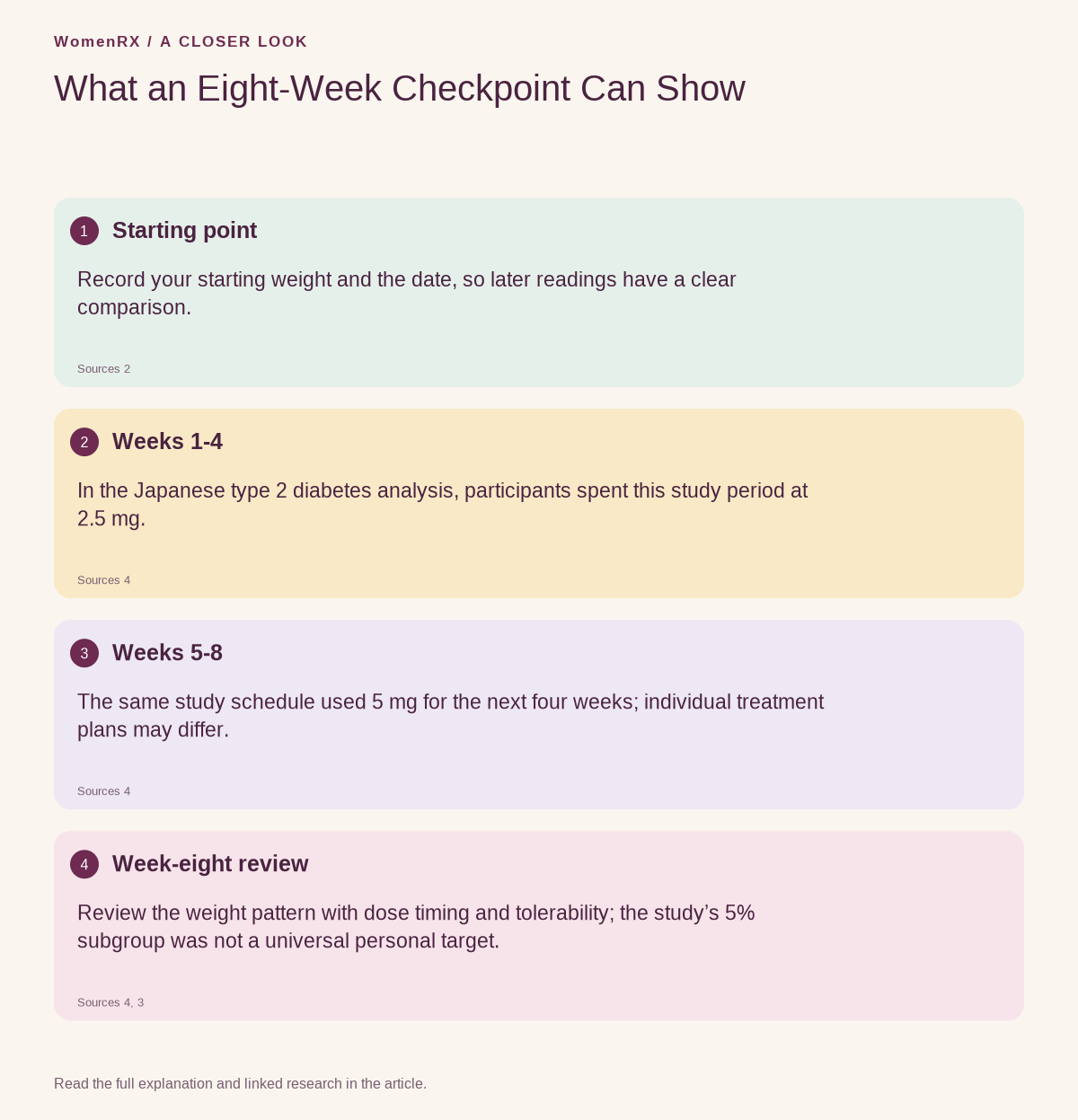
What an Eight-Week Checkpoint Can Show
Starting point: Record your starting weight and the date, so later readings have a clear comparison.2
Weeks 1-4: In the Japanese type 2 diabetes analysis, participants spent this study period at 2.5 mg.4
Weeks 5-8: The same study schedule used 5 mg for the next four weeks; individual treatment plans may differ.4
Week-eight review: Review the weight pattern with dose timing and tolerability; the study’s 5% subgroup was not a universal personal target.43
Read the figure as text
One study’s escalation schedule helps put week eight in context. It describes a study regimen, not a personal dosing plan or weight-loss forecast.- Starting point: Record your starting weight and the date, so later readings have a clear comparison.2
- Weeks 1-4: In the Japanese type 2 diabetes analysis, participants spent this study period at 2.5 mg.4
- Weeks 5-8: The same study schedule used 5 mg for the next four weeks; individual treatment plans may differ.4
- Week-eight review: Review the weight pattern with dose timing and tolerability; the study’s 5% subgroup was not a universal personal target.43
More questions, answered
Does losing less than 5% by week eight mean tirzepatide isn’t working?
No single early percentage can answer that for everyone. In a post hoc analysis of Japanese adults with type 2 diabetes, both the group that had lost less than 5% at week eight and the group that had lost at least 5% had weight reductions by week 52. The study doesn’t establish a universal cutoff for people using tirzepatide for weight management. 4
What should I do if the scale stalls?
A short-term pause on the scale doesn’t establish whether your overall trend has changed. Bring the pattern of readings, your dose history, and any symptoms to your prescriber, and ask how they affect the interpretation of your progress and the next check-in. 2 4
Sources you can check
- ZEPBOUND (TIRZEPATIDE) INJECTION, SOLUTION ZEPBOUND (TIRZEPATIDE) INJECTION, SOLUTION ZEPBOUND KWIKPEN (TIRZEPATIDE) INJECTION, SOLUTION [ELI LILLY AND COMPANY] | US prescribing information and patient instructionsAccessed 2026-09-25Return to first citation
- Body Weight: MedlinePlusAccessed 2026-09-25Return to first citation
- Comparison of Dose Escalation Versus Switching to Tirzepatide Among People With Type 2 Diabetes Inadequately Controlled on Lower Doses of Dulaglutide : A Randomized Clinical Trial.Billings LK, Winne L, Sharma P, Gomez-Valderas E, Chivukula KK, Kwan AYM. · Annals of internal medicine · 2025Return to first citation
- Association Between Early Weight Loss and Metabolic Outcomes with Tirzepatide in Japanese Patients with Type 2 Diabetes: A SURPASS J Post Hoc Analysis.Mimura H, Oura T, Chin R, Hirase T, Shimono D. · Diabetes therapy : research, treatment and education of diabetes and related disorders · 2025Return to first citation
- Tirzepatide for maintenance of bodyweight reduction in people with obesity in the USA (SURMOUNT-MAINTAIN): a multicentre, double-blind, randomised, placebo-controlled trial.Horn DB, Aronne LJ, Wharton S, Bays HE, le Roux CW, Srinath R, Gomez-Valderas E, Arad AD, Das S, Dunn JP, Ribeiro A, Glass LC, Lee CJ. · Lancet (London, England) · 2026Return to first citation