Wegovy Injections: Dose Changes and Weight Trends in the First Months
The Wegovy injection dose usually rises over the first 16 weeks, but the scale doesn’t have to follow the same schedule.
For Wegovy injections, the labeled starting schedule steps up every four weeks through week 16; from week 17, the maintenance dose depends on the treatment indication. That’s a dose timeline, not a promise of weight loss by any particular week. Follow-up is a chance to review both tolerability and the weight trend over time, rather than judge treatment by one weigh-in.12

The first 16 weeks are a dose schedule
If you’ve been prescribed Wegovy injections, the first months have a clear planned dose sequence: 0.25 mg once weekly in weeks 1-4, 0.5 mg in weeks 5-8, 1 mg in weeks 9-12, and 1.7 mg in weeks 13-16. From week 17 onward, the prescribing information directs readers to the maintenance dose for their treatment indication. These are labeled milestones, not instructions to change your dose on your own.1
The distinction matters because a dose increase isn’t a weight-loss deadline. You might notice a change on the scale before reaching a maintenance dose, or your trend might take longer to become clear. Neither the calendar alone nor a single weigh-in tells you how well treatment is working for you.
What an early follow-up can clarify
Early in treatment, the most useful question may be whether the current plan is tolerable. In a 24-week randomized trial conducted at 21 centers in India, gastrointestinal events were the most common treatment-emergent adverse events among participants receiving either Wegovy or a comparison semaglutide injection. That finding supports discussing digestive symptoms at follow-up; it doesn’t predict which symptoms you’ll have.2
Be specific about what’s happening. For example, “I felt nauseated on two mornings but could eat and drink normally” gives a different picture from “I’ve been vomiting and can’t keep fluids down.” Persistent vomiting or difficulty staying hydrated is worth raising with your prescriber alongside the weight trend. Guidance for people receiving semaglutide for metabolic dysfunction-associated steatohepatitis (MASH) identifies dehydration-related kidney injury as a monitoring concern in that population.3
If a planned dose change is approaching and side effects are getting in the way of eating, drinking, or daily life, raise that before making the change. The dose calendar describes the labeled sequence; your prescriber can weigh tolerability alongside the treatment plan.
Read the scale as a trend, not a set of deadlines
A useful weight review compares where you started with several measurements over time, alongside how treatment is going. For example, a higher reading one day followed by a lower one the next isn’t, by itself, evidence that Wegovy stopped working or suddenly started working better. Looking at the longer pattern keeps one reading from carrying too much weight.
A clinical trial result can give context, but not a personal timetable. In the India study, the 90 adults assigned to Wegovy had a mean weight change of −14.1% from baseline at week 24. The trial compared Wegovy with another semaglutide injection and reported a group average at a set endpoint, not an expected loss for each of the first 24 weeks. Its reported results do not establish a separate weight-loss timeline for women.2
At a later review, the conversation can move beyond whether the next scheduled dose is due: Is there a sustained change from your starting weight? Are symptoms manageable? Does the treatment still fit your health goals? Those questions are more useful together than a target for any single week.
If pregnancy plans change, bring them into the conversation
Pregnancy planning changes the treatment decision even if the scale trend looks encouraging. A review of GLP-1 medicines and fertility says semaglutide should not be used during pregnancy and discusses stopping it before conception. If you’re planning a pregnancy or think you may be pregnant, contact your prescriber about the plan rather than treating the next dose milestone as automatic.4
Perimenopause or postmenopause may also change what you want to discuss about weight and health. Keep the focus on your response and what matters to you.
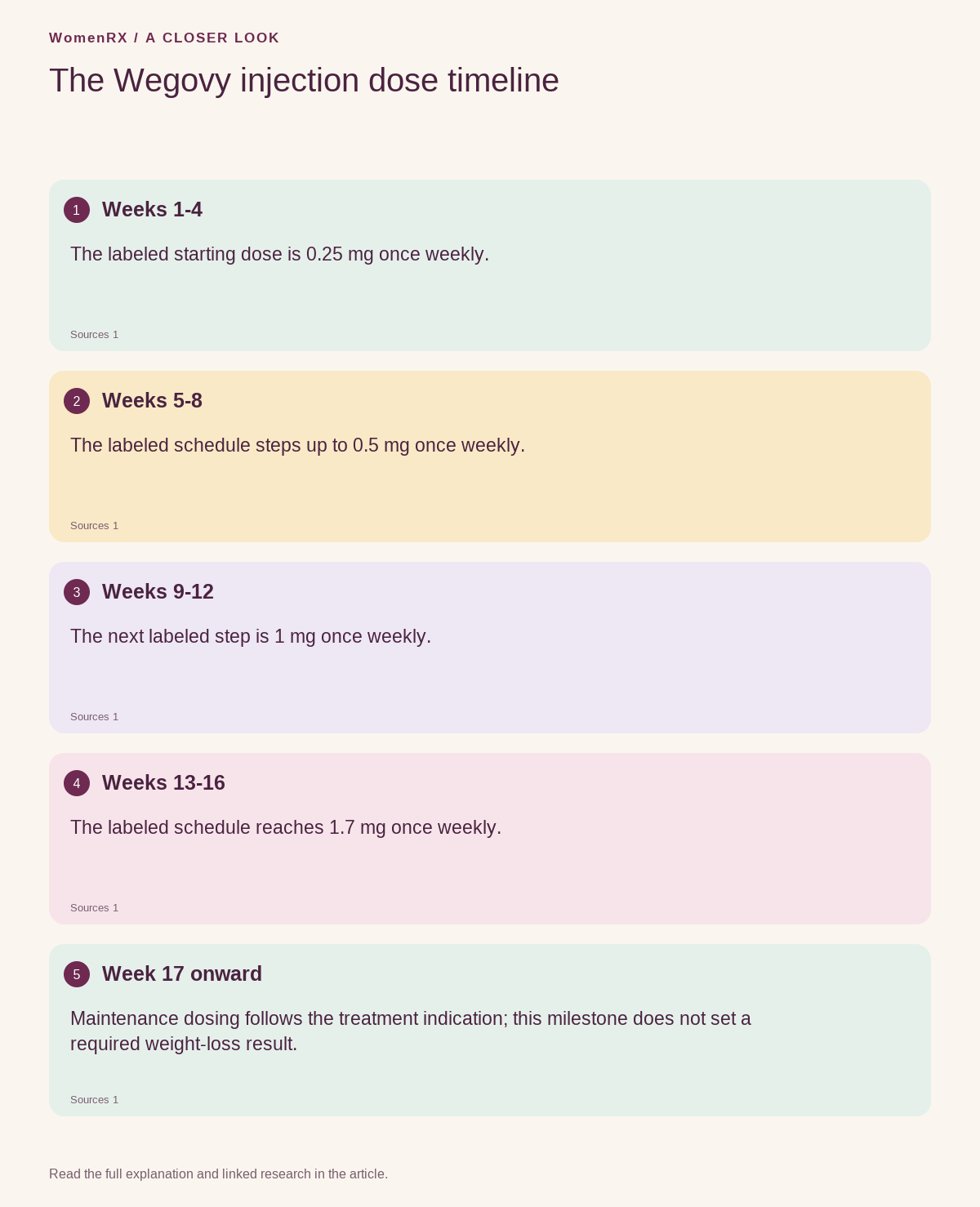
The Wegovy injection dose timeline
Weeks 1-4: The labeled starting dose is 0.25 mg once weekly.1
Weeks 5-8: The labeled schedule steps up to 0.5 mg once weekly.1
Weeks 9-12: The next labeled step is 1 mg once weekly.1
Weeks 13-16: The labeled schedule reaches 1.7 mg once weekly.1
Week 17 onward: Maintenance dosing follows the treatment indication; this milestone does not set a required weight-loss result.1
Read the figure as text
These are labeled dose milestones for injections, not predicted dates for weight loss.- Weeks 1-4: The labeled starting dose is 0.25 mg once weekly.1
- Weeks 5-8: The labeled schedule steps up to 0.5 mg once weekly.1
- Weeks 9-12: The next labeled step is 1 mg once weekly.1
- Weeks 13-16: The labeled schedule reaches 1.7 mg once weekly.1
- Week 17 onward: Maintenance dosing follows the treatment indication; this milestone does not set a required weight-loss result.1
More questions, answered
Does reaching week 17 mean I should have reached a certain weight?
No. Week 17 marks the end of the labeled initial dose-escalation sequence for Wegovy injections, not a required weight-loss result. Weight is better assessed as a change from your starting point over time, together with how you’re tolerating treatment.12
Sources you can check
- WEGOVY (SEMAGLUTIDE) INJECTION, SOLUTION WEGOVY (SEMAGLUTIDE) TABLET [NOVO NORDISK PHARMACEUTICAL INDUSTRIES, LP] | US prescribing information and patient instructionsAccessed 2026-09-25Return to first citation
- Semaglutide Injection Once-Weekly for Weight Management in Adults: Results From A Randomized Phase III, Active-Controlled Study.Ambika Gopalakrishnan U, Joshi A, Kumar H, Giri R, Maheshwari S, Prasad VS, Shukla J, M Chowdaiah R, Agrawal NK, Rasal Y, Sahoo B, Bhandari S, Gowda A, Phadke U, Supe P, Pathak N, ... · Diabetes, obesity & metabolism · 2026Return to first citation
- Semaglutide therapy for metabolic dysfunction-associated steatohepatitis: November 2025 updates to AASLD Practice Guidance.Bansal MB, Patton H, Morgan TR, Carr RM, Dranoff JA, Allen AM. · Hepatology (Baltimore, Md.) · 2026Return to first citation
- GLP-1 Receptor Agonists and Fertility: What Is Known So Far?Becker AS, Castilhos JP, Shugair SAS, Colombo T, Hentschke M-. · JBRA assisted reproduction · 2026Return to first citation