Three Months on Tirzepatide: What to Review
At 12 weeks, your dose may still be changing, so review the whole treatment picture rather than judging the plan by one scale number.
After about three months, review what dose you’ve actually taken, any missed or interrupted weeks, side effects, your weight trend, and the health goals you’re treating. Twelve weeks isn’t a universal pass-or-fail point: in a SURMOUNT-1 analysis of adults with obesity or overweight plus a weight-related complication, excluding people with diabetes, many participants below 5% weight loss at week 12 reached that mark later. Don’t change your dose without your prescriber. 3
Start with what the first 12 weeks actually looked like
Three months can sound like a clear checkpoint, but it doesn’t mean everyone has had the same treatment experience. At your review, bring the dates and doses you actually took, including any missed weeks, pauses, or dose changes. Note when side effects began and whether they made eating or drinking difficult. This gives you and your prescriber a more useful picture than “I’ve been on it for three months.”
Trial timing helps explain why. In SURMOUNT-1, dose escalation lasted 20 weeks; the assigned target dose was reached at week 4, 12, or 20, depending on the study group. So the week-12 mark fell at different points in the escalation process for different participants. That trial schedule describes the study, not an instruction for your own dose. 3
A separate prospective, observational study followed 115 adults with obesity but without diabetes who received 2.5 mg for four weeks, then 5 mg through week 12. Their average weight reduction was 7.3%, but results varied, and this small study is not a target for every person or a direct comparison with SURMOUNT-1. 4
Read the trend, not a single weigh-in
Look at several measurements over time, ideally taken in similar conditions, rather than treating one reading as a verdict. In SURMOUNT-1, study weights were collected in a consistent way, at roughly the same time in the morning when possible. Weight includes water, muscle, bone, and fat, so the number alone can’t tell the whole health story. 3 2
If you menstruate and notice a recurring scale pattern, you can jot down cycle dates beside your weights. Think of that as context for interpreting your own records, not as a correction to apply or a proven tirzepatide response rule. The SURMOUNT-1 analysis did not report cycle-specific weight changes or a women-only response timeline. 3
Most importantly, less than 5% weight loss by week 12 does not automatically mean treatment has failed. A post hoc analysis of SURMOUNT-1, a trial of adults with obesity or overweight plus a weight-related complication, excluding people with diabetes, included 1,545 tirzepatide-treated participants who had taken at least 75% of assigned doses. It classified 278 people, or 18%, as below 5% loss at week 12. Among those later responders, 70% had reached at least 5% loss by week 24 and 90% by week 72. The average time for that group to reach 5% was about 25 weeks. These are trial findings, not a promise about any one person’s outcome. 3
Check whether the plan is helping your health goals
Weight is one part of the review. Name the health goals that matter to you and ask whether there are changes worth tracking alongside the scale. Depending on why you’re taking tirzepatide, those might include a weight-related health measure your prescriber already follows, or practical changes in daily life. MedlinePlus notes that body weight doesn’t capture everything about health; body composition, waist circumference, and health history can also matter. 2
Ask your prescriber what they’ll use to assess progress for your situation, and when it makes sense to reassess. If your weight has changed little, that’s a reason to look at dose history, interruptions, tolerability, and goals together, not to adjust the dose on your own.
Put side effects and pregnancy plans on the table
Tell your prescriber about side effects, particularly persistent nausea or vomiting, or difficulty eating and drinking. A published case report described starvation ketoacidosis in one woman with repeated vomiting and markedly reduced intake while using tirzepatide; a single case cannot tell us how often this happens, but it shows why severe or ongoing symptoms deserve attention rather than being treated as a routine part of weight loss. 5
If you could become pregnant, bring up pregnancy plans and contraception at the review. The Zepbound medication guide says the medicine may harm an unborn baby and that oral birth-control pills may work less well after starting treatment and after dose increases. It says a prescriber may recommend another contraceptive method for four weeks after starting and for four weeks after each increase. Ask what applies to your specific medication and circumstances. 1
Leave with a shared next step
A useful review ends with a plan you understand: what to keep tracking, what symptoms to report, what health outcomes matter, and when you’ll revisit the decision. Trial averages can offer context, but your dose history, side effects, goals, and response belong in the conversation. The point of three months is to review the plan together, not to pass or fail a weight-loss test.
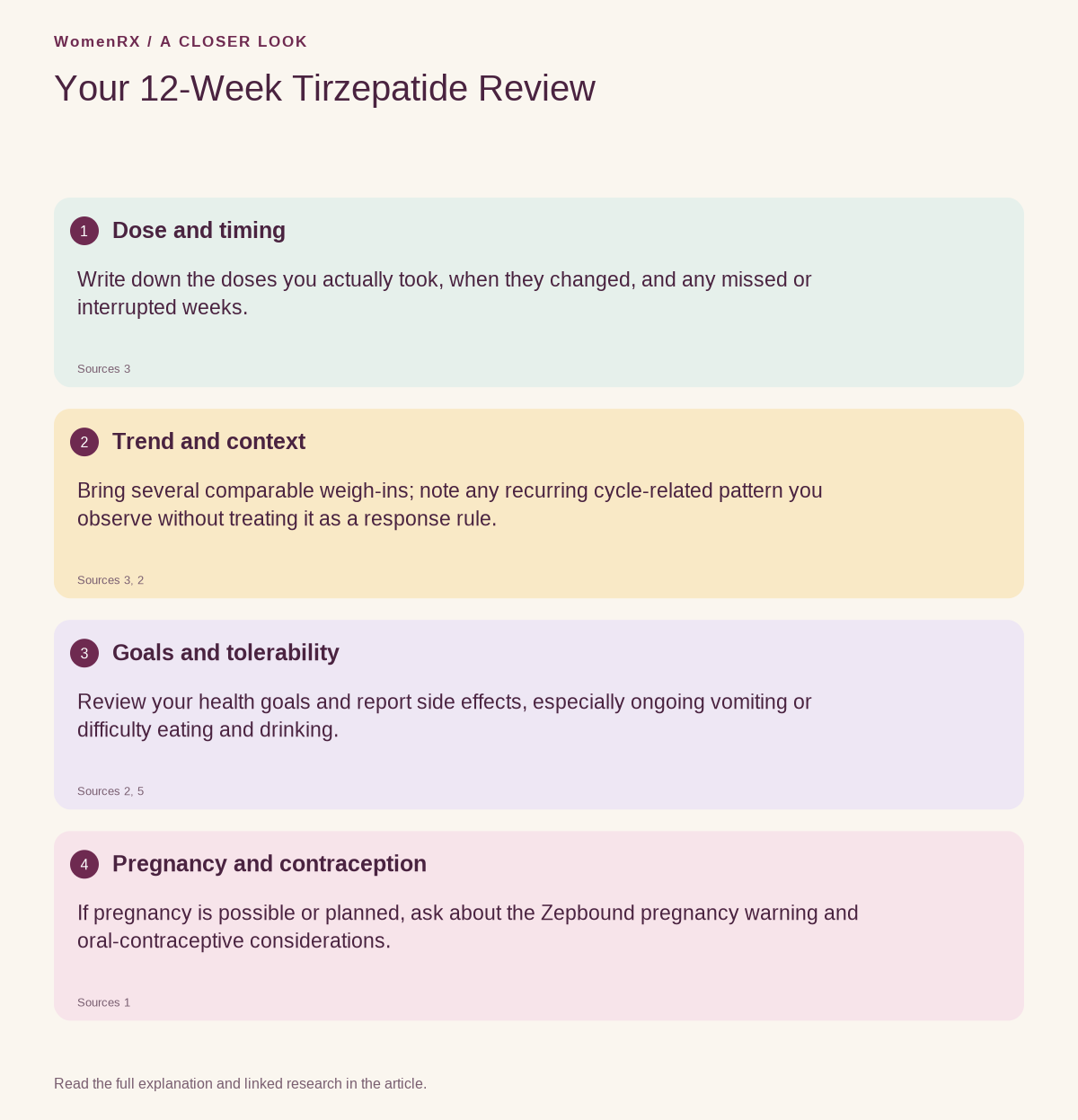
Your 12-Week Tirzepatide Review
Dose and timing: Write down the doses you actually took, when they changed, and any missed or interrupted weeks.3
Trend and context: Bring several comparable weigh-ins; note any recurring cycle-related pattern you observe without treating it as a response rule.32
Goals and tolerability: Review your health goals and report side effects, especially ongoing vomiting or difficulty eating and drinking.25
Pregnancy and contraception: If pregnancy is possible or planned, ask about the Zepbound pregnancy warning and oral-contraceptive considerations.1
Read the figure as text
Use these four prompts to organize a treatment review without treating one weight threshold as a pass or fail.- Dose and timing: Write down the doses you actually took, when they changed, and any missed or interrupted weeks.3
- Trend and context: Bring several comparable weigh-ins; note any recurring cycle-related pattern you observe without treating it as a response rule.32
- Goals and tolerability: Review your health goals and report side effects, especially ongoing vomiting or difficulty eating and drinking.25
- Pregnancy and contraception: If pregnancy is possible or planned, ask about the Zepbound pregnancy warning and oral-contraceptive considerations.1
Sources you can check
- ZEPBOUND (TIRZEPATIDE) INJECTION, SOLUTION ZEPBOUND (TIRZEPATIDE) INJECTION, SOLUTION ZEPBOUND KWIKPEN (TIRZEPATIDE) INJECTION, SOLUTION [ELI LILLY AND COMPANY] | US prescribing information and patient instructionsAccessed 2026-09-25Return to first citation
- Body Weight: MedlinePlusAccessed 2026-09-25Return to first citation
- Weight reduction over time in tirzepatide-treated participants by early weight loss response: Post hoc analysis in SURMOUNT-1.Ard J, Lee CJ, Gudzune K, Addison B, Lingvay I, Cao D, Mast CJ, Stefanski A, Falcon B, Mojdami D. · Diabetes, obesity & metabolism · 2025Return to first citation
- A real-world study of tirzepatide for weight loss in adults without diabetes mellitus.Angelopoulos N, Androulakis I, Rizoulis A, Boniakos A, Fousteris E, Mentzelopoulou V, Petkova V, Paparodis R, Zianni D, Florakis D, Korakovouni A, Mouslech Z, Livadas S, Tzoulis P. · International journal of obesity (2005) · 2026Return to first citation
- Starvation ketoacidosis associated with tirzepatide use for weight loss in a non-diabetic East Asian woman: a case report.Minoda Y, Ikeda S, Inukai K, Kishitani S, Takeuchi T, Aikawa H, Saito K, Kittaka H, Hayashi Y, Sawano H, Ito Y. · International journal of emergency medicine · 2026Return to first citation