Hair Shedding During Semaglutide-Related Weight Loss
Hair loss has been reported in semaglutide studies, but weight change and other health factors may also matter.
Hair shedding during semaglutide treatment is worth discussing, but it doesn’t by itself show that the medicine caused it. In trials of subcutaneous semaglutide 2.4 mg, hair loss was reported in 3% of treated participants and 1% of placebo participants. That difference is a signal, not proof of what caused your shedding. Weight change, nutrition, health conditions, and other medicines are also worth reviewing. 3 1
What the semaglutide evidence can tell you
There is a signal to discuss, not a settled answer about cause. A review summarizing product trials of subcutaneous semaglutide at 2.4 mg reported hair loss in 3% of treated participants versus 1% of placebo participants. That two-percentage-point difference came from trial groups; it can’t tell you whether semaglutide caused your shedding. 3
Other research has found associations too. A retrospective health-record study reported higher odds of some nonscarring hair-loss diagnoses among semaglutide users, including telogen effluvium at certain follow-up points. Because the study was observational, it cannot show that the medication itself caused the hair loss. Reviews also describe limitations in the research, including varied study designs and, in many reports, no dermatological confirmation of the hair-loss type. 4 5
The evidence doesn’t support treating semaglutide as the only possible explanation. Nor does a signal for semaglutide establish that every GLP-1 medicine has the same effect. A pharmacovigilance analysis found different reporting patterns among medicines in this group, but reports to a safety database can’t establish comparative causal risk. 6
The pattern and the timeline both matter
Reviews report telogen effluvium and androgenetic alopecia among the hair-loss types described in GLP-1 research. Those labels aren’t a diagnosis you can make from timing alone. If the change seems more like shedding across the scalp, gradual thinning, or distinct patches, describe that as clearly as you can when seeking an evaluation. A clinician may be able to identify a likely cause by looking at your hair. 3 2
Make a simple record of when treatment began, any dose changes, when your weight or eating changed, and when you first noticed shedding. Add major illness, stress, or new medicines. This helps keep separate events from being collapsed into one explanation; sequence alone doesn’t prove cause.
If reduced appetite has made it harder to eat enough or varied foods, mention that too. Low-protein diets and poor nutrition are among the possible causes of hair loss listed by MedlinePlus, along with stress, thyroid problems, other diseases, and certain medicines. Those possibilities don’t mean you have a deficiency or should start a supplement. Hair-loss treatment depends on the cause. 1
Include the details that are specific to you
If relevant, note whether you’re postpartum, whether your menstrual bleeding has changed or is heavy, or whether you’re going through menopause. These are useful timeline details to share, not proof that any one factor explains the shedding. Mention other health changes and medicines too.
At an evaluation, you can ask: “What pattern do you see?” and “Could my eating changes, another medicine, or a health condition be contributing?” If you’re concerned about the hair loss, it’s reasonable to seek an evaluation. 2 1
Bring your timeline if it helps you tell the story, but you don’t need to solve the cause before asking for help. Discuss medication concerns with the person managing your semaglutide treatment rather than assuming the shedding proves the medicine is responsible.
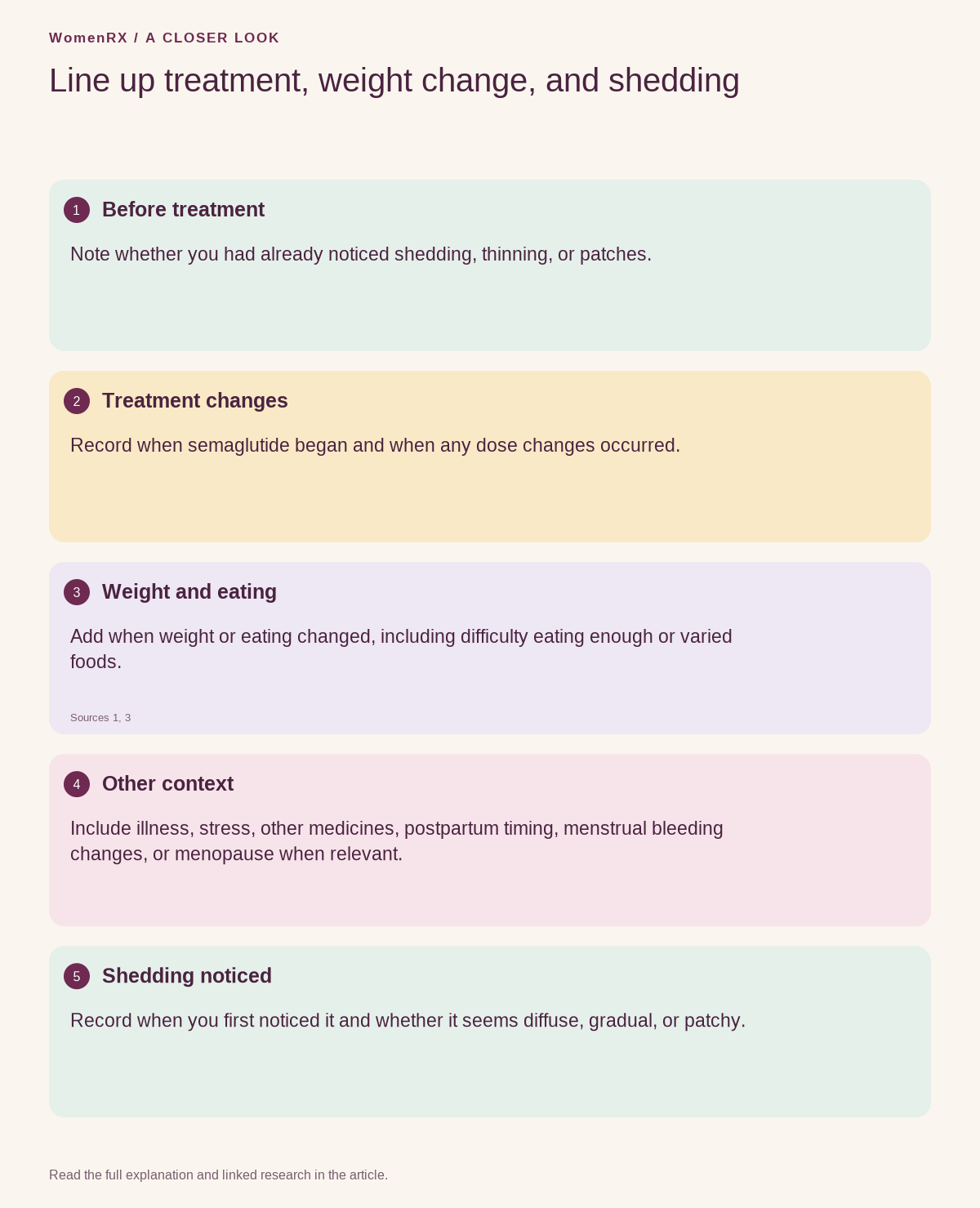
Line up treatment, weight change, and shedding
Before treatment: Note whether you had already noticed shedding, thinning, or patches.
Treatment changes: Record when semaglutide began and when any dose changes occurred.
Weight and eating: Add when weight or eating changed, including difficulty eating enough or varied foods.13
Other context: Include illness, stress, other medicines, postpartum timing, menstrual bleeding changes, or menopause when relevant.
Shedding noticed: Record when you first noticed it and whether it seems diffuse, gradual, or patchy.
Read the figure as text
Place these events in the order they happened. The timeline helps describe what changed, but sequence alone cannot show what caused the shedding.- Before treatment: Note whether you had already noticed shedding, thinning, or patches.
- Treatment changes: Record when semaglutide began and when any dose changes occurred.
- Weight and eating: Add when weight or eating changed, including difficulty eating enough or varied foods.13
- Other context: Include illness, stress, other medicines, postpartum timing, menstrual bleeding changes, or menopause when relevant.
- Shedding noticed: Record when you first noticed it and whether it seems diffuse, gradual, or patchy.
More questions, answered
Do all GLP-1 medicines have the same hair-loss evidence?
No. A pharmacovigilance study found different hair-loss reporting patterns across medicines in the group. Those reports can flag a possible association, but they don’t prove that one medicine causes more hair loss than another. 6
Sources you can check
- Hair Loss | Alopecia | Alopecia Areata | MedlinePlusAccessed 2026-09-25Return to first citation
- Hair loss - NHSAccessed 2026-09-25Return to first citation
- GLP-1 therapies and hair loss: A systematic review of current evidence and implications for counseling.Gupta AK, Teasell EM, Economopoulos V, Mirmirani P. · Science progress · 2026Return to first citation
- Nonscarring Alopecia in Adults Treated With GLP-1s: A Propensity Score Matched TriNetX Cohort Study.Katragadda R, Hayden J, Saltagi AK, Welschmeyer AF, Quereshy HA, Karasik D, Rabbani CC, Gourishetti SC, Goslawski AM. · The Laryngoscope · 2026Return to first citation
- Alopecia as an Emerging Adverse Effect Associated With Glucagon-Like Peptide-1 (GLP-1) Receptor Agonists for Weight Loss: A Scoping Review.Rojas Lopez RF, Lynett Barrera D, Amaya Muñoz MC, Saavedra Diaz MP. · Cureus · 2025Return to first citation
- Not All GLP-1 Receptor Agonists Are Alike: Real-World Evidence of Differential Endocrine and Dermatologic Safety.Lee N, Kim Y. · Diabetes/metabolism research and reviews · 2026Return to first citation