Hair Shedding on Wegovy: What Weight Change Can Explain
Hair loss has been reported during semaglutide treatment, but the timing, pattern, and other changes in your life matter more than any single explanation.
Hair loss has been reported by people using semaglutide, the medicine in Wegovy, but a report doesn’t show whether the medicine itself, weight loss, or something else caused a person’s shedding. Rapid weight loss may contribute to temporary, diffuse shedding called telogen effluvium. Androgenetic alopecia, iron deficiency, and other causes can also be worth considering.3478
A reported side effect isn’t a diagnosis
If you’re finding more hair in the shower while taking Wegovy, the timing deserves attention. Research reviews have found reports of hair loss among people using semaglutide and other weight-management medicines. But most studies did not confirm the type of hair loss with a dermatological assessment, and they cannot establish what caused an individual’s shedding.78
That distinction matters because treatment and weight change often happen together. Weight loss itself is a recognized possible cause of temporary hair loss. Researchers have proposed that rapid weight loss and related metabolic or nutritional changes could contribute to telogen effluvium, a type of diffuse shedding. A direct effect of GLP-1 medicines on hair follicles has also been proposed, but it hasn’t been established as the explanation for shedding on Wegovy.478
There isn’t a reliable rule that lets you look at your hair and separate those possibilities on your own. The useful next step is to work out what kind of hair loss is happening, then consider it alongside your weight change, eating patterns, health, and treatment goals.278
The pattern offers clues, not proof
Telogen effluvium tends to show up as shedding across the scalp rather than a distinct area of thinning. It’s generally temporary. Androgenetic alopecia follows a more progressive pattern; in women, it can appear as diffuse thinning. The two can coexist, so a period of increased shedding may make an underlying pattern more noticeable.8
Other explanations deserve room in the conversation. Illness, thyroid problems, stress, low protein intake, and poor nutrition are among the possible causes of hair loss. Iron deficiency is another possible cause of temporary hair loss. A review of studies in women found lower average ferritin, a measure of stored iron, among those with nonscarring hair loss than among women without it. That association does not mean low iron caused every case or that taking iron will fix shedding without a confirmed deficiency.246
Your stage of life can change the picture, too:
- After childbirth: Postpartum telogen effluvium often begins a few months after delivery as estrogen levels fall. Shedding usually peaks around four months after birth, and most women regain their usual fullness by their baby’s first birthday. If it hasn’t returned by then, the American Academy of Dermatology suggests an assessment for another cause.1
- Around and after menopause: A systematic review found associations between postmenopause and certain forms of alopecia, including female-pattern hair loss. That doesn’t mean menopause explains new shedding in someone taking Wegovy; it means an existing or developing pattern of thinning shouldn’t automatically be attributed to the medicine.5
One review of GLP-1 medicines reported that women appeared disproportionately affected by hair-loss reports. That is not the same as a clear, women-specific estimate of hair-loss risk with Wegovy, or evidence that the cause is different for women.8
Make the conversation about both hair and health goals
You don’t need to decide whether Wegovy is “the cause” before bringing up shedding. A few concrete details can make the discussion more useful:
- Describe the change. Are you seeing more loose hairs throughout the day, a widening area of thinning, or both? Diffuse shedding and progressive patterned thinning may point to different explanations.8
- Put events in order. Note when you started noticing shedding relative to starting treatment, changes in weight, an illness, childbirth, or other significant changes. Timing helps frame the possibilities, though it cannot prove cause.147
- Mention changes in eating and health. If you’ve been eating much less, struggling to get enough protein, or have reason to suspect iron deficiency, say so. Ask which possible causes fit your history and whether any evaluation would help.246
- Talk about the tradeoff you’re facing. If shedding is affecting how you feel about continuing treatment, say that plainly. You and your prescriber can consider your weight-management goals alongside the hair concern rather than treating either one as trivial.78
For now, be wary of a product or supplement promising to reverse “Wegovy hair loss.” The research has not established one cause for all shedding during treatment, and treatment for hair loss depends on its cause.278
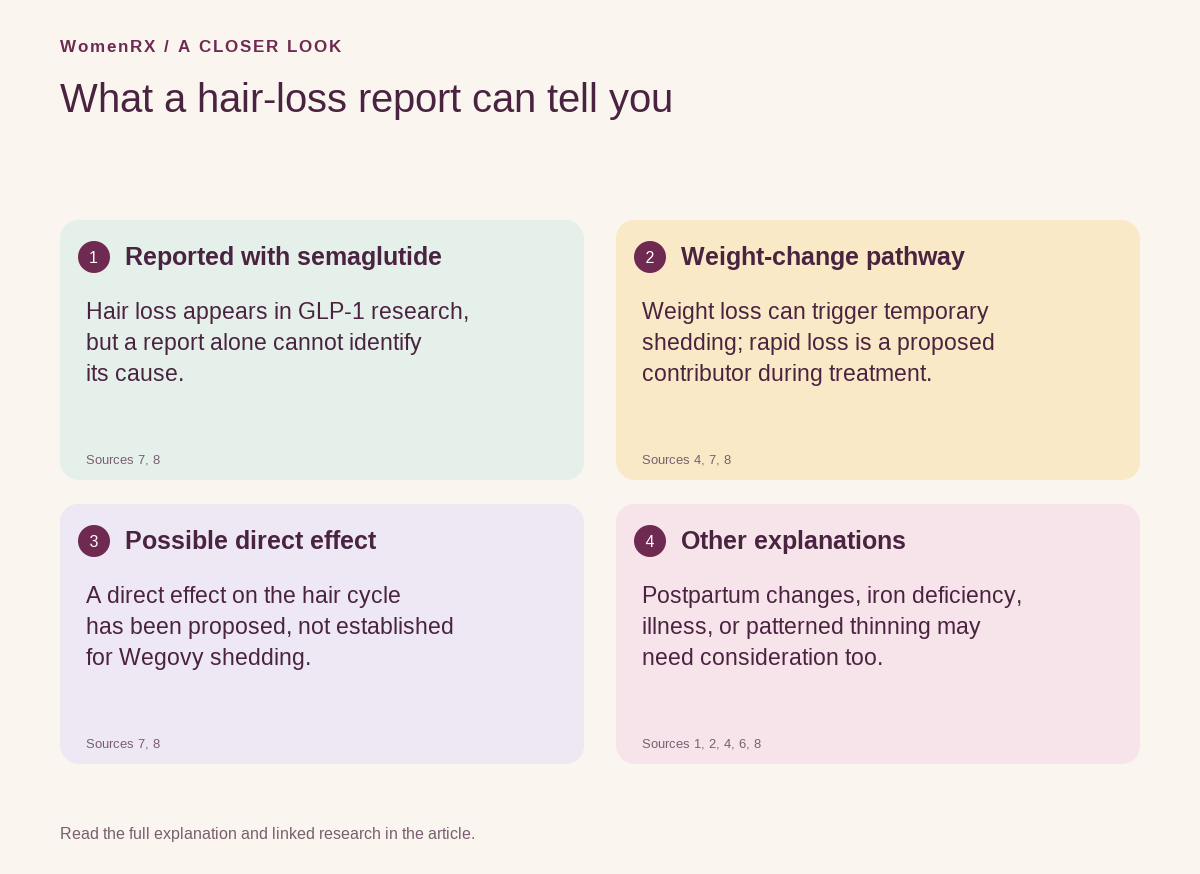
What a hair-loss report can tell you
Reported with semaglutide: Hair loss appears in GLP-1 research, but a report alone cannot identify its cause.78
Weight-change pathway: Weight loss can trigger temporary shedding; rapid loss is a proposed contributor during treatment.478
Possible direct effect: A direct effect on the hair cycle has been proposed, not established for Wegovy shedding.78
Other explanations: Postpartum changes, iron deficiency, illness, or patterned thinning may need consideration too.12468
Read the figure as text
These explanations sit at different levels of evidence and can overlap in one person.- Reported with semaglutide: Hair loss appears in GLP-1 research, but a report alone cannot identify its cause.78
- Weight-change pathway: Weight loss can trigger temporary shedding; rapid loss is a proposed contributor during treatment.478
- Possible direct effect: A direct effect on the hair cycle has been proposed, not established for Wegovy shedding.78
- Other explanations: Postpartum changes, iron deficiency, illness, or patterned thinning may need consideration too.12468
More questions, answered
Does hair loss on Wegovy always grow back?
No single answer fits every cause. Telogen effluvium is generally temporary, while androgenetic alopecia is progressive. Identifying the pattern and considering other possible causes gives you a better basis for discussing what to expect.48
Sources you can check
- Hair loss in new moms: Dermatologist tipsAccessed 2026-09-25Return to first citation
- Hair Loss | Alopecia | Alopecia Areata | MedlinePlusAccessed 2026-09-25Return to first citation
- WEGOVY (SEMAGLUTIDE) INJECTION, SOLUTION WEGOVY (SEMAGLUTIDE) TABLET [NOVO NORDISK PHARMACEUTICAL INDUSTRIES, LP] | US prescribing information and patient instructionsAccessed 2026-09-25Return to first citation
- Hair loss - NHSAccessed 2026-09-25Return to first citation
- Menopause and Common Dermatoses: A Systematic Review.Roster K, Fleshner L, Karatas TB, Ecanow A, Sayegh A, Farabi B, Marmon S. · American journal of clinical dermatology · 2026Return to first citation
- Iron Deficiency and Nonscarring Alopecia in Women: Systematic Review and Meta-Analysis.Treister-Goltzman Y, Yarza S, Peleg R. · Skin appendage disorders · 2022Return to first citation
- Alopecia as an Emerging Adverse Effect Associated With Glucagon-Like Peptide-1 (GLP-1) Receptor Agonists for Weight Loss: A Scoping Review.Rojas Lopez RF, Lynett Barrera D, Amaya Muñoz MC, Saavedra Diaz MP. · Cureus · 2025Return to first citation
- GLP-1 therapies and hair loss: A systematic review of current evidence and implications for counseling.Gupta AK, Teasell EM, Economopoulos V, Mirmirani P. · Science progress · 2026Return to first citation