GLP-1 Medicines and Fatty Liver: What to Ask
A better liver-fat result, less liver inflammation, and less scarring are different outcomes, so ask which one a medicine has actually been shown to change.
GLP-1 medicines may improve liver fat and, in some trials, steatohepatitis, but that does not establish that they reverse fibrosis. A review of six randomized trials found little to no change in liver stiffness, a measure used to assess scarring. Ask how your liver diagnosis was established, which outcome matters for you, and whether evidence applies to the specific medicine being considered. 3
“Fatty liver” can mean different things
A fatty liver finding means fat has built up in the liver. Some people also have steatohepatitis, meaning fat is accompanied by inflammation. Fibrosis is scar tissue that can develop as liver injury continues. These are related, but they aren’t interchangeable: reducing fat doesn’t by itself prove that inflammation has resolved or scarring has improved. Studies may use older terms such as NAFLD and NASH for fatty liver disease and steatohepatitis. 3
That distinction is useful when you hear that a medicine “helps fatty liver.” Ask what the study measured. Was it liver fat on imaging, inflammation and disease activity on biopsy, or fibrosis assessed by biopsy or a measure of liver stiffness? An improvement in one doesn’t automatically establish improvement in the others. 3
What the GLP-1 liver evidence shows
A 2025 systematic review and meta-analysis combined six randomized trials, with 478 participants, testing GLP-1 receptor agonists for at least six months. Three trials reported whether steatohepatitis resolved. Across those trials, treatment was associated with higher odds of resolution than the comparison condition (odds ratio 4.45, 95% confidence interval 1.92 to 10.3). The review also found a reduction in liver fat measured by imaging. These results are promising, but they describe specific study outcomes, not proof that every person’s liver disease will improve. 3
The same review found little to no reduction in liver stiffness on imaging, and concluded that effects on fibrosis remained unclear. Liver stiffness is used to assess scarring, but it is not the same outcome as liver fat or steatohepatitis. So a report of less fat, or improved inflammation, should not be translated into “the medicine reverses liver scarring.” 3
The review studied GLP-1 receptor agonists as a group; it does not show that every medicine in the broader GLP-1 category has the same liver effect. Its eligibility criteria excluded GIP receptor agonist therapy, so those pooled findings shouldn’t be assumed to establish a liver benefit for tirzepatide. Ask about evidence for the particular medicine under consideration, rather than relying on a class-wide claim. 3
A separate retrospective study looked at 242 adults with type 2 diabetes and fatty liver diagnoses; 79 were taking a GLP-1 medicine. The treated group had a small change in a calculated fibrosis score compared with controls over follow-up. Because this was an observational study, it can show an association, not that the medication caused the difference or reversed scarring. 4
Match the discussion to your diagnosis
Bring the exact wording of your imaging, biopsy, or other liver assessment into the conversation. Useful questions include:
- “Do I have liver fat alone, steatohepatitis, evidence of fibrosis, or a combination?”
- “Which result are we hoping to change: weight, liver fat, inflammation, or scarring?”
- “What evidence is there for this specific medicine and this liver outcome?”
- “How will we tell whether my liver risk is changing, and what will the test actually measure?”
Different tests answer different questions. MRI-based fat measurement and some ultrasound-based tests can assess steatosis; elastography methods can assess liver stiffness. A clinician can explain which measure was used in your case and what it can, and can’t, tell you. 3
Keep the reason for treatment clear
A medicine may be considered for weight management or another health condition even when its effect on liver scarring is uncertain. The American College of Physicians’ 2026 guideline addresses weight-management medicines for nonpregnant adults with overweight or obesity; it does not establish a liver-specific benefit for every medication it discusses. Ask whether the main reason for considering treatment is weight management, another condition, a liver outcome, or more than one of these. 1
If pregnancy or breastfeeding is relevant to your plans, include it in the discussion. The ACP guidance is for nonpregnant adults, and a 2025 position statement notes that clinical safety and efficacy data for obesity medicines during pregnancy or lactation are limited. That makes your reproductive plans relevant to weighing treatment, without assuming that the liver response is different in women. 1 2
The most useful question isn’t simply whether a GLP-1 medicine “works for fatty liver.” It’s which medicine, for which diagnosis, and which liver outcome your care plan is meant to address.
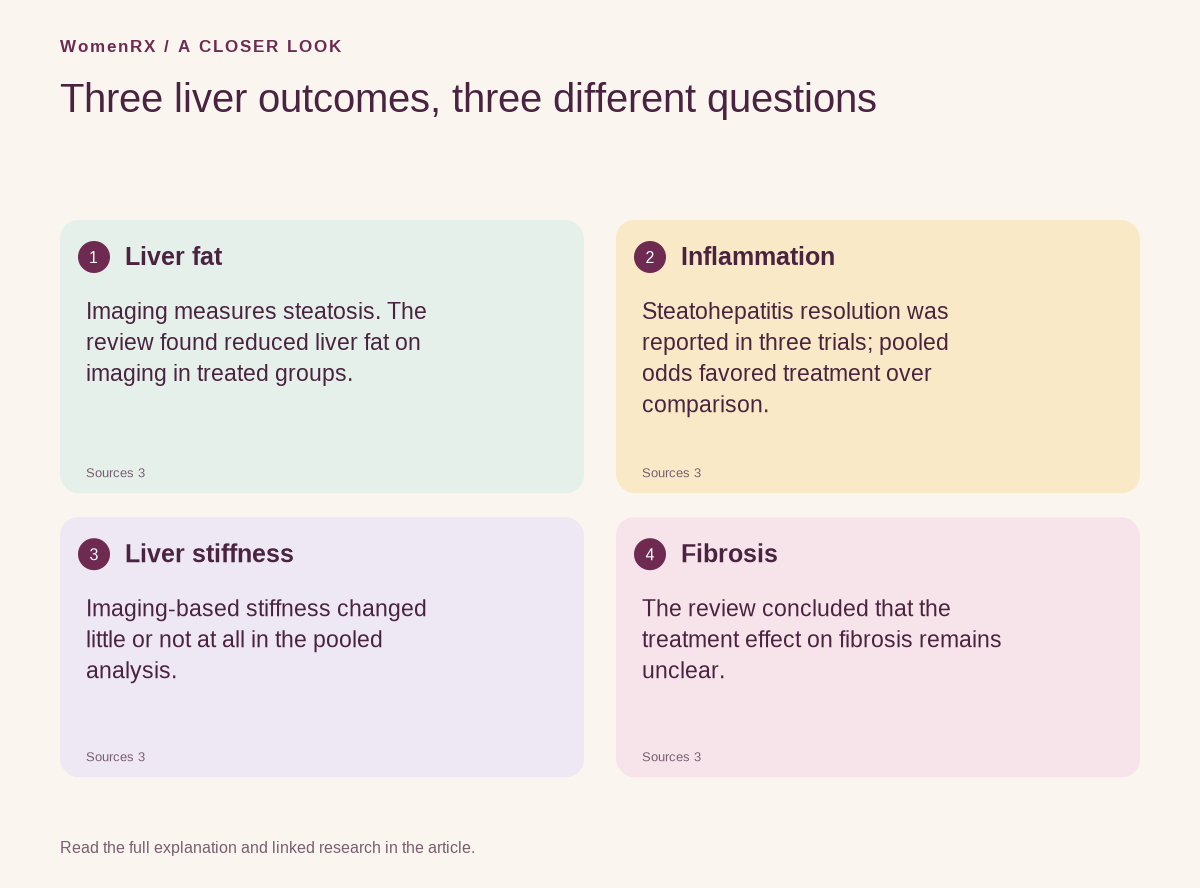
Three liver outcomes, three different questions
Liver fat: Imaging measures steatosis. The review found reduced liver fat on imaging in treated groups.3
Inflammation: Steatohepatitis resolution was reported in three trials; pooled odds favored treatment over comparison.3
Liver stiffness: Imaging-based stiffness changed little or not at all in the pooled analysis.3
Fibrosis: The review concluded that the treatment effect on fibrosis remains unclear.3
Read the figure as text
The evidence for changing liver fat or steatohepatitis does not by itself establish an effect on fibrosis.- Liver fat: Imaging measures steatosis. The review found reduced liver fat on imaging in treated groups.3
- Inflammation: Steatohepatitis resolution was reported in three trials; pooled odds favored treatment over comparison.3
- Liver stiffness: Imaging-based stiffness changed little or not at all in the pooled analysis.3
- Fibrosis: The review concluded that the treatment effect on fibrosis remains unclear.3
More questions, answered
Does less liver fat mean less liver scarring?
Not necessarily. Liver fat, steatohepatitis, and fibrosis are distinct outcomes. The randomized-trial review found improvement in liver fat but little to no change in liver stiffness, and said the effect on fibrosis remained unclear. 3
Do the reported liver results show a different effect in women?
The reported findings do not establish whether liver effects differ by sex. Ask whether the evidence for the particular medicine and outcome applies to your situation. 3
Sources you can check
- Pharmacologic Treatments With Lifestyle Modifications in Nonpregnant Adults With Overweight or Obesity in Outpatient Settings: A Living Clinical Guideline From the American College of Physicians (April 2026).Qaseem A, Cross JT, Harrod CS, Owens DK, Balk EM, Crandall CJ, Clinical Guidelines Committee of the American College of Physicians, Fitterman N, Gibson M, Lewis J, Mackey K, Miller... · Annals of internal medicine · 2026Return to first citation
- EASO Position Statement: Women with Obesity across the Reproductive Life - Fertility, Preconception, Pregnancy, Postpartum, and Breastfeeding.Filippi-Arriaga F, Agarwal N, Rodrigues-Martins D, Monteiro MP, Huvinen E, Suliman SGI, McGowan B, Ciudin A. · Obesity facts · 2025Return to first citation
- Effects of GLP-1 receptor agonist therapy on resolution of steatohepatitis in non-alcoholic fatty liver disease: a systematic review and meta-analysis.Potter KJ, Phinney J, Kulai T, Munro V. · Journal of the Canadian Association of Gastroenterology · 2025Return to first citation
- Impact of GLP-1 Receptor Agonist Use in Patients With Steatotic Liver Disease and Type 2 Diabetes: A Retrospective Cohort Study.Wood M, Kennedy AG, Khan S, Hitt JR, Davis K, Reddy SS, Gilbert MP. · Journal of pharmacy practice · 2024Return to first citation