Can a Supplement Really Work Like a GLP-1 Medicine?
Some ingredients may affect gut hormones, but that isn’t the same as proving a supplement produces medication-like weight loss.
No supplement in the human studies discussed here has been shown to produce weight loss comparable to semaglutide or to work as a substitute for a GLP-1 medicine. Some ingredients, including fiber, may influence the body’s own GLP-1 indirectly. A change in a hormone or a proposed mechanism, though, doesn’t prove meaningful weight loss or establish safety for your situation. 4 6

A hormone signal isn’t the same as a treatment effect
GLP-1 medicines such as semaglutide act on the GLP-1 receptor. Some supplements are marketed as if they do the same thing, but a product claim, a proposed biological mechanism, and a demonstrated weight-loss result are different levels of evidence. 1 6
Fiber offers a useful example of the distinction. Gut bacteria can ferment some fibers, and this process may stimulate the body’s own GLP-1. That’s an indirect effect, not evidence that a fiber supplement acts like a prescription receptor agonist. A 2026 review describes weight loss with fiber alone as typically more modest than with GLP-1 receptor agonists, with effects depending on the type and duration of use. 6
A small randomized riboflavin trial shows why it matters to look beyond a hormone result. After two weeks, researchers reported a trend toward increased GLP-1 in the 100 mg group. The study’s focus was gut bacteria and related measures, not weight loss, so it doesn’t show that riboflavin causes weight loss or can stand in for a GLP-1 medicine. 4
Four checks for a “natural GLP-1” claim
1. What exactly was studied? A cell experiment can show that an ingredient affects cells under laboratory conditions. It can’t establish what happens when people take a finished product. For instance, research on a milk-protein and tea-polyphenol combination measured GLP-1 in human colon cells, not weight loss in people. 7
2. Was there a human outcome trial? A study that measures a hormone, appetite rating, or gut bacteria hasn’t necessarily shown a change in body weight. Look for trials in people that measure the outcome the advertisement promises. A review of supplements after GLP-1 treatment describes much of its ingredient evidence as coming from people who were not taking GLP-1 medicines, so it should not be read as proof those supplements maintain weight loss after stopping one. 3
3. Does the result apply to this product? Evidence about one ingredient or a specially made combination doesn’t automatically apply to every product using similar marketing. Check whether the studied formulation and amount match the product being sold. For transdermal “natural GLP-1” products, an editorial examining 24 patches and one gel reported that no certificates of analysis were posted for the products it identified. That finding is specific to the products examined, but it’s a reason not to treat a confident label as proof of quality. 2
4. Was the benefit meaningful and was safety assessed? A biological signal isn’t the same as a measured, worthwhile change in weight. And a small or short study may not answer questions about side effects, interactions, pregnancy, or breastfeeding. Before using a product marketed as a GLP-1 alternative, have a pharmacist or prescriber review its exact ingredients, especially if you take medicines, are pregnant, are trying to conceive, or are breastfeeding.
Where fiber may fit
Fiber may be useful for reasons other than acting like a weight-loss medicine. Reviews describe possible roles in bowel regularity and appetite, including as a supportive measure during or after GLP-1 treatment. Those are potential complementary benefits, not evidence that fiber replaces the medicine. Fiber can also cause gas or bloating, particularly when intake rises quickly. 5 6
If your goal is fullness or digestive support, think of fiber as a nutrition option to consider on its own merits, not as a way to reproduce a prescription drug’s effects. If you’re taking a GLP-1 medicine or considering a supplement alongside one, review the specific product with your care team rather than relying on “natural GLP-1” language. The ingredients, the evidence for the claimed outcome, and your own medication and pregnancy or breastfeeding context all matter.
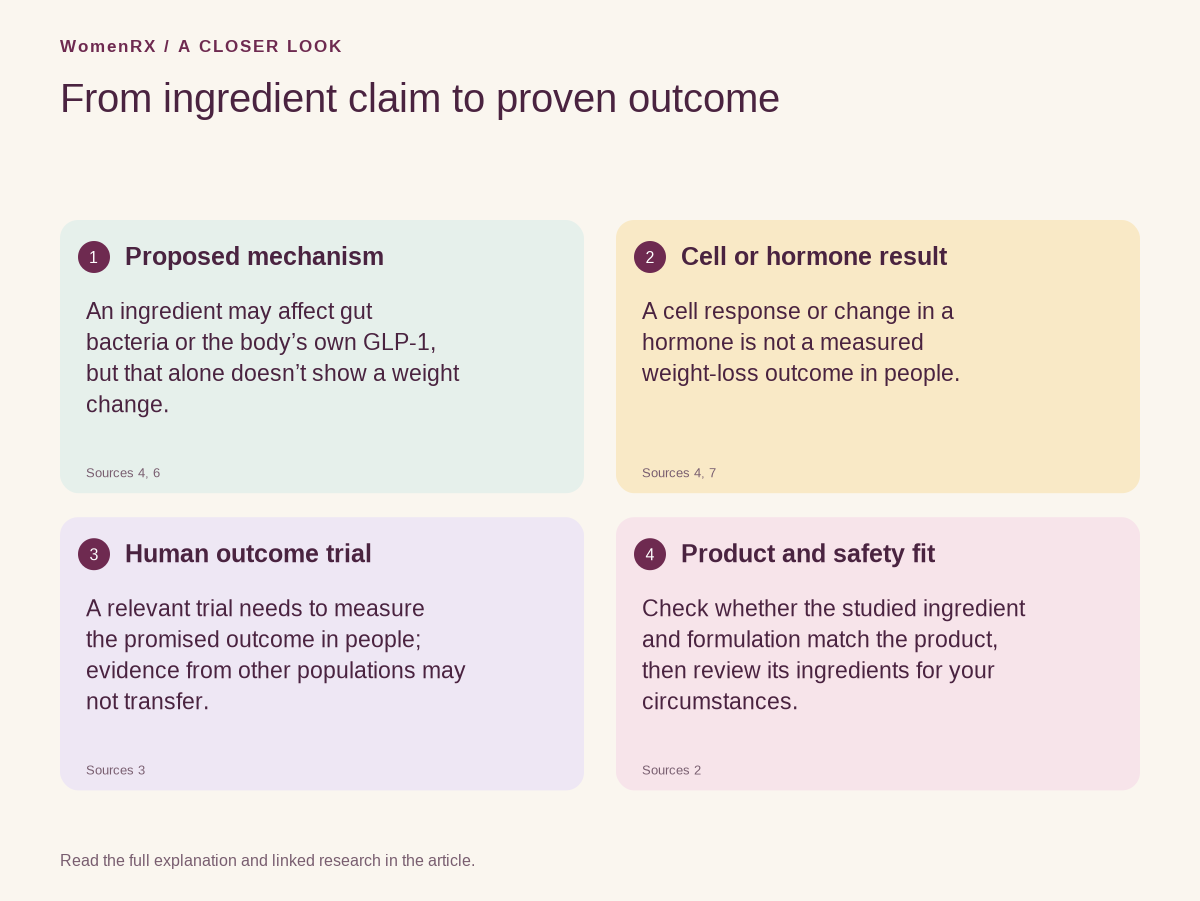
From ingredient claim to proven outcome
Proposed mechanism: An ingredient may affect gut bacteria or the body’s own GLP-1, but that alone doesn’t show a weight change.46
Cell or hormone result: A cell response or change in a hormone is not a measured weight-loss outcome in people.47
Human outcome trial: A relevant trial needs to measure the promised outcome in people; evidence from other populations may not transfer.3
Product and safety fit: Check whether the studied ingredient and formulation match the product, then review its ingredients for your circumstances.2
Read the figure as text
Each step asks a different question. A promising mechanism is only the beginning of evidence for a product’s weight-loss claim.- Proposed mechanism: An ingredient may affect gut bacteria or the body’s own GLP-1, but that alone doesn’t show a weight change.46
- Cell or hormone result: A cell response or change in a hormone is not a measured weight-loss outcome in people.47
- Human outcome trial: A relevant trial needs to measure the promised outcome in people; evidence from other populations may not transfer.3
- Product and safety fit: Check whether the studied ingredient and formulation match the product, then review its ingredients for your circumstances.2
More questions, answered
Does a supplement that raises GLP-1 in a study prove it helps with weight loss?
No. A hormone change is a biological finding, not proof of weight loss. The riboflavin trial reported a trend in GLP-1 after two weeks but did not measure a weight-loss outcome. 4
Sources you can check
- OZEMPIC (ORAL SEMAGLUTIDE) TABLET RYBELSUS (ORAL SEMAGLUTIDE) TABLET [NOVO NORDISK PHARMACEUTICAL INDUSTRIES, LP] | US prescribing information and patient instructionsAccessed 2026-09-25Return to first citation
- Transdermal "Natural GLP-1" Dietary Supplements Violate Law and Place Patients at Risk.White CM, Tai Z, Nuzi K. · The Annals of pharmacotherapy · 2026Return to first citation
- Considerations for Dietary Supplements after GLP-1RA Treatment: A Narrative Review.Johnson BV. · The Journal of nutrition · 2026Return to first citation
- Riboflavin Supplementation Promotes Butyrate Production in the Absence of Gross Compositional Changes in the Gut Microbiota.Liu L, Sadaghian Sadabad M, Gabarrini G, Lisotto P, von Martels JZH, Wardill HR, Dijkstra G, Steinert RE, Harmsen HJM. · Antioxidants & redox signaling · 2023Return to first citation
- Fiber Supplementation during and after Glucagon-Like Peptide-1 Receptor Agonists Treatment: A Perspective on Clinical Benefits.Johnson BV. · The Journal of nutrition · 2026Return to first citation
- Dietary Fiber and Glucagon-Like Peptide-1 Receptor Agonists in Obesity Management: Converging Mechanisms, Interactions, and Strategies for Durable Weight Control.Wang Y, Liu J, Verbeke K, Retamal NG, Akkerman R, de Vos P. · Advances in nutrition (Bethesda, Md.) · 2026Return to first citation
- Effect of Milk Protein-Polyphenol Conjugate on the Regulation of GLP-1 Hormone.Wazzan HA, Abraham AN, Saiara N, Anand S, Gill H, Shukla R. · Foods (Basel, Switzerland) · 2024Return to first citation