When GLP-1 Side Effects Feel Like IBS
Cramping and bowel changes can come from IBS or a weight-management medicine, so what’s different from your usual pattern matters.
IBS and weight-management medicines such as semaglutide, liraglutide, and tirzepatide can all be associated with abdominal pain, diarrhea, or constipation. Nausea and vomiting are also common medication side effects, though nausea can occur with IBS too. A familiar symptom isn’t automatically an IBS flare or a drug effect. Compare it with your usual pattern, note when treatment changed, and pay attention to symptoms that are severe or won’t go away.2567
The same symptom can have a different pattern
If you already live with IBS, a change in your gut after starting a weight-management medicine can be hard to interpret. IBS commonly brings abdominal pain or cramps, bloating, diarrhea, and constipation. Symptoms can come and go, sometimes after particular foods or drinks and sometimes for no clear reason. IBS pain is often worse after eating and better after a bowel movement.12
The overlap is real. US prescribing information for the weight-management medicines Wegovy (semaglutide), Saxenda (liraglutide), and Zepbound (tirzepatide) lists nausea, vomiting, diarrhea, constipation, and abdominal pain among common adverse reactions. Wegovy’s information also lists abdominal distension, which can feel like bloating. These findings come from weight-management trials, not trials designed to tell whether an individual symptom in someone with IBS is caused by the medicine.567
There’s a useful distinction between where a medicine acts and where you feel a symptom. Semaglutide and liraglutide delay stomach emptying; tirzepatide also delays stomach emptying, with the greatest effect after its first dose and a diminishing effect over time. That helps explain why upper-abdominal discomfort, nausea, or a sense of fullness may deserve a place in your notes alongside bowel changes. It doesn’t mean you can identify the cause of a symptom by its location alone.567
Look for change, not a single culprit
Before starting a medicine, think about what an ordinary IBS week looks like for you: where cramps tend to occur, whether a bowel movement eases them, and whether constipation, diarrhea, or both are typical. Then compare new symptoms with that baseline. For example, cramps that follow a familiar food and ease after a bowel movement resemble a known IBS pattern. New vomiting or a marked change in bowel habits after treatment starts is different information to share with the prescriber. Neither pattern proves the cause.2567
Timing can add context. Wegovy’s gastrointestinal reactions were reported most frequently during dose escalation, and Zepbound’s trial information says most nausea, vomiting, and diarrhea events occurred during dose escalation and decreased over time. Saxenda’s trial information says the percentage of patients reporting nausea declined as treatment continued. Those are group findings, not a promise that symptoms will settle for you or a reason to wait out a severe symptom.567
If you menstruate, cycle timing may be another piece of your baseline. In a study using daily diaries across one menstrual cycle, symptoms among women with IBS varied by cycle phase as well as predominant bowel pattern. Record cycle timing if you’ve noticed a pattern; don’t assume every change around your period is unrelated to a newly started medicine.4
A short log that gives the full picture
You don’t need to label each episode “IBS” or “side effect.” A few lines on days when something changes can be more useful:
- Your usual pattern versus today: Note the location and severity of pain, bloating or nausea, whether you vomited, your bowel pattern, and whether a bowel movement changed the pain.2567
- Medicine timing: Record the medicine’s name, when you started it, and when a prescribed dose changed. These details help put symptoms alongside treatment changes without claiming one caused the other.567
- Food, drink, and fluids: Note any familiar IBS food or drink trigger and whether nausea, vomiting, or diarrhea has made it difficult to drink. Fluid loss with these medication-related symptoms can lead to dehydration and kidney problems.2567
- Other context: If relevant, add menstrual-cycle timing and any symptom that feels new or unlike your usual flares.4
Bring the pattern, rather than a guessed diagnosis, to the clinician prescribing the medicine. A pharmacist can also help you describe when symptoms appeared in relation to the medicine. Don’t change a prescribed dose on the strength of a symptom log alone.
Know when this is more than a familiar flare
Contact the prescriber promptly for gastrointestinal symptoms that are severe or won’t go away, especially persistent vomiting or diarrhea that makes it hard to keep up with fluids. The prescribing information for these medicines warns about severe gastrointestinal reactions and kidney injury related to dehydration.567
Severe abdominal pain that won’t go away, particularly if it reaches your back, needs prompt medical attention rather than an IBS label; it’s a warning symptom for pancreatitis in the prescribing information for all three medicines. Upper-abdominal pain with fever or yellowing of the skin or eyes also warrants prompt assessment for a possible gallbladder problem. Bloody diarrhea or rectal bleeding shouldn’t be written off as IBS, whether or not you take one of these medicines.2567
Research specifically about these weight-management medicines in people with IBS doesn’t settle whether they reliably improve or worsen IBS. One health-record study found lower rates of several coded gastrointestinal symptoms among people with IBS who started GLP-1-based treatment than among matched people who did not, but its observational design cannot establish a treatment effect or predict your experience. Your own baseline and any meaningful change from it remain the practical comparison.3
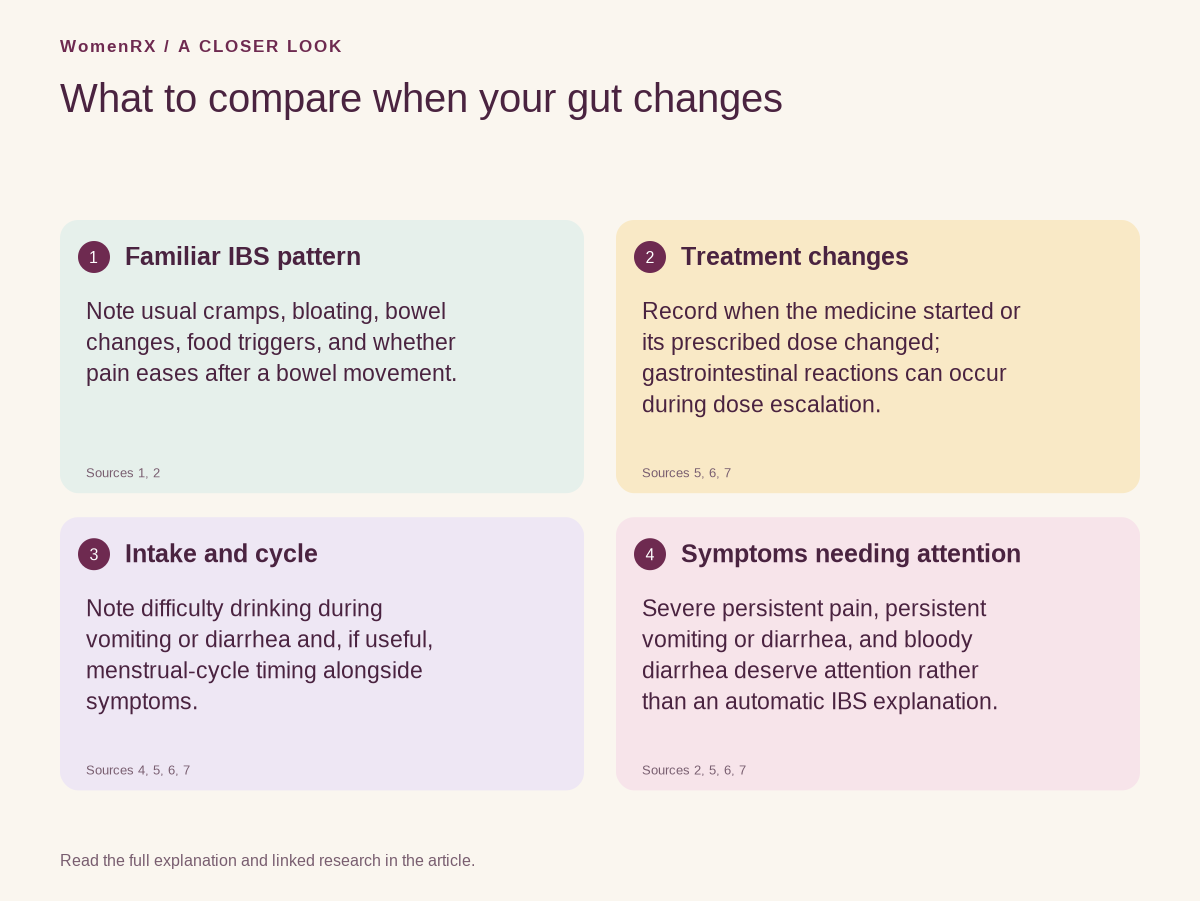
What to compare when your gut changes
Familiar IBS pattern: Note usual cramps, bloating, bowel changes, food triggers, and whether pain eases after a bowel movement.12
Treatment changes: Record when the medicine started or its prescribed dose changed; gastrointestinal reactions can occur during dose escalation.567
Intake and cycle: Note difficulty drinking during vomiting or diarrhea and, if useful, menstrual-cycle timing alongside symptoms.4567
Symptoms needing attention: Severe persistent pain, persistent vomiting or diarrhea, and bloody diarrhea deserve attention rather than an automatic IBS explanation.2567
Read the figure as text
These distinctions organize a symptom log; they don’t diagnose the cause.- Familiar IBS pattern: Note usual cramps, bloating, bowel changes, food triggers, and whether pain eases after a bowel movement.12
- Treatment changes: Record when the medicine started or its prescribed dose changed; gastrointestinal reactions can occur during dose escalation.567
- Intake and cycle: Note difficulty drinking during vomiting or diarrhea and, if useful, menstrual-cycle timing alongside symptoms.4567
- Symptoms needing attention: Severe persistent pain, persistent vomiting or diarrhea, and bloody diarrhea deserve attention rather than an automatic IBS explanation.2567
Sources you can check
- What is IBS (irritable bowel syndrome) - NHSAccessed 2026-09-25Return to first citation
- Symptoms of IBS (irritable bowel syndrome) - NHSAccessed 2026-09-25Return to first citation
- Impact of GLP-1 Analogue Therapy on Gastrointestinal Outcomes in Patients with Irritable Bowel Syndrome: A Real-World TriNetX Analysis.Khan SA, Marasini A, Shrestha A, Bharadwaj HR, Abdul RHM, Dhali A, Alsakarneh S, Sharma A, Ali H, Dahiya DS. · Digestive diseases and sciences · 2026Return to first citation
- Symptoms across the menstrual cycle in women with irritable bowel syndrome.Heitkemper MM, Cain KC, Jarrett ME, Burr RL, Hertig V, Bond EF. · The American journal of gastroenterology · 2003Return to first citation
- WEGOVY (SEMAGLUTIDE) INJECTION, SOLUTION WEGOVY (SEMAGLUTIDE) TABLET [NOVO NORDISK PHARMACEUTICAL INDUSTRIES, LP] | US prescribing information and patient instructionsAccessed 2026-09-25Return to first citation
- SAXENDA (LIRAGLUTIDE) INJECTION, SOLUTION [NOVO NORDISK PHARMACEUTICAL INDUSTRIES, LP] | US prescribing information and patient instructionsAccessed 2026-09-25Return to first citation
- ZEPBOUND (TIRZEPATIDE) INJECTION, SOLUTION ZEPBOUND (TIRZEPATIDE) INJECTION, SOLUTION ZEPBOUND KWIKPEN (TIRZEPATIDE) INJECTION, SOLUTION [ELI LILLY AND COMPANY] | US prescribing information and patient instructionsAccessed 2026-09-25Return to first citation