What Collagen Studies Show for Skin, Joints, and Bone
Collagen peptides have been studied for skin measurements, knee symptoms, and bone density, but those results answer different questions.
Human studies have tested collagen peptides for measured skin changes, symptoms of knee osteoarthritis, and bone mineral density. A skin trial found changes in several instrument-measured features; a knee trial found improved symptom scores; and a bone review found higher density in some analyses, with substantial variation across studies. None of these findings establishes a benefit for every collagen product or shows that collagen prevents fractures. 1 2 3
If you’re comparing collagen supplements, start with the outcome you care about. A skin measurement, a knee pain score, and a bone-density scan tell you different things. The studies also test different collagen preparations in different people. That’s why a positive result for one use can’t stand in for evidence about another.
Skin: instruments detected changes over 12 weeks
In a randomized trial, 100 healthy adults received either a low-molecular-weight collagen peptide product or a placebo. Researchers measured wrinkles, elasticity, hydration, and skin color at the start and during 12 weeks of treatment. Compared with placebo, the collagen group had greater improvement on several measures of wrinkle roughness and height and of skin elasticity. Hydration and skin-color measures also changed more. 1
These were measured skin properties. The findings don’t establish how noticeable the changes would be when you look in the mirror, or whether someone would consider them worth paying for. The trial abstract doesn’t report sex-specific results. And the trial tested a particular low-molecular-weight product, not collagen powders or drinks as a category. 1
Joints: a more direct measure of how people feel
A placebo-controlled trial tested peptides made from pork skin and bovine bone in people diagnosed with knee osteoarthritis. After 13 weeks, both collagen groups had better scores than the placebo group on measures of osteoarthritis symptoms, pain, and quality of life. 3
Pain and symptom questionnaires get closer to everyday experience than a skin instrument or a blood test does. Still, the findings don’t establish how many people felt a worthwhile improvement. The trial abstract doesn’t report sex-specific results, and it doesn’t show whether women responded differently. Nor does this trial establish that one animal source worked better than the other, or that collagen helps joint pain unrelated to knee osteoarthritis. 3
Bone: density findings aren’t fracture findings
A 2025 meta-analysis of collagen-peptide trials found increases in bone mineral density at the spine and femoral neck. But bone-density results varied substantially between studies, with a reported I² of 80.1%. The review discusses trials of particular bioactive collagen peptides in postmenopausal women, so this area of research does include women after menopause. Its reported pooled findings don’t specify a separate estimate for that group. 2
Bone mineral density is useful to distinguish from the outcome that may matter most to you: whether a fracture occurs. The review’s reported findings don’t establish that collagen prevents fractures. Changes in bone-turnover markers, which reflect aspects of bone remodeling, don’t answer that question either. 2
Preparation is especially relevant here. The review includes studies of collagen peptides alone and studies that combined them with calcium and vitamin D. A result from a combination can’t be credited to collagen alone. The review also identifies differences in collagen type and study duration among reasons results may vary. 2
How to read a collagen claim
Look for three matching details: what was tested, who took it, and what changed. For example, if a product points to a study of knee symptoms in people with osteoarthritis, that study doesn’t demonstrate a skin benefit for healthy adults. A bone-density finding in postmenopausal women doesn’t show that a different preparation prevents fractures. 1 2 3
Collagen peptides have produced promising findings across these areas, but there isn’t one all-purpose “collagen benefit.” The skin evidence here concerns measured features, the knee evidence concerns symptom scores, and the bone evidence chiefly concerns density and remodeling measures. Keeping those endpoints separate gives you a clearer basis for deciding whether a claim speaks to your goal.
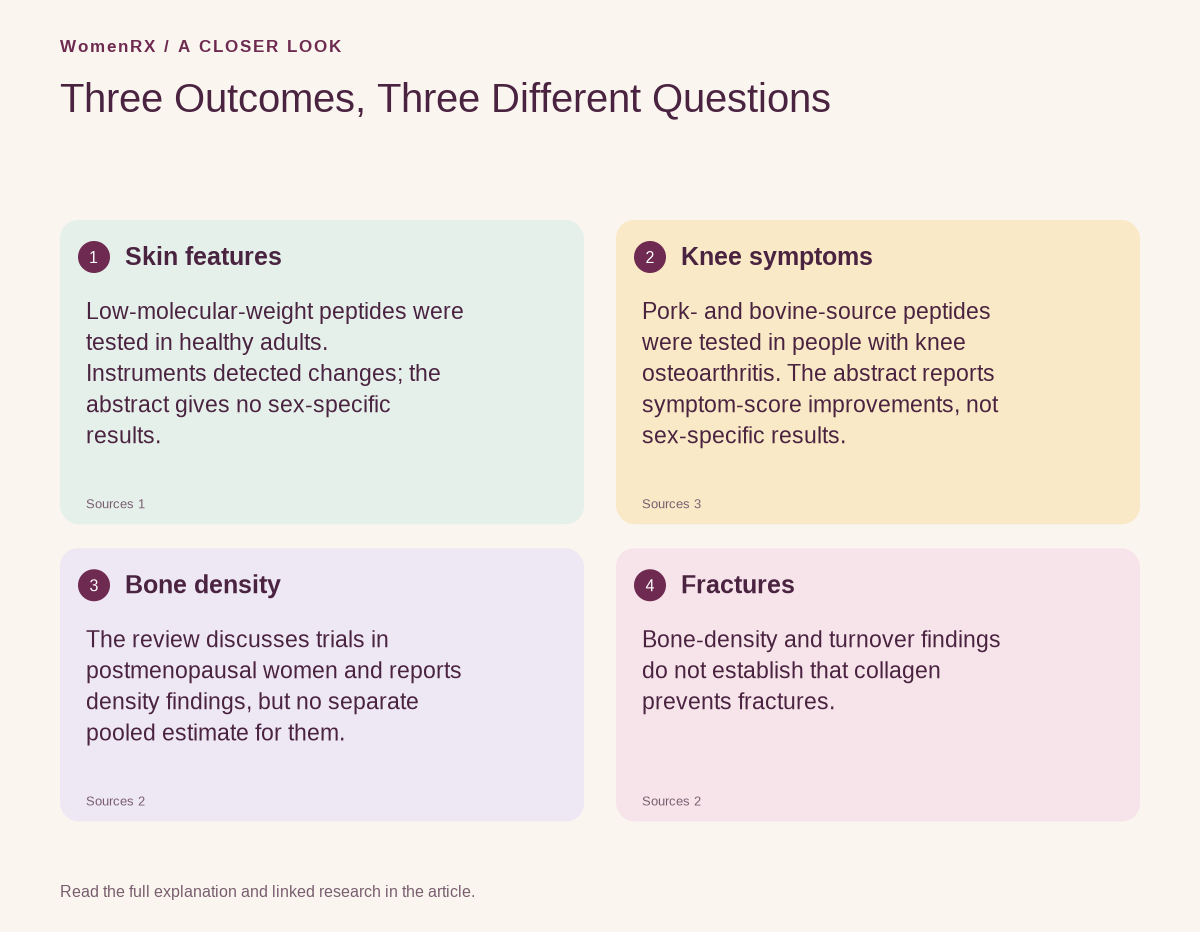
Three Outcomes, Three Different Questions
Skin features: Low-molecular-weight peptides were tested in healthy adults. Instruments detected changes; the abstract gives no sex-specific results.1
Knee symptoms: Pork- and bovine-source peptides were tested in people with knee osteoarthritis. The abstract reports symptom-score improvements, not sex-specific results.3
Bone density: The review discusses trials in postmenopausal women and reports density findings, but no separate pooled estimate for them.2
Fractures: Bone-density and turnover findings do not establish that collagen prevents fractures.2
Read the figure as text
Compare the preparation and population with the outcome measured before applying a collagen claim to yourself.- Skin features: Low-molecular-weight peptides were tested in healthy adults. Instruments detected changes; the abstract gives no sex-specific results.1
- Knee symptoms: Pork- and bovine-source peptides were tested in people with knee osteoarthritis. The abstract reports symptom-score improvements, not sex-specific results.3
- Bone density: The review discusses trials in postmenopausal women and reports density findings, but no separate pooled estimate for them.2
- Fractures: Bone-density and turnover findings do not establish that collagen prevents fractures.2
Sources you can check
- Low-molecular-weight collagen peptides supplement promotes a healthy skin: A randomized, double-blinded, placebo-controlled study.Seong SH, Lee YI, Lee J, Choi S, Kim IA, Suk J, Jung I, Baeg C, Kim J, Oh D, Lee JH. · Journal of cosmetic dermatology · 2024Return to first citation
- Efficacy of collagen peptide supplementation on bone and muscle health: a meta-analysis.Sun C, Yang A, Teng F, Xia Y. · Frontiers in nutrition · 2025Return to first citation
- A double-blind, placebo-controlled, randomised, clinical study on the effectiveness of collagen peptide on osteoarthritis.Kumar S, Sugihara F, Suzuki K, Inoue N, Venkateswarathirukumara S. · Journal of the science of food and agriculture · 2015Return to first citation