Everyday Meal Choices, and When Fatigue Needs a Closer Look
Varied meals can support a nourishing routine, but persistent fatigue can have causes food alone won’t address.
Choose meals you can fit into your day, whether that means breakfast before work or a simple combination you can put together later. Vary your foods, including sources of iron and vitamin B12. If fatigue lasts for weeks, or heavy bleeding or pregnancy raises concern about iron deficiency, discuss what else might be causing it rather than relying on meal changes alone. 1 2 4
Food can support a routine, not explain every tired day
A meal can help you meet your nutritional needs, but feeling tired isn’t a diagnosis. Fatigue can follow too little sleep, stress, or activity, and it can also be a symptom of conditions such as anemia, thyroid disease, infection, sleep disorders, depression, or anxiety. A change in eating may be useful if meals have been sparse or limited, but it won’t identify or treat every cause. 1 2
Research has found an association between greater food-group diversity and lower fatigue scores in a cross-sectional study of 400 adults in Jordan, 276 of them women. Because the study measured diet and fatigue at one point in time, it can’t show that changing meals reduces fatigue. Think of varied meals as a practical foundation, not a promise of more energy. 7
Make meals varied and workable
There isn’t one required “energy meal.” Instead, look at where eating fits into your day. If you have time in the morning, oatmeal with milk or a fortified alternative and fruit is one option. If lunch needs to be simple, try beans with rice and vegetables. Eggs with toast and fruit can work whenever you have a few minutes to put food together. These are examples to adapt to your appetite, budget, and schedule, not a meal plan you have to follow.
Iron deserves particular attention when it may be missing from the diet or lost through blood. Iron is found in meat, seafood, and poultry, as well as beans, lentils, nuts, vegetables, and iron-fortified grain products. Plant foods and fortified foods provide nonheme iron; meat, seafood, and poultry also provide heme iron, which is more readily absorbed. Vitamin C can help the body absorb nonheme iron, so beans with tomatoes or fruit alongside a meal are practical pairings. 2
Vitamin B12 comes naturally from animal foods such as fish, meat, eggs, and dairy. Plant foods don’t naturally contain B12, though some breakfast cereals and nutritional yeasts are fortified. If you eat vegan or mostly plant-based, check whether your usual foods include fortified sources; don’t assume a food is fortified without checking its label. 4
When fatigue calls for more than meal changes
If fatigue hasn’t improved after several weeks, contact a healthcare provider rather than continuing to experiment with food alone. Assessment may include questions about sleep, daily activities, appetite, and exercise, along with an examination or lab tests to look for a cause. Iron deficiency is one possibility, but tiredness by itself can’t confirm it. 1 2
Bring up heavy menstrual bleeding, a mostly plant-based diet, pregnancy, or breastfeeding if any apply. Menstruation increases iron loss, and pregnancy increases iron needs; people who are pregnant or breastfeeding are among groups at risk of inadequate iron. Iron deficiency can progress before anemia develops, so a normal hemoglobin result alone may not describe iron stores fully. A clinician can decide whether testing is appropriate and interpret results in context. 2 3
Don’t start iron just because you feel tired. Too much supplemental iron can cause stomach upset, constipation, nausea, or other problems, and fatigue has many possible causes. If low iron is confirmed, the right response depends on the cause as well as the result. 2 3
Fatigue around the menopause transition also deserves context, not an automatic “it’s hormones” explanation. In a longitudinal study of 2,329 women, repeated episodes of heavy menstrual bleeding were associated with higher odds of reporting tiredness. Changes in bleeding are worth mentioning alongside low energy. Hot flashes and night sweats may disrupt sleep, which can contribute to tiredness; menopause-related symptoms don’t rule out other causes. 5 6
After pregnancy, mention ongoing fatigue, whether you’re breastfeeding, and any concerns about what you’re able to eat. Breastfeeding can affect nutritional needs, but it isn’t by itself an explanation for persistent fatigue. Fatigue has several possible causes, so don’t attribute ongoing postpartum tiredness to diet or breastfeeding alone. 1 2 4
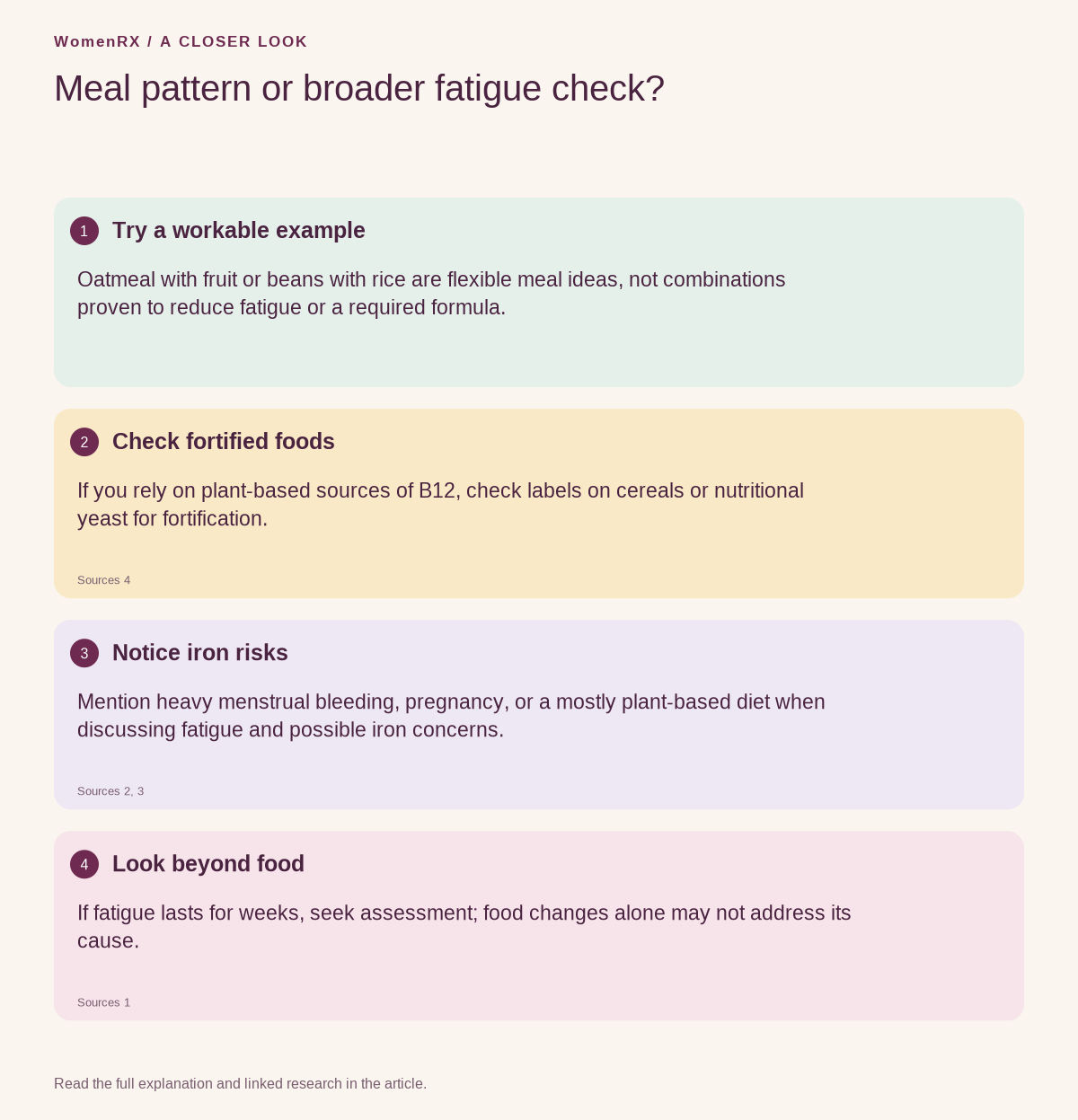
Meal pattern or broader fatigue check?
Try a workable example: Oatmeal with fruit or beans with rice are flexible meal ideas, not combinations proven to reduce fatigue or a required formula.
Check fortified foods: If you rely on plant-based sources of B12, check labels on cereals or nutritional yeast for fortification.4
Notice iron risks: Mention heavy menstrual bleeding, pregnancy, or a mostly plant-based diet when discussing fatigue and possible iron concerns.23
Look beyond food: If fatigue lasts for weeks, seek assessment; food changes alone may not address its cause.1
Read the figure as text
Use this review to distinguish practical food choices from context that makes persistent fatigue worth assessing. It is not a diagnostic checklist.- Try a workable example: Oatmeal with fruit or beans with rice are flexible meal ideas, not combinations proven to reduce fatigue or a required formula.
- Check fortified foods: If you rely on plant-based sources of B12, check labels on cereals or nutritional yeast for fortification.4
- Notice iron risks: Mention heavy menstrual bleeding, pregnancy, or a mostly plant-based diet when discussing fatigue and possible iron concerns.23
- Look beyond food: If fatigue lasts for weeks, seek assessment; food changes alone may not address its cause.1
More questions, answered
Can plant-based foods provide vitamin B12?
Plant foods don’t naturally contain vitamin B12. Some breakfast cereals and nutritional yeasts are fortified, so check labels if you rely on them as sources. 4
Sources you can check
- Fatigue: MedlinePlusAccessed 2026-09-25Return to first citation
- Iron - Health Professional Fact SheetAccessed 2026-09-25Return to first citation
- Iron: MedlinePlusAccessed 2026-09-25Return to first citation
- Vitamin B12 - Health Professional Fact SheetAccessed 2026-09-25Return to first citation
- Abnormal uterine bleeding is associated with fatigue during the menopause transition.Harlow SD, Gold EB, Hood MM, Mukwege AA, Randolph JF, Greendale GA. · Menopause (New York, N.Y.) · 2025Return to first citation
- A Systematic Review of Anxiety and Depressive Symptoms Among Women Experiencing Vasomotor Symptoms Across Reproductive Stages in the US.Gibson CJ, Ajmera M, O'Sullivan F, Shiozawa A, Lozano-Ortega G, Badillo EC, Venkataraman M, Mancuso S. · International journal of women's health · 2025Return to first citation
- The impact of diet quality and supplement use on fatigue, sleep, and quality of life in adults: A cross-sectional study.Batarseh N, Al-Dalaeen A, Abdulla FA, Abdelhadi NN. · Nutrition and health · 2026Return to first citation