Which Changes Can Happen During the Menopause Transition?
Changing periods and hot flashes are familiar clues, but timing and pattern help show when a change needs a closer look.
Periods that become less predictable, hot flashes or night sweats, disrupted sleep, mood or concentration changes, and vaginal or urinary symptoms can happen around menopause. None proves menopause is the cause. 6 Any bleeding after menopause needs assessment, even once. 2 For sudden trouble speaking or seeing, call 911. 8
Start with the pattern, not a symptom count
The menopause transition, also called perimenopause, is the time leading up to the final menstrual period. Your periods may come closer together or farther apart, and bleeding may become lighter or heavier. Hot flashes may begin around the same time. After 12 months without a period, menopause is generally identified and the time afterward is called postmenopause. This timing is most straightforward for women over 45 whose periods aren't being affected by hormonal contraception. Menopause can also happen earlier, including after surgery or medical treatment. 465 If you think these changes are happening before 45, or they follow surgery or medical treatment, arrange an assessment rather than relying on the usual age-and-period pattern alone. 57
There isn't one required set of symptoms. Some changes are disruptive; others are mild or continue after periods stop. Symptoms can also have causes unrelated to menopause, so the useful question is not “How many do I have?” but “What's changed, and does this pattern need a closer look?” 63 This map helps you sort common patterns from reasons to arrange assessment.
Changes that often travel together
Periods and temperature. Changing cycle timing is often an early clue. A hot flash can feel like a sudden wave of heat in the face, neck or chest, sometimes with sweating, a racing-heart sensation or dizziness. When it happens at night, it can interrupt sleep. 6 A fast or noticeable heartbeat deserves a routine medical assessment, even when it happens alongside hot flashes. 6 A spell of sweating under heavy bedding is different from repeatedly waking to soaked clothes and sheets in a cool room. Regular drenching night sweats, particularly alongside unexplained weight loss, fever or cough, warrant a medical assessment rather than an assumption that they're hot flashes. 1
Sleep, mood and thinking. Poor sleep, mood changes, forgetfulness and trouble concentrating can occur during perimenopause and afterward. If night sweats repeatedly wake you, disrupted sleep may be the change you notice most. But these experiences aren't specific enough to identify menopause on their own. Describe what's happening rather than feeling you must decide first whether hormones explain it. 6
Vaginal, urinary and other changes. Vaginal dryness can continue after periods end; joint pain may, too. Dryness or discomfort during sex is worth discussing on its own, rather than putting up with it because you don't have hot flashes. If thinning of vaginal tissues is the cause, vaginal estrogen cream is one treatment that may be offered. 62 Needing to pee more often or having symptoms that feel like a urinary tract infection can also occur around menopause. Burning or pain when you pee can feel like a urinary tract infection; it does not establish that menopause is the cause. 6
When bleeding changes the next move
While you're still having periods, irregular timing can fit the transition. It doesn't make every bleeding change routine. Arrange an assessment if your usual pattern changes, bleeding occurs between periods, periods last longer than seven days, or bleeding is getting heavier rather than lighter. Thyroid problems and other conditions can also affect cycle regularity. Keeping a record of dates and bleeding can make the pattern easier to explain. 36
After menopause, any new vaginal bleeding needs medical assessment, even a single episode or a little spotting. The bleeding is often not caused by cancer, but cancer is one possible cause that needs to be ruled out. Don't save it for a future routine menopause check. 26 If your periods stopped before 45 or because of surgery or medical treatment, don't use the usual over-45 timing rule to dismiss new bleeding. Arrange an assessment to clarify what it means in your circumstances. 572 If you're taking systemic hormone therapy, seek prompt medical help for unexpected bleeding beyond the first six months of treatment or more than three months after a change in dose or preparation. 5
Match help to the symptom that's bothering you
You don't need to wait until several symptoms appear together. For example, if nighttime heat is repeatedly breaking your sleep, that's a useful reason to discuss treatment options even if your periods have barely changed. Menopause guidance includes options for managing bothersome symptoms; the right discussion starts with the symptom affecting your day or night, not with completing a symptom checklist. 56
Sudden trouble speaking or seeing isn't a menopause symptom to watch and wait on. Call 911 if either occurs, including if it seems to pass after a few minutes. Sudden weakness on one side of the body is another reason to call 911. 8
If vaginal dryness is the main problem, a conversation focused on vaginal symptoms may be more useful than a broad discussion of hot flashes. If periods are changing, start with the bleeding pattern. And if you use hormonal contraception, remember that it can change your periods and make the usual 12-month marker harder to interpret. 236
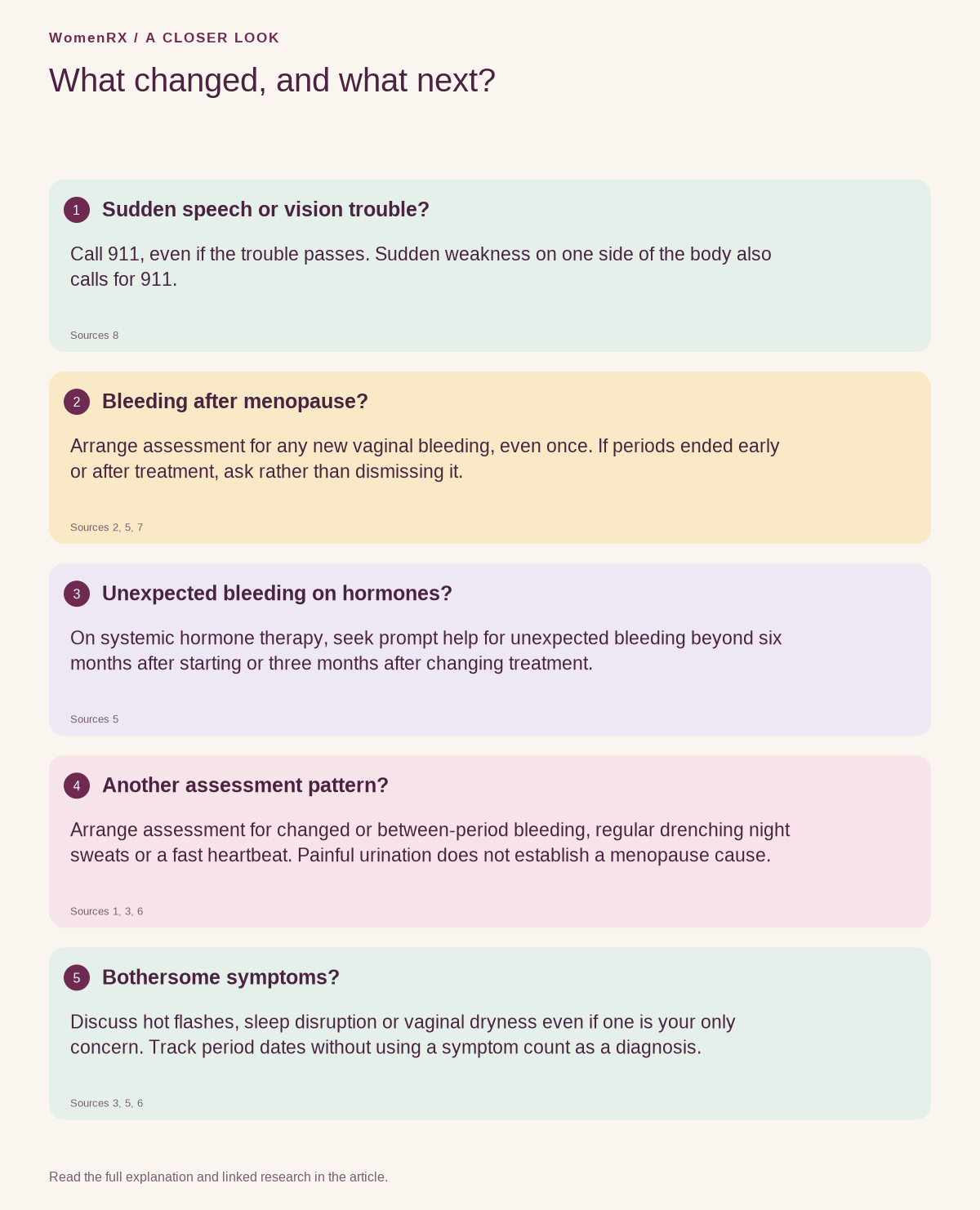
What changed, and what next?
Sudden speech or vision trouble?: Call 911, even if the trouble passes. Sudden weakness on one side of the body also calls for 911.8
Bleeding after menopause?: Arrange assessment for any new vaginal bleeding, even once. If periods ended early or after treatment, ask rather than dismissing it.257
Unexpected bleeding on hormones?: On systemic hormone therapy, seek prompt help for unexpected bleeding beyond six months after starting or three months after changing treatment.5
Another assessment pattern?: Arrange assessment for changed or between-period bleeding, regular drenching night sweats or a fast heartbeat. Painful urination does not establish a menopause cause.136
Bothersome symptoms?: Discuss hot flashes, sleep disruption or vaginal dryness even if one is your only concern. Track period dates without using a symptom count as a diagnosis.356
Read the figure as text
Start with signs needing immediate help. Then use the symptom pattern to decide whether to arrange assessment or discuss a bothersome change.- Sudden speech or vision trouble?: Call 911, even if the trouble passes. Sudden weakness on one side of the body also calls for 911.8
- Bleeding after menopause?: Arrange assessment for any new vaginal bleeding, even once. If periods ended early or after treatment, ask rather than dismissing it.257
- Unexpected bleeding on hormones?: On systemic hormone therapy, seek prompt help for unexpected bleeding beyond six months after starting or three months after changing treatment.5
- Another assessment pattern?: Arrange assessment for changed or between-period bleeding, regular drenching night sweats or a fast heartbeat. Painful urination does not establish a menopause cause.136
- Bothersome symptoms?: Discuss hot flashes, sleep disruption or vaginal dryness even if one is your only concern. Track period dates without using a symptom count as a diagnosis.356
More questions, answered
Can I have menopause symptoms while I still get periods?
Yes. Perimenopause happens before the final period, and cycle changes and hot flashes may occur during it. Symptoms alone don't tell you exactly when your last period will be. 46
Does a single episode of spotting after menopause count?
Yes. Arrange an assessment for new vaginal bleeding after menopause, even if it happens just once. If your periods stopped early or because of treatment and you're unsure whether you've reached menopause, ask for an assessment rather than dismissing the bleeding. 257
Sources you can check
- Night sweats - NHSAccessed 2026-09-25Return to first citation
- Postmenopausal bleeding - NHSAccessed 2026-09-25Return to first citation
- Irregular periods - NHSAccessed 2026-09-25Return to first citation
- Executive summary of the Stages of Reproductive Aging Workshop + 10: addressing the unfinished agenda of staging reproductive aging.Harlow SD, Gass M, Hall JE, Lobo R, Maki P, Rebar RW, Sherman S, Sluss PM, de Villiers TJ, STRAW + 10 Collaborative Group. · The Journal of clinical endocrinology and metabolism · 2012Return to first citation
- Recommendations | Menopause: identification and management | Guidance | NICEAccessed 2026-09-25Return to first citation
- Symptoms of menopause and perimenopause - NHSAccessed 2026-09-25Return to first citation
- Early or premature menopause - NHSAccessed 2026-09-25Return to first citation
- Signs and Symptoms of Stroke | Stroke | CDCAccessed 2026-09-26Return to first citation