Vitamin C Supplements: Check Your Dose and Stone Risk
Most adults can meet their vitamin C needs with food, so check your total intake and personal risk factors before adding a separate supplement.
A vitamin C supplement isn’t automatically needed because you’re a woman, pregnant, or breastfeeding. For adult women, the recommended daily amount is 75 mg, 85 mg during pregnancy, and 120 mg while breastfeeding; food and prenatal products count toward your total. High-dose supplements can cause stomach upset, and kidney-stone risk is uncertain overall but deserves a closer check with a history of hyperoxaluria or kidney problems. 1
Start with what you already get
Vitamin C helps the body make collagen and absorb nonheme iron, the type found in plant foods. Fruits and vegetables such as peppers, oranges, kiwifruit, broccoli, and strawberries provide it, and a varied diet can supply substantial amounts. The vitamin C in common supplements is absorbed about as well as vitamin C from food. 1
For adults, the recommended amount is 75 mg a day for women, 85 mg during pregnancy, and 120 mg while breastfeeding. These are intake targets, not supplement doses. If you take a prenatal, multivitamin, or drink a vitamin-fortified product, count its vitamin C before deciding whether a separate supplement has a purpose. Pregnancy or breastfeeding doesn’t, by itself, mean you need an extra vitamin C pill. 1
A useful label check is to add up the vitamin C in each supplement you take, following the amount per serving and how many servings you use. The adult upper limit is 2,000 mg a day from all sources, including food and supplements. It’s a ceiling for intake, not a goal. High vitamin C intakes can cause diarrhea, nausea, and abdominal cramps. 1
Kidney stones: focus on your own risk
The concern is that high vitamin C intake may raise the amount of oxalate and uric acid in urine, which could contribute to stone formation. But studies of vitamin C and urinary oxalate have had conflicting results, and the overall contribution of vitamin C to kidney stones is not clear. The NIH fact sheet identifies pre-existing hyperoxaluria, a condition involving high oxalate in urine, as the clearest concern, particularly alongside kidney disorders. A US evidence review describes limited evidence suggesting a possible kidney-stone risk with vitamin C supplements. 1 2
That doesn’t mean every person who has had a stone must avoid vitamin C in food or all supplements. It does mean a high-dose product deserves a more careful review if you’ve had stones, have known hyperoxaluria, or have a kidney disorder. If you know what type of stone you had, mention that when you ask whether a supplement fits your situation.
Iron conditions and treatment checks
Vitamin C improves absorption of iron from plant foods. In healthy people, the NIH fact sheet says excess iron absorption from high vitamin C intake is not generally a concern. But with hereditary hemochromatosis, a condition that can cause iron overload, long-term high-dose vitamin C could worsen iron accumulation and tissue damage. If you have this condition, review a high-dose supplement with your care team rather than assuming it’s harmless because it’s sold over the counter. 1
Two treatment situations merit a specific check. First, evidence about antioxidant supplements during chemotherapy or radiation is conflicting, and it’s unclear whether oral vitamin C changes treatment effects; ask your oncology team before using a high-dose antioxidant supplement during treatment. Second, an interaction has been reported for antioxidant combinations that include vitamin C with niacin and simvastatin: the combination may lessen the expected rise in HDL cholesterol. Whether this applies to other regimens or vitamin C alone is unknown. 1
A quick review before you buy
Ask yourself what you want the supplement to do, then check whether your food and existing products already cover your needs. If the reason is a specific health claim, don’t assume that a higher dose will prevent or treat an illness; evidence for vitamin C supplements does not support that as a general promise. 1
Before adding a product, check its vitamin C amount, look for vitamin C in your prenatal or multivitamin, and consider your stone, kidney, or iron-overload history. A modest-dose multivitamin and a separate high-dose vitamin C tablet are not interchangeable choices: compare the actual amounts on the labels. If you’re pregnant or breastfeeding, use the life-stage intake target and include your prenatal in the total rather than adding a separate supplement by default. 1
Check Before Adding Vitamin C
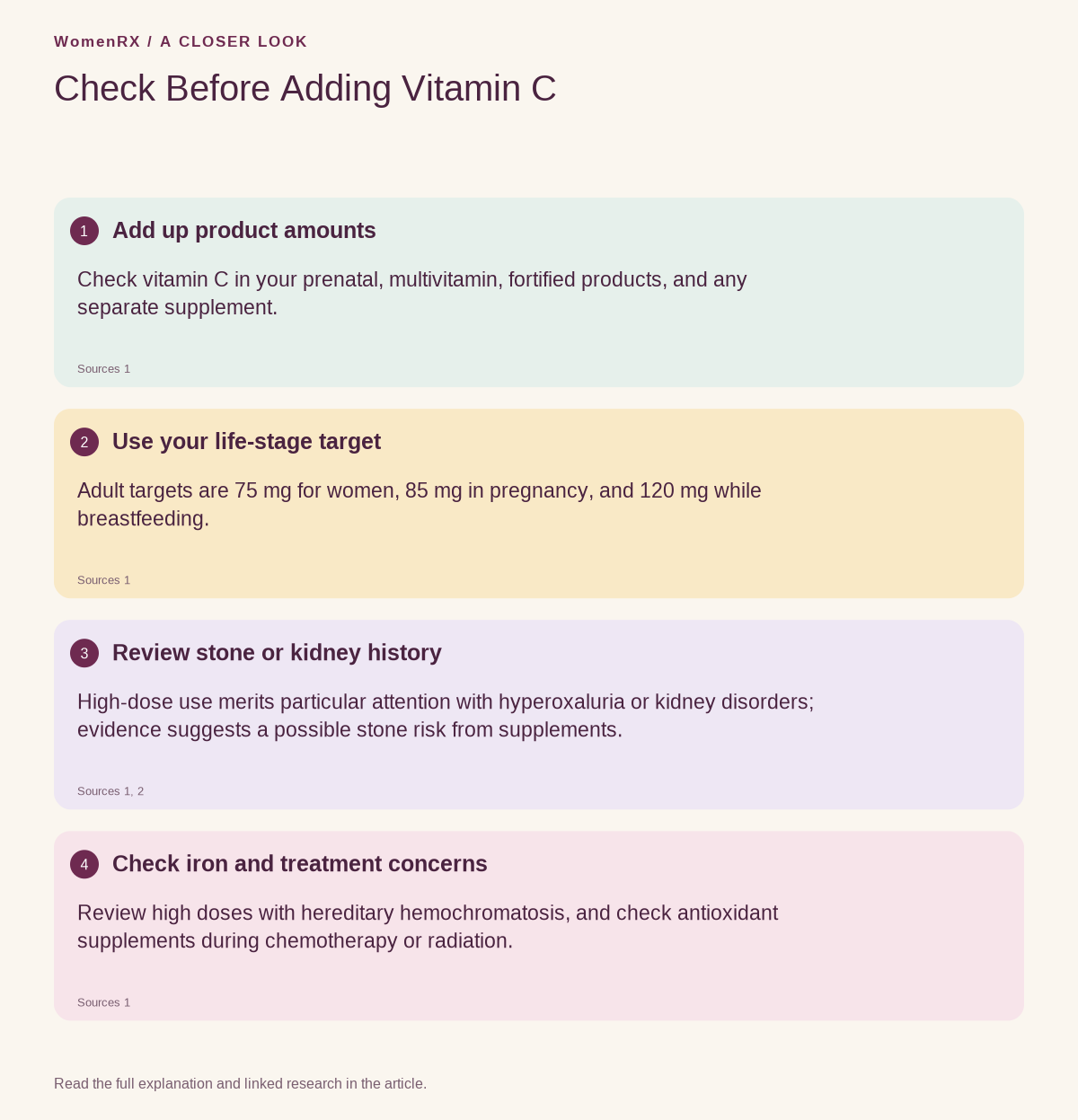
Add up product amounts: Check vitamin C in your prenatal, multivitamin, fortified products, and any separate supplement.1
Use your life-stage target: Adult targets are 75 mg for women, 85 mg in pregnancy, and 120 mg while breastfeeding.1
Review stone or kidney history: High-dose use merits particular attention with hyperoxaluria or kidney disorders; evidence suggests a possible stone risk from supplements.12
Check iron and treatment concerns: Review high doses with hereditary hemochromatosis, and check antioxidant supplements during chemotherapy or radiation.1
Read the figure as text
Review the product amount, overlapping supplements, health history, and reason for use before deciding whether a separate vitamin C product makes sense.- Add up product amounts: Check vitamin C in your prenatal, multivitamin, fortified products, and any separate supplement.1
- Use your life-stage target: Adult targets are 75 mg for women, 85 mg in pregnancy, and 120 mg while breastfeeding.1
- Review stone or kidney history: High-dose use merits particular attention with hyperoxaluria or kidney disorders; evidence suggests a possible stone risk from supplements.12
- Check iron and treatment concerns: Review high doses with hereditary hemochromatosis, and check antioxidant supplements during chemotherapy or radiation.1
More questions, answered
Does a kidney-stone history mean I should avoid all vitamin C?
Not necessarily. The overall role of vitamin C in kidney-stone formation is unclear, while pre-existing hyperoxaluria, particularly alongside kidney disorders, is the clearest concern described by NIH. A history of stones is a reason to review high-dose supplements in light of your individual history. 1
Does taking vitamin C help me absorb iron?
Vitamin C improves absorption of nonheme iron from plant foods. That’s a normal effect, but high-dose supplements call for extra care if you have hereditary hemochromatosis, because they could worsen iron overload over time. 1
Sources you can check
- Vitamin C - Health Professional Fact SheetAccessed 2026-09-25Return to first citation
- Vitamin and Mineral Supplements for the Primary Prevention of Cardiovascular Disease and Cancer: Updated Evidence Report and Systematic Review for the US Preventive Services Task Force.O'Connor EA, Evans CV, Ivlev I, Rushkin MC, Thomas RG, Martin A, Lin JS. · JAMA · 2022Return to first citation